Thank you for visiting SNEWPapers!
Sign up free
Litchfield Enquirer
Litchfield, Litchfield County, Connecticut
What is this article about?
A Yankee visitor describes the unique above-ground cemetery in New Orleans, built due to watery soil, with oven-like tombs and miniature architectural structures resembling a Lilliputian city. He witnesses a burial procession and reflects on the unmarked graves of young northerners who died in the city's pestilential climate.
Clipping
OCR Quality
Full Text
From the Southwest—by a Yankee.
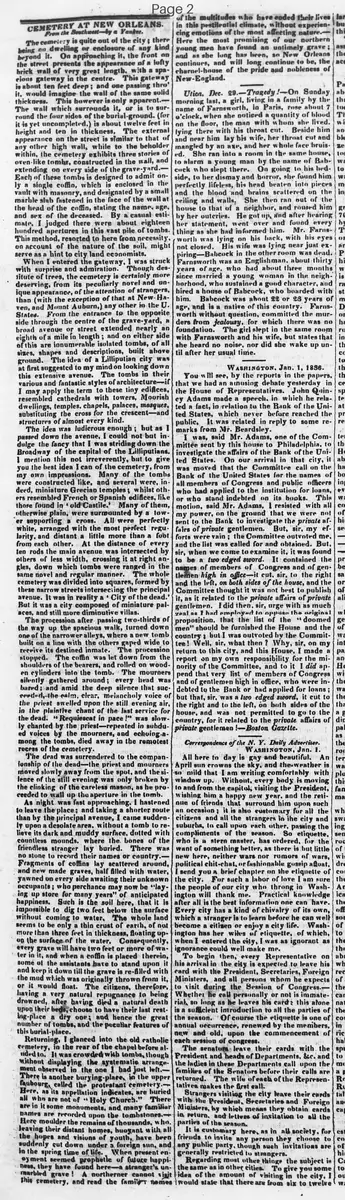
The cemetery is quite out of the city; there being no dwelling or enclosure of any kind beyond it. On approaching it, the street presents the appearance of a lofty brick wall of very great length, with a spacious gateway in the centre. This gateway is about ten feet deep; and one passing thro' it, would imagine the wall of the same solid thickness. This however is only apparent.— The wall which surrounds it, or is to surround the four sides of the burial-ground (for it is yet uncompleted) is about twelve feet in height and ten in thickness. The external appearance on the street is similar to that of any other high wall, while to the beholder within, the cemetery exhibits three stories of oven-like tombs, constructed in the wall, and extending on every side of the grave-yard.— Each of these tombs is designed to admit only a single coffin, which is enclosed in the vault with masonry, and designated by a small marble slab stepped up the face of the wall at the head of the coffin, stating the name, age, and sex of the deceased. By a casual estimate, I judged there were about eighteen hundred apertures in this vast pile of tombs. This method, resorted to here from necessity, on account of the nature of the soil, might serve as a hint to city land economists. When I entered the gateway, I was struck with surprise and admiration. Though destitute of trees, the cemetery is certainly more deserving, from its peculiarly novel and unique appearance, of the attention of strangers, than (with the exception of that at New-Haven, and Mount Auburn,) any other in the U. States. From the entrance to the opposite side through the centre of the grave-yard, a broad avenue or street extended nearly an eighth of a mile in length; and on either side of this are innumerable isolated tombs, of all sizes, shapes and descriptions, built above ground. The idea of a Lilliputian city was at first suggested to my mind on looking down this extensive avenue. The tombs in their various and fantastic styles of architecture—if I may apply the term to these tiny edifices, resembled cathedrals with towers, Moorish dwellings, temples, chapels, palaces, mosques, substituting the cross for the crescent—and structures of almost every kind. The idea was ludicrous enough; but as I passed down the avenue, I could not but indulge the fancy that I was striding down the Broadway of the capital of the Lilliputians. I mention this not irreverently, but to give you the best idea I can of the cemetery, from my own impressions. Many of the tombs were constructed like, and several were, indeed, miniature Grecian temples whilst others resembled French or Spanish edifices, like those found in 'old Castile.' Many of them, otherwise plain, were surmounted by a tower supporting a cross. All were perfectly white, arranged with the most perfect regularity, and distant a little more than a foot from each other. At the distance of every ten rods the main avenue was intersected by others of less width, crossing it at right angles, down which tombs were ranged in the same novel and regular manner. The whole cemetery was divided into squares, formed by these narrow streets intersecting the principal avenue. It was in reality a 'City of the dead.' But it was a city composed of miniature palaces, and still more diminutive villas. The procession after passing two-thirds of the way up the spacious walk, turned down one of the narrower alleys, where a new tomb built on a line with the others gaped wide to receive its destined inmate. The procession stopped. The coffin was let down from the shoulders of the bearers, and rolled on wooden cylinders into the tomb. The mourners silently gathered around; every head was bared; and amid the deep silence that succeeded,—the calm, clear, melancholy voice of the priest swelled upon the still evening air, in the plaintive chant of the last service for the dead. "Requiescat in pace!" was slowly chanted by the priest—repeated in subdued voices by the mourners, and echoing among the tombs, died away in the remotest recesses of the cemetery. The dead was surrendered to the companionship of the dead—the priest and mourners moved slowly away from the spot, and the silence of the still evening was only broken by the clinking of the careless mason, as he proceeded to wall up the aperture in the tomb. As night was fast approaching, I hastened to leave the place; and taking a shorter route than by the principal avenue, I came suddenly upon a desolate area, without a tomb to relieve its dark and muddy surface, dotted with countless mounds, where the bones of the friendless stranger lay buried. There was no stone to record their names or country.— Fragments of coffins lay scattered around, and new made graves, half filled with water, yawned on every side awaiting their unknown occupants; who perchance may now be "laying up store for many years" of anticipated happiness. Such is the soil here, that it is impossible to dig two feet below the surface without coming to water. The whole land seems to be only a thin crust of earth, of not more than three feet in thickness, floating upon the surface of the water. Consequently, every grave will have two feet or more of water in it, and when a coffin is placed therein, some of the assistants have to stand upon it and keep it down till the grave is re-filled with the mud which was originally thrown from it, or it would float. The citizens, therefore, having a very natural repugnance to being drowned, after having died a natural death upon their beds, choose to have their last resting-place a dry one; and hence the great number of tombs, and the peculiar features of this burial-place. Returning, I glanced into the old catholic cemetery, in the rear of the chapel before alluded to. It was crowded with tombs, though without displaying the systematic arrangement observed in the one I had just left.— There is another burying-place, in the upper faubourg, called the protestant cemetery: Here, as its appellation indicates, are buried all who are not of "Holy Church." There are in it some monuments, and many familiar names are recorded upon the tombstones.— Here moulder the remains of thousands, who, leaving their distant homes, buoyant with all the hopes and visions of youth, have been suddenly cut down under a foreign sun, and in the spring time of life. When present enjoyment seemed prophetic of future happiness, they have found here—a stranger's unmarked grave! A northerner cannot visit this cemetery, and read the familiar names of the multitudes who have ended their lives in this pestilential climate, without experiencing emotions of the most affecting nature.— Here the most promising of our northern young men have found an untimely grave; and as she long has been, so New Orleans continues, and will long continue to be, the charnel-house of the pride and nobleness of New-England.
What sub-type of article is it?
What themes does it cover?
What keywords are associated?
Where did it happen?
Story Details
Location
New Orleans Cemetery
Story Details
A Yankee visitor explores the unique above-ground cemetery in New Orleans, describing its wall of oven-like tombs and avenue of miniature architectural mausoleums resembling a Lilliputian city. He observes a Catholic burial procession and reflects on the watery soil necessitating such burials, the desolate pauper graves, and the Protestant cemetery where many young northerners lie in unmarked graves due to the city's deadly climate.