Thank you for visiting SNEWPapers!
Sign up free
Editorial
August 31, 1929
The Bismarck Tribune
Bismarck, Mandan, Burleigh County, Morton County, North Dakota
What is this article about?
An editorial ironically critiques U.S. policy of lending money to European competitors, who use it to buy advanced American machinery, modernizing their industries and gaining an edge over outdated U.S. manufacturers, especially in textiles, while autos succeed abroad.
Clipping
OCR Quality
98%
Excellent
Full Text
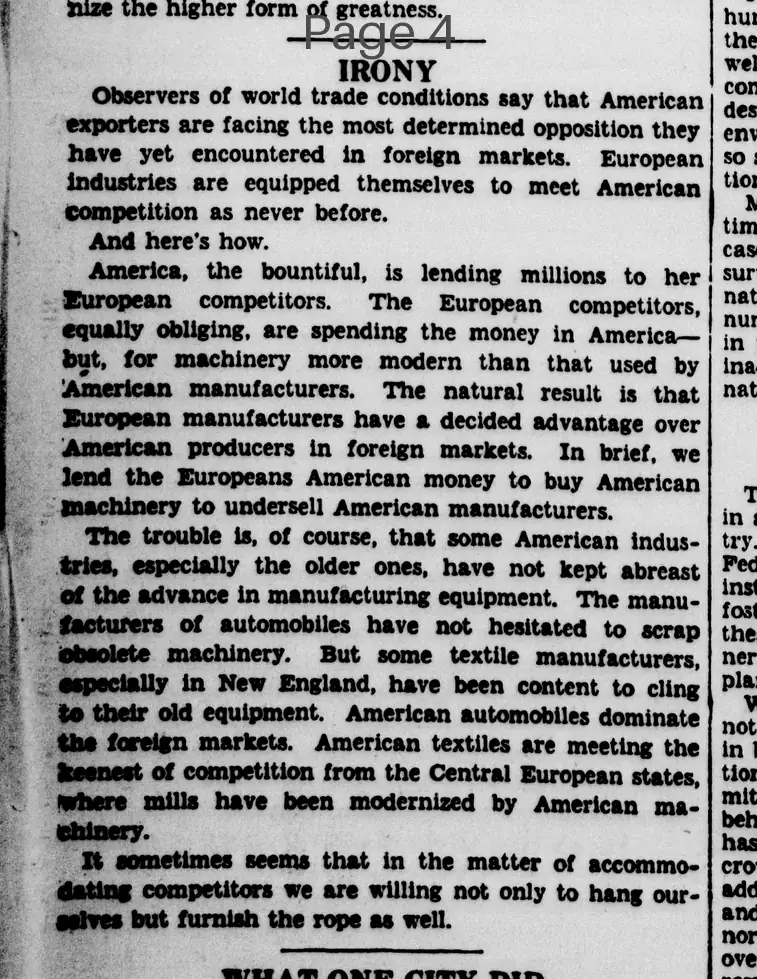
IRONY
Observers of world trade conditions say that American exporters are facing the most determined opposition they have yet encountered in foreign markets. European industries are equipped themselves to meet American competition as never before.
And here's how.
America, the bountiful, is lending millions to her European competitors.
The European competitors, equally obliging, are spending the money in America—but, for machinery more modern than that used by American manufacturers. The natural result is that European manufacturers have a decided advantage over American producers in foreign markets. In brief, we lend the Europeans American money to buy American machinery to undersell American manufacturers.
The trouble is, of course, that some American industries, especially the older ones, have not kept abreast of the advance in manufacturing equipment. The manufacturers of automobiles have not hesitated to scrap obsolete machinery. But some textile manufacturers, especially in New England, have been content to cling to their old equipment. American automobiles dominate the foreign markets. American textiles are meeting the keenest of competition from the Central European states, where mills have been modernized by American machinery.
It sometimes seems that in the matter of accommodating competitors we are willing not only to hang ourselves but furnish the rope as well.
Observers of world trade conditions say that American exporters are facing the most determined opposition they have yet encountered in foreign markets. European industries are equipped themselves to meet American competition as never before.
And here's how.
America, the bountiful, is lending millions to her European competitors.
The European competitors, equally obliging, are spending the money in America—but, for machinery more modern than that used by American manufacturers. The natural result is that European manufacturers have a decided advantage over American producers in foreign markets. In brief, we lend the Europeans American money to buy American machinery to undersell American manufacturers.
The trouble is, of course, that some American industries, especially the older ones, have not kept abreast of the advance in manufacturing equipment. The manufacturers of automobiles have not hesitated to scrap obsolete machinery. But some textile manufacturers, especially in New England, have been content to cling to their old equipment. American automobiles dominate the foreign markets. American textiles are meeting the keenest of competition from the Central European states, where mills have been modernized by American machinery.
It sometimes seems that in the matter of accommodating competitors we are willing not only to hang ourselves but furnish the rope as well.
What sub-type of article is it?
Trade Or Commerce
Economic Policy
Satire
What keywords are associated?
World Trade
American Exporters
European Competition
Lending Money
Modern Machinery
Textile Industry
Automobile Exports
What entities or persons were involved?
American Exporters
European Industries
American Manufacturers
Textile Manufacturers In New England
Automobile Manufacturers
Central European States
Editorial Details
Primary Topic
U.S. Lending To European Competitors Enabling Them To Modernize And Undersell American Products
Stance / Tone
Ironic Criticism Of Self Defeating Economic Policy
Key Figures
American Exporters
European Industries
American Manufacturers
Textile Manufacturers In New England
Automobile Manufacturers
Central European States
Key Arguments
American Lending To Europe Allows Competitors To Buy Superior U.S. Machinery
European Manufacturers Gain Advantage Over Outdated American Industries
U.S. Automobiles Succeed Abroad Due To Modernization, Unlike Textiles
Policy Enables Competitors To Undersell Americans In Foreign Markets