Thank you for visiting SNEWPapers!
Sign up free
The Kentucky Gazette
Lexington, Fayette County, Kentucky
What is this article about?
Proceedings of the U.S. House of Representatives from May 6-9, 1789, including debates on import duties and tonnage bills, referral of petitions, and delivery of the House's formal address to President George Washington with his reply.
Clipping
OCR Quality
Full Text
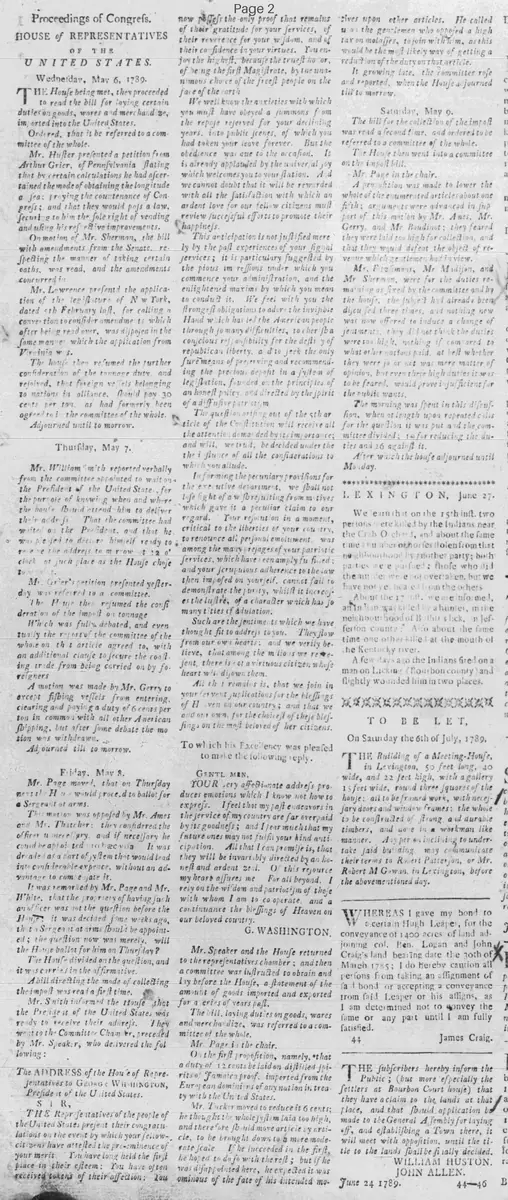
HOUSE of REPRESENTATIVES
THE UNITED STATES.
Wednesday, May 6, 1789.
The House being met, they proceeded to read the bill for laying certain duties on goods, wares and merchandise, imported into the United States.
Ordered, that it be referred to a committee of the whole.
Mr. Hunter presented a petition from Arthur Grier, of Pennsylvania, stating that by certain calculations he had ascertained the mode of obtaining the longitude at sea; praying the countenance of Congress; and that they would pass a law, securing to him the sole right of vending and using his respective improvements.
On motion of Mr. Sherman, the bill with amendments from the Senate, regulating the manner of taking certain oaths, was read, and the amendments concurred in.
Mr. Lawrence presented the application of the legislature of New York, dated 8th February last, for calling a convention to consider amendments which after being read over, was disposed in the same manner which the application from Virginia was.
The House then resumed the further consideration of the tonnage duty, and resolved, that foreign vessels belonging to nations in alliance, should pay 30 cents per ton, as had formerly been agreed to by the committee of the whole.
Adjourned until to-morrow.
Thursday, May 7.
Mr. William Smith reported verbally from the committee appointed to wait on the President of the United States, for the purpose of knowing when and where the House should attend him to deliver their address. That the committee had waited on the President, and that he was pleased to declare himself ready to receive the address to-morrow at 12 o'clock, at such place as the House chose to meet in.
Mr. Grier's petition presented yesterday was referred to a committee.
The House then resumed the consideration of the import of tonnage, which was fully debated, and eventually the report of the committee of the whole on that article agreed to, with an additional clause to secure the coasting trade from being carried on by foreigners.
A motion was made by Mr. Gerry to except fishing vessels from entering, clearing and paying a duty of 6 cents per ton in common with all other American shipping, but after some debate the motion was withdrawn.
Adjourned till to-morrow.
Friday, May 8.
Mr. Page moved, that on Thursday next the House would proceed to ballot for a Sergeant at arms.
This motion was opposed by Mr. Ames and Mr. Thatcher; they considered the officer unnecessary, and if necessary he could be appointed pro hac vice. It was urged as a part of system that would lead into considerable expense, without an advantage to the state of it.
It was remarked by Mr. Page and Mr. White, that the propriety of having such an officer was not the question before the House: it was decided five weeks ago, that a Sergeant at arms should be appointed; the question now was merely, will the House ballot for him on Thursday?
The House divided on the question, and it was carried in the affirmative.
A bill directing the mode of collecting the impost was read a first time.
Mr. Smith informed the House that the President of the United States was ready to receive their address. They went to the Committee Chamber, preceded by Mr. Speaker, who delivered the following:
The ADDRESS of the House of Representatives to George Washington, President of the United States.
SIR,
THE Representatives of the people of the United States present their congratulations on the event by which your fellow-citizens have attested the pre-eminence of your merit. You have long held the first place in their esteem: you have often received tokens of their affection: They now possess the only proof that remains of their gratitude for your services, of their reverence for your wisdom, and of their confidence in your virtues. You enjoy the highest, because the truest honor, of being the first Magistrate, by the unanimous choice of the free people on the face of the earth.
We well know the anxieties with which you must have obeyed a summons from the repose reserved for your declining years, into public scenes, of which you had taken your leave forever. But the obedience was due to the occasion. It is already applauded by the universal joy which welcomes you to your station. And we cannot doubt that it will be rewarded with all the satisfaction with which an ardent love for our fellow citizens must review successful efforts to promote their happiness.
This anticipation is not justified merely by the past experience of your signal services; it is particularly suggested by the pious impressions under which you commence your administration, and the enlightened maxims by which you mean to conduct it. We feel with you the strongest obligations to adore the invisible Hand which has led the American people through so many difficulties, to cherish a conscious responsibility for the destiny of republican liberty, and to seek the only sure means of preserving and recommending the precious deposit in a system of legislation, founded on the principles of an honest policy and directed by the spirit of a diffusive patriotism.
The question respecting the sixth article of the Constitution will receive all the attention demanded by its importance; and will, we trust, be decided under the influence of all the considerations to which you allude.
In forming the pecuniary provisions for the executive department, we shall not lose sight of what is due to a resolution in a moment, critical to the liberties of your country, to renounce all personal emolument. Your resolution in a moment, critical to the liberties of your country, to renounce all personal emolument, was among the many signal instances of your patriotic services, which have eminently fulfilled; and your scrupulous adherence to the law then imposed on yourself, cannot fail to demonstrate the justice, whilst it increases the lustre, of a character which has so many titles to adulation.
Such are the sentiments which we have thought fit to address to you. They flow from our own hearts: and we verily believe, that among the millions we represent, there is not a virtuous citizen whose heart will disown them.
All that remains is, that we join in your fervent felicitations for the blessings of Heaven on our country; and that we add our own, for the choicest of these blessings on the beloved of her citizens.
To which his Excellency was pleased to make the following reply.
GENTLEMEN,
YOUR very affectionate address produces emotions which I know not how to express. I feel that my past endeavors in the service of my country are far overpaid by its goodness; and I fear much that my future ones may not fulfil your kind anticipation. All that I can promise is, that they will be invariably directed by an honest and ardent zeal. Of this resource my heart assures me. For all beyond, I rely on the wisdom and patriotism of those with whom I am to co-operate, and on a continuance the blessings of Heaven on our beloved country.
G. WASHINGTON.
Mr. Speaker and the House returned to the representatives chamber; and then a committee was instructed to obtain and lay before the House, a statement of the amount of goods imported and exported for a series of years past.
The bill, laying duties on goods, wares and merchandise, was referred to a committee of the whole.
Mr. Page in the chair.
On the first proposition, namely, that a duty of 12 cents be laid on distilled spirits of Jamaica proof, imported from the European dominions of any nation in treaty with the United States.
Mr. Tucker moved to reduce it 6 cents; he thought the whole system laid too high, and therefore should move article by article, to be brought down to a more moderate scale. If he succeeded in the first, he hoped to do so with the rest; but if he was disappointed here, he expected it was ominous of the fate of his intended motions upon other articles. He called upon the gentlemen who opposed a high tariff on molasses, to join with him, as this would be the most likely way of getting a reduction of the duty on that article.
It growing late, the committee rose and reported, when the House adjourned till to-morrow.
Saturday, May 9.
The bill for the collection of the impost was read a second time, and ordered to be referred to a committee of the whole.
The House then went into a committee on the impost bill.
Mr. Page in the chair.
A proposition was made to lower the whole of the enumerated articles about one fifth; arguments were advanced in support of this motion by Mr. Ames, Mr. Gerry, and Mr. Boudinot: they feared they were laid too high for collection, and that they would defeat the object of revenue which gentlemen had in view.
Mr. Fitzsimons, Mr. Madison, and Mr. Sherman, were for the duties remaining as laid by the committee and by the House, the subject had already been discussed three times, and nothing new was now offered to induce a change of sentiments they did not think the duties were too high, nothing if compared to what other nations paid. At best whether they were so or not was mere matter of opinion. But even their high duties it was to be feared, would prove insufficient for the public wants.
The morning was spent in this discussion, when at length upon repeated calls for the question it was put and the committee divided: 19 for reducing the duties and 26 against it.
After which the House adjourned until Monday.
What sub-type of article is it?
What keywords are associated?
What entities or persons were involved?
Domestic News Details
Event Date
May 6 9, 1789
Key Persons
Outcome
bills on duties and tonnage referred to committees and debated; petition from arthur grier referred; house address delivered to president washington, who replied; motion to ballot for sergeant at arms passed; proposal to reduce duties on enumerated articles defeated 19-26.
Event Details
The House of Representatives met daily from May 6 to 9, 1789, to read and refer bills on import duties and tonnage, consider petitions and applications for constitutional amendments, debate tonnage rates and fishing vessel exemptions, appoint committees, deliver a formal address to President Washington, and discuss reductions in duty rates on spirits and other goods.