Thank you for visiting SNEWPapers!
Sign up free
The New Hampshire Gazette And General Advertiser
Portsmouth, Rockingham County, New Hampshire
What is this article about?
London foreign intelligence from August 21 to September 3 reports on Anglo-Spanish diplomatic tensions, with Spain demanding Britain disarm amid unresolved disputes; naval preparations including Earl Howe's fleet ordered to engage Spanish and French forces off Brest and Finisterre; sightings of Spanish fleet; rumors of French support; Prussian mediation in Turkish peace; and British squadron dispatch to Baltic to back Prussia against Russia.
Merged-components note: Continuation of the 'Foreign Intelligence' article from London within page 2; sequential reading order and text flows coherently on international affairs between England, Spain, and France.
Clipping
OCR Quality
Full Text
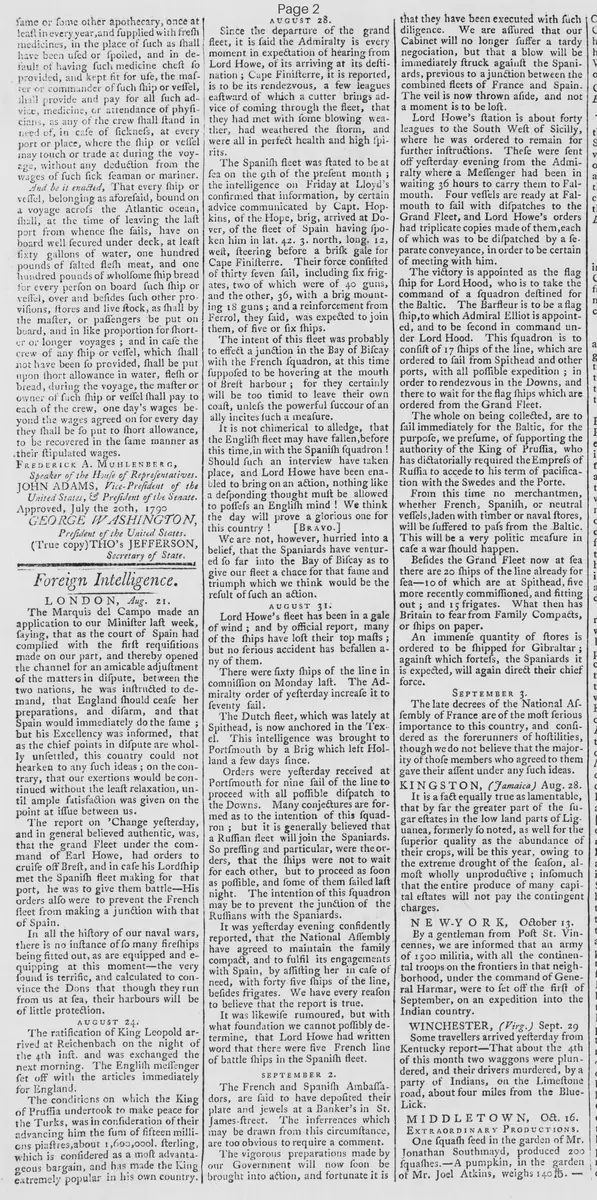
LONDON, Aug. 21.
The Marquis del Campo made an application to our Minister last week, saying, that as the court of Spain had complied with the first requisitions made on our part, and thereby opened the channel for an amicable adjustment of the matters in dispute, between the two nations, he was instructed to demand, that England should cease her preparations, and disarm, and that Spain would immediately do the same; but his Excellency was informed, that as the chief points in dispute are wholly unsettled, this country could not hearken to any such ideas; on the contrary, that our exertions would be continued without the least relaxation, until ample satisfaction was given on the point at issue between us.
The report on 'Change yesterday, and in general believed authentic, was, that the grand Fleet under the command of Earl Howe, had orders to cruise off Brest, and in case his Lordship met the Spanish fleet making for that port, he was to give them battle--His orders also were to prevent the French fleet from making a junction with that of Spain.
In all the history of our naval wars, there is no instance of so many fireships being fitted out, as are equipped and equipping at this moment--the very sound is terrific, and calculated to convince the Dons that though they run from us at sea, their harbours will be of little protection.
AUGUST 24.
The ratification of King Leopold arrived at Reichenbach on the night of the 4th inst. and was exchanged the next morning. The English messenger set off with the articles immediately for England.
The conditions on which the King of Prussia undertook to make peace for the Turks, was in consideration of their advancing him the sum of fifteen millions piastres, about 1,600,000l. sterling, which is considered as a most advantageous bargain, and has made the King extremely popular in his own country.
AUGUST 28.
Since the departure of the grand fleet, it is said the Admiralty is every moment in expectation of hearing from Lord Howe, of its arriving at its destination; Cape Finisterre, it is reported, is to be its rendezvous, a few leagues eastward of which a cutter brings advice of coming through the fleet, that they had met with some blowing weather, had weathered the storm, and were all in perfect health and high spirits.
The Spanish fleet was stated to be at sea on the 9th of the present month; the intelligence on Friday at Lloyd's confirmed that information, by certain advice communicated by Capt. Hopkins, of the Hope, brig, arrived at Dover, of the fleet of Spain having spoken him in lat. 42. 3. north, long. 12, west, steering before a brisk gale for Cape Finisterre. Their force consisted of thirty seven sail, including six frigates, two of which were of 40 guns, and the other, 36, with a brig mounting 18 guns; and a reinforcement from Ferrol, they said, was expected to join them, of five or six ships.
The intent of this fleet was probably to effect a junction in the Bay of Biscay with the French squadron, at this time supposed to be hovering at the mouth of Brest harbour; for they certainly will be too timid to leave their own coast, unless the powerful succour of an ally incites such a measure.
It is not chimerical to allege, that the English fleet may have fallen, before this time, in with the Spanish squadron! Should such an interview have taken place, and Lord Howe have been enabled to bring on an action, nothing like a desponding thought must be allowed to possess an English mind! We think the day will prove a glorious one for this country! [Bravo.]
We are not, however, hurried into a belief, that the Spaniards have ventured so far into the Bay of Biscay as to give our fleet a chace for that fame and triumph which we think would be the result of such an action.
AUGUST 31:
Lord Howe's fleet has been in a gale of wind; and by official report, many of the ships have lost their top masts; but no serious accident has befallen any of them.
There were sixty ships of the line in commission on Monday last. The Admiralty order of yesterday increase it to seventy sail.
The Dutch fleet, which was lately at Spithead, is now anchored in the Texel. This intelligence was brought to Portsmouth by a Brig which left Holland a few days since.
Orders were yesterday received at Portsmouth for nine sail of the line to proceed with all possible dispatch to the Downs. Many conjectures are formed as to the intention of this squadron; but it is generally believed that a Russian fleet will join the Spaniards. So pressing and particular, were the orders, that the ships were not to wait for each other, but to proceed as soon as possible, and some of them sailed last night. The intention of this squadron may be to prevent the junction of the Russians with the Spaniards.
It was yesterday evening confidently reported, that the National Assembly have agreed to maintain the family compact, and to fulfil its engagements with Spain, by assisting her in case of need, with forty five ships of the line, besides frigates. We have every reason to believe that the report is true.
It was likewise rumoured, but with what foundation we cannot possibly determine, that Lord Howe had written word that there were five French line of battle ships in the Spanish fleet.
SEPTEMBER 2.
The French and Spanish Ambassadors, are said to have deposited their plate and jewels at a Banker's in St. James-street. The inferences which may be drawn from this circumstance, are too obvious to require a comment.
The vigorous preparations made by our Government will now soon be brought into action, and fortunate it is that they have been executed with such diligence. We are assured that our Cabinet will no longer suffer a tardy negotiation, but that a blow will be immediately struck against the Spaniards, previous to a junction between the combined fleets of France and Spain.
The veil is now thrown aside, and not a moment is to be lost.
Lord Howe's station is about forty leagues to the South West of Sicily, where he was ordered to remain for further instructions. These were sent off yesterday evening from the Admiralty where a Messenger had been in waiting 36 hours to carry them to Falmouth. Four vessels are ready at Falmouth to sail with dispatches to the Grand Fleet, and Lord Howe's orders had triplicate copies made of them, each of which was to be dispatched by a separate conveyance, in order to be certain of meeting with him.
The victory is appointed as the flag ship for Lord Hood, who is to take the command of a squadron destined for the Baltic. The Barfleur is to be a flag ship, to which Admiral Elliot is appointed, and to be second in command under Lord Hood. This squadron is to consist of 17 ships of the line, which are ordered to sail from Spithead and other ports, with all possible expedition; in order to rendezvous in the Downs, and there to wait for the flag ships which are ordered from the Grand Fleet.
The whole on being collected, are to sail immediately for the Baltic, for the purpose, we presume, of supporting the authority of the King of Prussia, who has dictatorially required the Empress of Russia to accede to his terms of pacification with the Swedes and the Porte.
From this time no merchantmen, whether French, Spanish, or neutral vessels, laden with timber or naval stores, will be suffered to pass from the Baltic. This will be a very politic measure in case a war should happen.
Besides the Grand Fleet now at sea there are 20 ships of the line already for sea--10 of which are at Spithead, five more recently commissioned, and fitting out; and 15 frigates. What then has Britain to fear from Family Compacts, or ships on paper.
An immense quantity of stores is ordered to be shipped for Gibraltar; against which fortress, the Spaniards it is expected, will again direct their chief force.
SEPTEMBER 3.
The late decrees of the National Assembly of France are of the most serious importance to this country, and considered as the forerunners of hostilities, though we do not believe that the majority of those members who agreed to them gave their assent under any such ideas.
What sub-type of article is it?
What keywords are associated?
What entities or persons were involved?
Where did it happen?
Foreign News Details
Primary Location
Spain
Event Date
August 21 To September 3
Key Persons
Outcome
diplomatic refusal to disarm; spanish fleet of 37 sail sighted heading to finisterre; british fleet preparations increased to 70 ships of the line; prussian peace mediation for 1,600,000l. sterling; squadron to baltic to support prussia; rumors of french aid to spain with 45 ships.
Event Details
Reports from London detail ongoing Anglo-Spanish disputes where Spain demands Britain cease preparations, but Britain refuses until satisfaction on issues; Earl Howe's grand fleet ordered to cruise off Brest to battle Spanish fleet and prevent French junction; Spanish fleet sighted at sea; preparations include many fireships; updates on fleet weather and health; Prussian mediation secures peace for Turks; British squadron of 17 ships to Baltic to back Prussia against Russia; French decrees seen as hostile precursors; ambassadors deposit valuables indicating tensions.