Thank you for visiting SNEWPapers!
Sign up free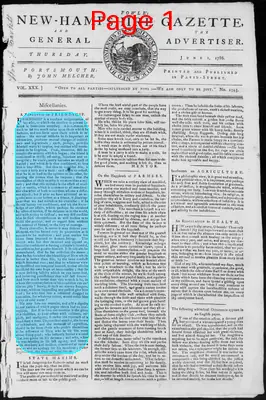
Literary
June 1, 1786
Fowle's New Hampshire Gazette And General Advertiser
Portsmouth, Rockingham County, New Hampshire
What is this article about?
An essay praising friendship as a reciprocal bond, warning against misunderstandings that breed enmity, and advocating Christian forgiveness even towards betrayers, drawing on biblical precepts to elevate human nature beyond pagan virtue.
Clipping
OCR Quality
98%
Excellent
Full Text
A PANEGYRIC On FRIENDSHIP.
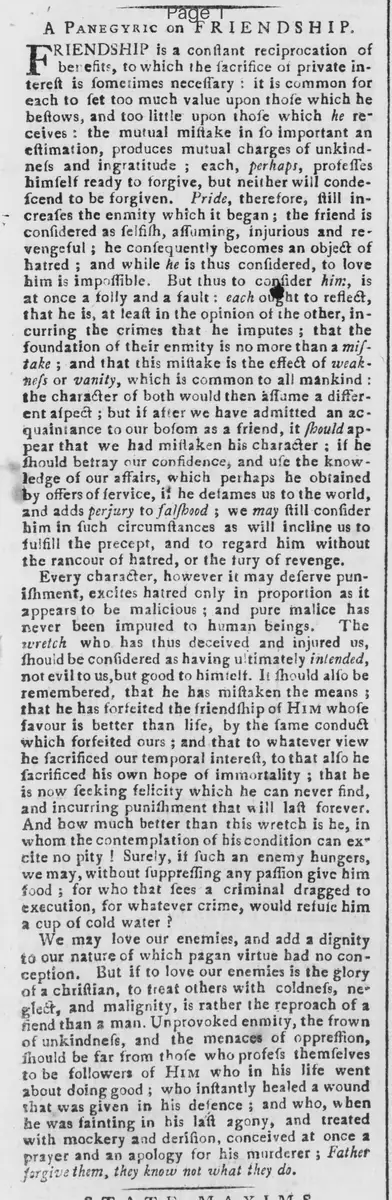
FRIENDSHIP is a constant reciprocation of benefits. to which the sacrifice of private interest is sometimes necessary : it is common for each to set too much value upon those which he bestows, and too little upon those which he receives : the mutual mistake in so important an estimation, produces mutual charges of unkindness and ingratitude ; each, perhaps, professes himself ready to forgive, but neither will condescend to be forgiven. Pride, therefore, still increases the enmity which it began; the friend is considered as selfish, assuming, injurious and revengeful ; he consequently becomes an object of hatred ; and while he is thus considered, to love him is impossible. But thus to consider him. is at once a folly and a fault : each ought to reflect, that he is, at least in the opinion of the other, incurring the crimes that he imputes ; that the foundation of their enmity is no more than a mistake ; and that this mistake is the effect of weakness or vanity, which is common to all mankind : the character of both would then assume a different aspect ; but if after we have admitted an acquaintance to our bosom as a friend, it should appear that we had mistaken his character : if he should betray our confidence, and use the knowledge of our affairs, which perhaps he obtained by offers of service, if he defames us to the world, and adds perjury to falsehood ; we may still consider him in such circumstances as will incline us to fulfill the precept, and to regard him without the rancour of hatred, or the fury of revenge. Every character, however it may deserve punishment, excites hatred only in proportion as it appears to be malicious ; and pure malice has never been imputed to human beings. The wretch who has thus deceived and injured us, should be considered as having ultimately intended, not evil to us,but good to himself. It should also be remembered, that he has mistaken the means ; that he has forfeited the friendship of HIM whose favour is better than life, by the same conduct which forfeited ours ; and that to whatever view he sacrificed our temporal interest. to that also he sacrificed his own hope of immortality ; that he is now seeking felicity which he can never find, and incurring punishment that will last forever. And how much better than this wretch is he, in whom the contemplation of his condition can excite no pity ! Surely, if such an enemy hungers, we may, without suppressing any passion give him food ; for who that sees a criminal dragged to execution, for whatever crime, would refuse him a cup of cold water ? We may love our enemies, and add a dignity to our nature of which pagan virtue had no conception. But if to love our enemies is the glory of a christian, to treat others with coldness, neglect, and malignity, is rather the reproach of a fiend than a man. Unprovoked enmity, the frown of unkindness, and the menaces of oppression, should be far from those who profess themselves to be followers of HIM who in his life went about doing good ; who instantly healed a wound that was given in his defence ; and who, when he was fainting in his last agony, and treated with mockery and derision, conceived at once a prayer and an apology for his murderer ; Father forgive them, they know not what they do.
FRIENDSHIP is a constant reciprocation of benefits. to which the sacrifice of private interest is sometimes necessary : it is common for each to set too much value upon those which he bestows, and too little upon those which he receives : the mutual mistake in so important an estimation, produces mutual charges of unkindness and ingratitude ; each, perhaps, professes himself ready to forgive, but neither will condescend to be forgiven. Pride, therefore, still increases the enmity which it began; the friend is considered as selfish, assuming, injurious and revengeful ; he consequently becomes an object of hatred ; and while he is thus considered, to love him is impossible. But thus to consider him. is at once a folly and a fault : each ought to reflect, that he is, at least in the opinion of the other, incurring the crimes that he imputes ; that the foundation of their enmity is no more than a mistake ; and that this mistake is the effect of weakness or vanity, which is common to all mankind : the character of both would then assume a different aspect ; but if after we have admitted an acquaintance to our bosom as a friend, it should appear that we had mistaken his character : if he should betray our confidence, and use the knowledge of our affairs, which perhaps he obtained by offers of service, if he defames us to the world, and adds perjury to falsehood ; we may still consider him in such circumstances as will incline us to fulfill the precept, and to regard him without the rancour of hatred, or the fury of revenge. Every character, however it may deserve punishment, excites hatred only in proportion as it appears to be malicious ; and pure malice has never been imputed to human beings. The wretch who has thus deceived and injured us, should be considered as having ultimately intended, not evil to us,but good to himself. It should also be remembered, that he has mistaken the means ; that he has forfeited the friendship of HIM whose favour is better than life, by the same conduct which forfeited ours ; and that to whatever view he sacrificed our temporal interest. to that also he sacrificed his own hope of immortality ; that he is now seeking felicity which he can never find, and incurring punishment that will last forever. And how much better than this wretch is he, in whom the contemplation of his condition can excite no pity ! Surely, if such an enemy hungers, we may, without suppressing any passion give him food ; for who that sees a criminal dragged to execution, for whatever crime, would refuse him a cup of cold water ? We may love our enemies, and add a dignity to our nature of which pagan virtue had no conception. But if to love our enemies is the glory of a christian, to treat others with coldness, neglect, and malignity, is rather the reproach of a fiend than a man. Unprovoked enmity, the frown of unkindness, and the menaces of oppression, should be far from those who profess themselves to be followers of HIM who in his life went about doing good ; who instantly healed a wound that was given in his defence ; and who, when he was fainting in his last agony, and treated with mockery and derision, conceived at once a prayer and an apology for his murderer ; Father forgive them, they know not what they do.
What sub-type of article is it?
Essay
What themes does it cover?
Friendship
Moral Virtue
Religious
What keywords are associated?
Friendship
Reciprocation
Ingratitude
Forgiveness
Enmity
Christian Virtue
Love Enemies
Literary Details
Title
A Panegyric On Friendship.
Key Lines
Friendship Is A Constant Reciprocation Of Benefits. To Which The Sacrifice Of Private Interest Is Sometimes Necessary
We May Love Our Enemies, And Add A Dignity To Our Nature Of Which Pagan Virtue Had No Conception.
But If To Love Our Enemies Is The Glory Of A Christian, To Treat Others With Coldness, Neglect, And Malignity, Is Rather The Reproach Of A Fiend Than A Man.
Father Forgive Them, They Know Not What They Do.