Thank you for visiting SNEWPapers!
Sign up free
Story
October 13, 1864
Monmouth Herald & Inquirer
Monmouth County, New Jersey
What is this article about?
A husband scolds his wife for buying a silk dress on credit against his wishes, causing her deep distress. She attends a party alone and dies suddenly of heart disease upon returning home, leaving him filled with remorse.
Clipping
OCR Quality
98%
Excellent
Full Text
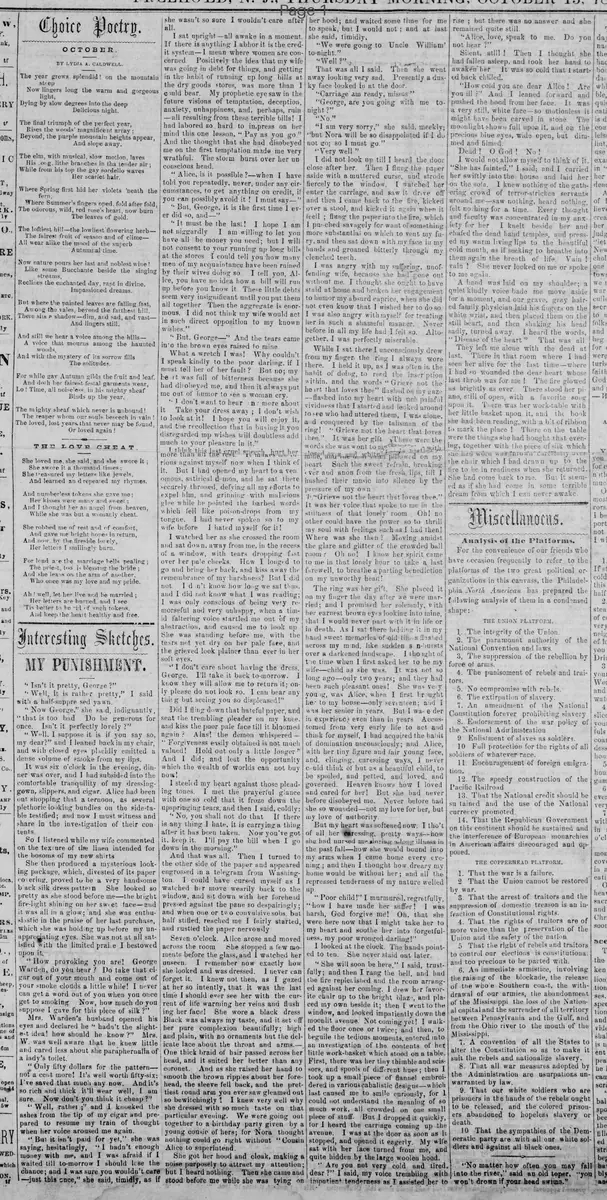
Interesting Sketches.
MY PUNISHMENT.
"Isn't it pretty, George?"
"Well, it is rather pretty," I said with a half-suppressed yawn.
"Now George," she said, indignantly, "that is too bad. Do be generous for once. Isn't it perfectly lovely?"
"Well, I suppose it is if you say so, my dear," and I leaned back in my chair, and with closed eyes placidly emitted a dense volume of smoke from my lips.
It was six o'clock in the evening, dinner was over, and I had subsided into the comfortable tranquility of my dressing-gown, slippers, and cigar. Alice had been out shopping that afternoon, as several plethoric looking bundles on the side-table testified; and now I must witness and share in the investigation of their contents.
So I listened while my wife commented on the texture of the linen intended for the bosoms of my new shirts. She then produced a mysterious looking package, which, divested of its paper covering, proved to be a very handsome black silk dress pattern. She looked so pretty as she stood before me--the bright fire-light shining on her sweet face--and it was all in a glow; and she was enthusiastic in the praise of her last purchase, which she was holding up before my unappreciating eyes. She was not at all satisfied with the limited praise I bestowed upon it.
"How provoking you are! George Warden, do you hear? Do take that cigar out of your mouth and come out of your smoke clouds a little while! I never can get a word out of you when you once get to smoking. Now, how much do you suppose I gave for this piece of silk?"
Mrs. Warden's husband opened his eyes and declared he "hadn't the slightest idea! how should he know?" Mrs. W. was well aware that he knew little and cared less about the paraphernalia of a lady's toilet.
"Only fifty dollars for the pattern--not a cent more! It's well worth fifty-six; I've saved that much anyway. And it's so rich and thick it'll wear well, I am sure. Now don't you think it cheap?"
"Well, rather," and I knocked the ashes from the tip of my cigar and prepared to resume my train of thought when her voice aroused me again.
"But it isn't paid for yet," she was saying, hesitatingly, "I hadn't enough money with me, and I was afraid if I waited till to-morrow I should lose the chance; and I was sure you wouldn't care--just this once," she said, timidly, as if she wasn't so sure I wouldn't care after all.
I sat upright--all awake in a moment. If there is anything I abhor it is the credit system--I mean where women are concerned. Positively the idea that my wife was going in debt for things, and getting in the habit of running up long bills at the dry goods stores, was more than I could bear. My prophetic eye saw in the future visions of temptation, deception, anxiety, unhappiness, and, perhaps, ruin--all resulting from these terrible bills! I had labored so hard to impress on her mind this one lesson, "Pay as you go." And the thought that she had disobeyed me on the first temptation made me very wrathful. The storm burst over her unconscious head,
"Alice, is it possible?--when I have told you repeatedly, never, under any circumstances, to get anything on credit, if you can possibly avoid it! I must say--"
"But, George, it is the first time I ever did so, and--"
"It must be the last! I hope I am not niggardly. I am willing to let you have all the money you need; but I will not consent to your running up long bills at the stores. I could tell you how many men of my acquaintance have been ruined by their wives doing so. I tell you, Alice, you have no idea how a bill will run up before you know it. These little debts seem very insignificant until you put them all together. Then the aggregate is enormous. I did not think my wife would act in such direct opposition to my known wishes."
"But, George--" And the tears came into the brown eyes raised to mine. What a wretch I was! Why couldn't I speak kindly to the poor darling, if I must tell her of her fault? But no; my heart was full of bitterness because she had disobeyed me, and then it always put me out of humor to see a woman cry.
"I don't want to hear any more about it. Take your dress away; I don't wish to look at it! I hope you will enjoy it, and the recollection that in buying it you disregarded my wishes will doubtless add much to your pleasure in it."
I am furious against myself now when I think of it. But I had opened my heart to a venomous, satirical demon, and he sat there securely throned, defying all my efforts to expel him, and grinning with malicious glee while he pointed the barbed words which fell like poison-drops from my tongue. I had never spoken so to my wife before. I hated myself for it!
I watched her as she crossed the room and sat down, away from me, in the recess of a window, with tears dropping fast over her pale cheeks. How I longed to go and bring her back, and kiss away the remembrance of my harshness? But I did not. I didn't know how long we sat thus, and I did not know what I was reading; I was only conscious of being very remorseful and very unhappy, when a timid faltering voice startled me out of my abstraction, and caused me to look up.
She was standing before me, with the tears not yet dry on her pale face, and the grieved look plainer than ever in her soft eyes.
"I don't care about having the dress, George. I'll take it back to-morrow. I know they will allow me to return it; only please do not look so. I can bear anything but seeing you so displeased!"
Did I fling down that hateful paper, and seat the trembling pleader on my knee, and kiss the poor pale face till it bloomed again? Alas! the demon whispered--
"Forgiveness easily obtained is not much valued! Hold out only a little longer."
And I did; and lost the opportunity which the wealth of worlds cannot buy now!
I steeled my heart against those pleading tones. I met the prayerful glance with one so cold that it froze down the upspringing tears, and then I said, coldly:
"No, you shall not do that. If there is anything I hate, it is carrying a thing after it has been taken. Now you've got it, keep it. I'll pay the bill when I go down in the morning."
And that was all. Then I turned to the other side of the paper and appeared engrossed in a telegram from Washington. I could have cursed myself as I watched her move wearily back to the window, and sit down with her forehead pressed against the pane so despairingly; and when one or two convulsive sobs, but half stifled, reached me I fairly started, and rustled the paper nervously.
Seven o'clock. Alice arose and moved across the room. She stopped a few moments before the glass, and I watched her unseen. I remember now exactly how she looked and was dressed. I never can forget it. I knew not then, as I gazed at her so intently, that it was the last time I should ever see her with the current of life warming her veins and flushing her face. She wore a black dress. Black was always my taste, and it set off her pure complexion beautifully; high and plain, with no ornaments but the delicate lace about the throat and arms. One thick braid of hair passed across her head, and it suited her better than any coronet. And as she raised her hand to smooth the brown ripples about her forehead, the sleeve fell back, and the prettiest round arm you ever saw gleamed out so bewitchingly! I knew very well why she dressed with so much taste on that particular evening. We were going out together to a birthday party given by a young cousin of hers; for Nora thought nothing could go right without "Cousin Alice to superintend."
She got her hood and cloak, making a noise purposely to attract my attention; but I heard nothing. Then she came and stood before me while she was tying on her hood: and waited some time for me to speak, but I would not: and at last she said, timidly,
"We were going to Uncle William's to-night."
"Well?"
That was all I said. Then she went away looking very sad. Presently a dusky face looked in at the door.
"Carriage am ready, missus."
"George, are you going with me to-night?"
"No."
"I am very sorry," she said, meekly; but Nora will be so disappointed if I do not go; so I must go."
"Very well."
I did not look up till I heard the door close after her. Then I flung the paper aside with a muttered curse, and strode fiercely to the window. I watched her enter the carriage, and saw it drive off, and then I came back to the fire, kicked over a stool, and kicked it again when it fell; flung the paper into the fire, which I poked savagely for want of something more substantial on which to vent my fury, and then sat down with my face in my hands and groaned bitterly through my clenched teeth.
I was angry with my suffering, unoffending wife, because she had gone out without me. I thought she ought to have stayed at home and broken her engagement to humor my absurd caprice, when she did not even know that I wished her to do so. I was also angry with myself for treating her in such a shameful manner. Never before in all my life had I felt so. Altogether, I was perfectly miserable.
While I sat there I unconsciously drew from my finger the ring I always wore there. I held it up, as I was often in the habit of doing, to read the inscription within, and the words "Grieve not the heart that loves thee" flashed on my gaze--flashed into my heart with such painful vividness that I started and looked around to see who had uttered them. I was alone, and conquered by the talisman of the ring! "Grieve not the heart that loves thee." It was her gift. These were the words she was wont to murmur at our trysts, and whispered pillowed on my heart. Such the sweet refrain, breaking ever and anon from the fresh lips, till I hushed their music into silence by the pressure of my own. "Grieve not the heart that loves thee."
It was her voice that spoke to me in the stillness of that lonely room. Oh! no other could have the power so to thrill my soul with feelings such as I had then. Where was she then? Moving amidst the glare and glitter of the crowded ball room? Oh no! I know her spirit came to me in that lonely hour to take a last farewell, to breathe a parting benediction on my unworthy head!
The ring was her gift. She placed it on my finger the day after we were married; and I promised her solemnly, with her earnest brown eyes looking into mine, that I would never part with it in life or in death. As I sat there holding it in my hand sweet memories of old times flashed across my mind, like sudden sun-bursts over a darkened landscape. I thought of the time when I first asked her to be my wife--child as she was. It was not so long ago--only two years; and they had been such pleasant ones! She was very young, was Alice, when I first brought her to my house--only seventeen: and I was her senior in years. But I was older in experience even than in years. Accustomed from very early life to act and think for myself, I had acquired the habit of domination unconsciously; and Alice, with her tiny figure and fair young face, and clinging, caressing ways, I never could think of but as a beautiful child, to be spoiled, and petted, and loved, and governed. Heaven knows how I loved and cared for her! But she had never before disobeyed me. Never before had she so wounded--not my love for her, but my love of authority.
But my heart was softened now. I thought of all her caressing, pretty ways--how she had nursed me during a long illness in the past fall--how she would bound into my arms when I came home every evening; and then I thought how dreary my home would be without her; and all the repressed tenderness of my nature welled up
"Poor child!" I murmured, regretfully, "how I have made her suffer! I was harsh, God forgive me! Oh, that she were here now that I might take her to my heart and soothe her into forgetfulness, my poor wronged darling!"
I looked at the clock. The hands pointed to ten. She never stayed out later.
"She will soon be here," I said, trustfully; and then I rang the bell, and had the fire replenished and the room arranged against her coming. I drew her favorite chair up to the bright blaze, and placed my own beside it; then I went to the window, and looked impatiently down the moonlit avenue. Not coming yet! I walked the floor once or twice: and then, to beguile the tedious moments, entered into an investigation of the contents of her little work-basket which stood on a table.
First, there was her tiny thimble and scissors, and spools of different hues: then I took up a small piece of flannel embroidered in various cabalistic designs--which last caused me to smile curiously, for I could not understand the meaning of so much work, all crowded on one small piece of stuff. But I dropped it quickly, for I heard the carriage coming up the avenue. I was at the door as soon as it stopped, and opened it eagerly. My wife sat with her face turned from me, and quite hidden by the large woolen hood.
"Are you not very cold and tired, dear?" I said, my voice trembling with emotion as I assisted her to rise; but there was no answer and she remained quite still.
"Alice, love, speak to me. Do you not hear?"
Silent, still! Then I thought she had fallen asleep, and took her hand to awaken her. It was so cold that I started back chilled.
"How cold you are, dear Alice! Are you ill?" And I leaned forward and pushed the hood from her face. It was a very still, white face--so motionless it might have been carved in stone. The moonlight shone full upon it, and on the precious blue eyes, wide open, but dimmed and filmed.
Dead! O God! No!
I would not allow myself to think of it.
"She has fainted," I said: and I carried her swiftly into the house and laid her on the sofa. I knew nothing of the gathering crowd of terror-stricken servants around me--saw nothing, heard nothing, felt nothing for a time. Every thought and faculty was concentrated in my anxiety for her. I knelt beside her and chafed the dead hand, temples, and pressed my warm living lips to the beautiful cold mouth, as if seeking to breathe into them again the breath of life. Vain! vain! She never looked on me or spoke to me again.
A hand was laid on my shoulder; a quiet kindly voice bade me move aside for a moment, and our grave, gray-haired family physician laid his fingers on the white wrist, and then placed them on the still heart, and then shaking his head sadly, turned away. I heard the words, "Disease of the heart." That was all.
They left me alone with the dead at last. There in that room where I had seen her alive for the last time--where I had so wounded the dear heart whose last throb was for me! The fire glowed as brightly as ever. There stood her piano, still open, with a favorite song upon it. There was her work-table with her little basket upon it, and the book she had been reading, with a bit of ribbon to mark the place. There on the table were the things she had bought that evening, together with the piece of silk which she had worn was thrown carelessly over the chair which I had drawn up to the fire to be in readiness when she returned.
She had come back to me. But it seemed as if she had come in some terrible dream from which I can never awake.
MY PUNISHMENT.
"Isn't it pretty, George?"
"Well, it is rather pretty," I said with a half-suppressed yawn.
"Now George," she said, indignantly, "that is too bad. Do be generous for once. Isn't it perfectly lovely?"
"Well, I suppose it is if you say so, my dear," and I leaned back in my chair, and with closed eyes placidly emitted a dense volume of smoke from my lips.
It was six o'clock in the evening, dinner was over, and I had subsided into the comfortable tranquility of my dressing-gown, slippers, and cigar. Alice had been out shopping that afternoon, as several plethoric looking bundles on the side-table testified; and now I must witness and share in the investigation of their contents.
So I listened while my wife commented on the texture of the linen intended for the bosoms of my new shirts. She then produced a mysterious looking package, which, divested of its paper covering, proved to be a very handsome black silk dress pattern. She looked so pretty as she stood before me--the bright fire-light shining on her sweet face--and it was all in a glow; and she was enthusiastic in the praise of her last purchase, which she was holding up before my unappreciating eyes. She was not at all satisfied with the limited praise I bestowed upon it.
"How provoking you are! George Warden, do you hear? Do take that cigar out of your mouth and come out of your smoke clouds a little while! I never can get a word out of you when you once get to smoking. Now, how much do you suppose I gave for this piece of silk?"
Mrs. Warden's husband opened his eyes and declared he "hadn't the slightest idea! how should he know?" Mrs. W. was well aware that he knew little and cared less about the paraphernalia of a lady's toilet.
"Only fifty dollars for the pattern--not a cent more! It's well worth fifty-six; I've saved that much anyway. And it's so rich and thick it'll wear well, I am sure. Now don't you think it cheap?"
"Well, rather," and I knocked the ashes from the tip of my cigar and prepared to resume my train of thought when her voice aroused me again.
"But it isn't paid for yet," she was saying, hesitatingly, "I hadn't enough money with me, and I was afraid if I waited till to-morrow I should lose the chance; and I was sure you wouldn't care--just this once," she said, timidly, as if she wasn't so sure I wouldn't care after all.
I sat upright--all awake in a moment. If there is anything I abhor it is the credit system--I mean where women are concerned. Positively the idea that my wife was going in debt for things, and getting in the habit of running up long bills at the dry goods stores, was more than I could bear. My prophetic eye saw in the future visions of temptation, deception, anxiety, unhappiness, and, perhaps, ruin--all resulting from these terrible bills! I had labored so hard to impress on her mind this one lesson, "Pay as you go." And the thought that she had disobeyed me on the first temptation made me very wrathful. The storm burst over her unconscious head,
"Alice, is it possible?--when I have told you repeatedly, never, under any circumstances, to get anything on credit, if you can possibly avoid it! I must say--"
"But, George, it is the first time I ever did so, and--"
"It must be the last! I hope I am not niggardly. I am willing to let you have all the money you need; but I will not consent to your running up long bills at the stores. I could tell you how many men of my acquaintance have been ruined by their wives doing so. I tell you, Alice, you have no idea how a bill will run up before you know it. These little debts seem very insignificant until you put them all together. Then the aggregate is enormous. I did not think my wife would act in such direct opposition to my known wishes."
"But, George--" And the tears came into the brown eyes raised to mine. What a wretch I was! Why couldn't I speak kindly to the poor darling, if I must tell her of her fault? But no; my heart was full of bitterness because she had disobeyed me, and then it always put me out of humor to see a woman cry.
"I don't want to hear any more about it. Take your dress away; I don't wish to look at it! I hope you will enjoy it, and the recollection that in buying it you disregarded my wishes will doubtless add much to your pleasure in it."
I am furious against myself now when I think of it. But I had opened my heart to a venomous, satirical demon, and he sat there securely throned, defying all my efforts to expel him, and grinning with malicious glee while he pointed the barbed words which fell like poison-drops from my tongue. I had never spoken so to my wife before. I hated myself for it!
I watched her as she crossed the room and sat down, away from me, in the recess of a window, with tears dropping fast over her pale cheeks. How I longed to go and bring her back, and kiss away the remembrance of my harshness? But I did not. I didn't know how long we sat thus, and I did not know what I was reading; I was only conscious of being very remorseful and very unhappy, when a timid faltering voice startled me out of my abstraction, and caused me to look up.
She was standing before me, with the tears not yet dry on her pale face, and the grieved look plainer than ever in her soft eyes.
"I don't care about having the dress, George. I'll take it back to-morrow. I know they will allow me to return it; only please do not look so. I can bear anything but seeing you so displeased!"
Did I fling down that hateful paper, and seat the trembling pleader on my knee, and kiss the poor pale face till it bloomed again? Alas! the demon whispered--
"Forgiveness easily obtained is not much valued! Hold out only a little longer."
And I did; and lost the opportunity which the wealth of worlds cannot buy now!
I steeled my heart against those pleading tones. I met the prayerful glance with one so cold that it froze down the upspringing tears, and then I said, coldly:
"No, you shall not do that. If there is anything I hate, it is carrying a thing after it has been taken. Now you've got it, keep it. I'll pay the bill when I go down in the morning."
And that was all. Then I turned to the other side of the paper and appeared engrossed in a telegram from Washington. I could have cursed myself as I watched her move wearily back to the window, and sit down with her forehead pressed against the pane so despairingly; and when one or two convulsive sobs, but half stifled, reached me I fairly started, and rustled the paper nervously.
Seven o'clock. Alice arose and moved across the room. She stopped a few moments before the glass, and I watched her unseen. I remember now exactly how she looked and was dressed. I never can forget it. I knew not then, as I gazed at her so intently, that it was the last time I should ever see her with the current of life warming her veins and flushing her face. She wore a black dress. Black was always my taste, and it set off her pure complexion beautifully; high and plain, with no ornaments but the delicate lace about the throat and arms. One thick braid of hair passed across her head, and it suited her better than any coronet. And as she raised her hand to smooth the brown ripples about her forehead, the sleeve fell back, and the prettiest round arm you ever saw gleamed out so bewitchingly! I knew very well why she dressed with so much taste on that particular evening. We were going out together to a birthday party given by a young cousin of hers; for Nora thought nothing could go right without "Cousin Alice to superintend."
She got her hood and cloak, making a noise purposely to attract my attention; but I heard nothing. Then she came and stood before me while she was tying on her hood: and waited some time for me to speak, but I would not: and at last she said, timidly,
"We were going to Uncle William's to-night."
"Well?"
That was all I said. Then she went away looking very sad. Presently a dusky face looked in at the door.
"Carriage am ready, missus."
"George, are you going with me to-night?"
"No."
"I am very sorry," she said, meekly; but Nora will be so disappointed if I do not go; so I must go."
"Very well."
I did not look up till I heard the door close after her. Then I flung the paper aside with a muttered curse, and strode fiercely to the window. I watched her enter the carriage, and saw it drive off, and then I came back to the fire, kicked over a stool, and kicked it again when it fell; flung the paper into the fire, which I poked savagely for want of something more substantial on which to vent my fury, and then sat down with my face in my hands and groaned bitterly through my clenched teeth.
I was angry with my suffering, unoffending wife, because she had gone out without me. I thought she ought to have stayed at home and broken her engagement to humor my absurd caprice, when she did not even know that I wished her to do so. I was also angry with myself for treating her in such a shameful manner. Never before in all my life had I felt so. Altogether, I was perfectly miserable.
While I sat there I unconsciously drew from my finger the ring I always wore there. I held it up, as I was often in the habit of doing, to read the inscription within, and the words "Grieve not the heart that loves thee" flashed on my gaze--flashed into my heart with such painful vividness that I started and looked around to see who had uttered them. I was alone, and conquered by the talisman of the ring! "Grieve not the heart that loves thee." It was her gift. These were the words she was wont to murmur at our trysts, and whispered pillowed on my heart. Such the sweet refrain, breaking ever and anon from the fresh lips, till I hushed their music into silence by the pressure of my own. "Grieve not the heart that loves thee."
It was her voice that spoke to me in the stillness of that lonely room. Oh! no other could have the power so to thrill my soul with feelings such as I had then. Where was she then? Moving amidst the glare and glitter of the crowded ball room? Oh no! I know her spirit came to me in that lonely hour to take a last farewell, to breathe a parting benediction on my unworthy head!
The ring was her gift. She placed it on my finger the day after we were married; and I promised her solemnly, with her earnest brown eyes looking into mine, that I would never part with it in life or in death. As I sat there holding it in my hand sweet memories of old times flashed across my mind, like sudden sun-bursts over a darkened landscape. I thought of the time when I first asked her to be my wife--child as she was. It was not so long ago--only two years; and they had been such pleasant ones! She was very young, was Alice, when I first brought her to my house--only seventeen: and I was her senior in years. But I was older in experience even than in years. Accustomed from very early life to act and think for myself, I had acquired the habit of domination unconsciously; and Alice, with her tiny figure and fair young face, and clinging, caressing ways, I never could think of but as a beautiful child, to be spoiled, and petted, and loved, and governed. Heaven knows how I loved and cared for her! But she had never before disobeyed me. Never before had she so wounded--not my love for her, but my love of authority.
But my heart was softened now. I thought of all her caressing, pretty ways--how she had nursed me during a long illness in the past fall--how she would bound into my arms when I came home every evening; and then I thought how dreary my home would be without her; and all the repressed tenderness of my nature welled up
"Poor child!" I murmured, regretfully, "how I have made her suffer! I was harsh, God forgive me! Oh, that she were here now that I might take her to my heart and soothe her into forgetfulness, my poor wronged darling!"
I looked at the clock. The hands pointed to ten. She never stayed out later.
"She will soon be here," I said, trustfully; and then I rang the bell, and had the fire replenished and the room arranged against her coming. I drew her favorite chair up to the bright blaze, and placed my own beside it; then I went to the window, and looked impatiently down the moonlit avenue. Not coming yet! I walked the floor once or twice: and then, to beguile the tedious moments, entered into an investigation of the contents of her little work-basket which stood on a table.
First, there was her tiny thimble and scissors, and spools of different hues: then I took up a small piece of flannel embroidered in various cabalistic designs--which last caused me to smile curiously, for I could not understand the meaning of so much work, all crowded on one small piece of stuff. But I dropped it quickly, for I heard the carriage coming up the avenue. I was at the door as soon as it stopped, and opened it eagerly. My wife sat with her face turned from me, and quite hidden by the large woolen hood.
"Are you not very cold and tired, dear?" I said, my voice trembling with emotion as I assisted her to rise; but there was no answer and she remained quite still.
"Alice, love, speak to me. Do you not hear?"
Silent, still! Then I thought she had fallen asleep, and took her hand to awaken her. It was so cold that I started back chilled.
"How cold you are, dear Alice! Are you ill?" And I leaned forward and pushed the hood from her face. It was a very still, white face--so motionless it might have been carved in stone. The moonlight shone full upon it, and on the precious blue eyes, wide open, but dimmed and filmed.
Dead! O God! No!
I would not allow myself to think of it.
"She has fainted," I said: and I carried her swiftly into the house and laid her on the sofa. I knew nothing of the gathering crowd of terror-stricken servants around me--saw nothing, heard nothing, felt nothing for a time. Every thought and faculty was concentrated in my anxiety for her. I knelt beside her and chafed the dead hand, temples, and pressed my warm living lips to the beautiful cold mouth, as if seeking to breathe into them again the breath of life. Vain! vain! She never looked on me or spoke to me again.
A hand was laid on my shoulder; a quiet kindly voice bade me move aside for a moment, and our grave, gray-haired family physician laid his fingers on the white wrist, and then placed them on the still heart, and then shaking his head sadly, turned away. I heard the words, "Disease of the heart." That was all.
They left me alone with the dead at last. There in that room where I had seen her alive for the last time--where I had so wounded the dear heart whose last throb was for me! The fire glowed as brightly as ever. There stood her piano, still open, with a favorite song upon it. There was her work-table with her little basket upon it, and the book she had been reading, with a bit of ribbon to mark the place. There on the table were the things she had bought that evening, together with the piece of silk which she had worn was thrown carelessly over the chair which I had drawn up to the fire to be in readiness when she returned.
She had come back to me. But it seemed as if she had come in some terrible dream from which I can never awake.
What sub-type of article is it?
Family Drama
Tragedy
What themes does it cover?
Family
Misfortune
Tragedy
What keywords are associated?
Marital Conflict
Sudden Death
Regret
Credit System
Heart Disease
What entities or persons were involved?
George Warden
Alice
Where did it happen?
Home
Story Details
Key Persons
George Warden
Alice
Location
Home
Story Details
Husband George harshly rebukes wife Alice for buying a dress on credit, ignoring her pleas and causing her distress. She attends a family party alone, returns home, and dies suddenly of heart disease, leaving George in deep remorse.