Thank you for visiting SNEWPapers!
Sign up free
The Rhode Island American, And General Advertiser
Providence, Providence County, Rhode Island
What is this article about?
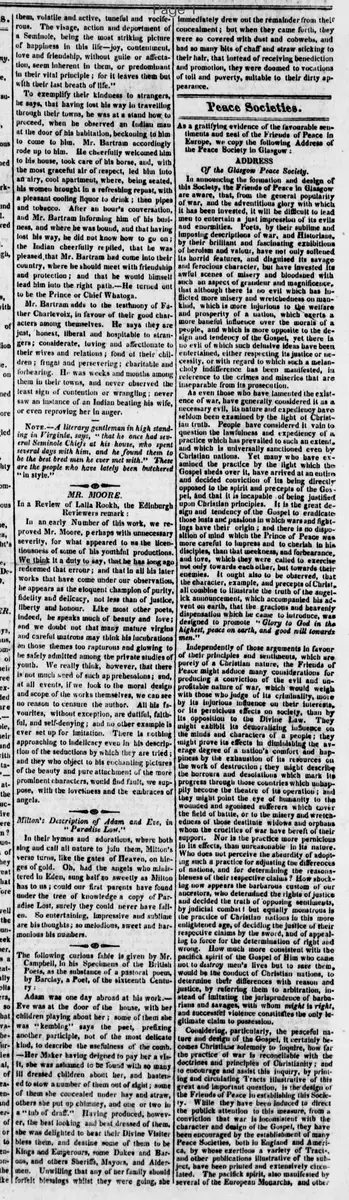
Adam was one day abroad at his work.--Eve was at the door of the house, with her children playing about her; some of them she was "kembing" says the poet, prefixing another participle, not of the most delicate kind, to describe the usefulness of the comb. --Her Maker having deigned to pay her a visit, she was ashamed to be found with so many ill dressed children about her, and hastened to stow a number of them out of sight; some of them she concealed under hay and straw, others she put up chimney, and one or two in a "tub of draff." Having produced, however, the best looking and best dressed of them, she was delighted to hear their Divine Visitor bless them, and destine some of them to be Kings and Emperors, some Dukes and Barons, and others Sheriffs, Mayors, and Aldermen. Unwilling that any of her family should forfeit blessings whilst they were going, she immediately drew out the remainder from their concealment; but when they came forth, they were so covered with dust and cobwebs, and had so many bits of chaff and straw sticking to their hair, that instead of receiving benediction and promotion, they were doomed to vocations of toil and poverty, suitable to their dirty appearance.
Clipping
OCR Quality
Full Text
This is Event 2 of 2. The full text below covers all events in this component.
In their hymns and adorations, where both sing and call all nature to join them, Milton's verse turns, like the gates of Heaven, on hinges of gold. Oh, had the angels who ministered in Eden, sung half so sweetly as Milton has to us; could our first parents have found under the tree of knowledge a copy of Paradise Lost, surely they could never have fallen. So entertaining, impressive and sublime are his thoughts; so melodious, sweet and harmonious his numbers.
The following curious fable is given by Mr. Campbell, in his Specimens of the British Poets, as the substance of a pastoral poem, by Barclay, a Poet, of the sixteenth Century:
Adam was one day abroad at his work.--Eve was at the door of the house, with her children playing about her; some of them she was "kembing" says the poet, prefixing another participle, not of the most delicate kind, to describe the usefulness of the comb. --Her Maker having deigned to pay her a visit, she was ashamed to be found with so many ill dressed children about her, and hastened to stow a number of them out of sight; some of them she concealed under hay and straw, others she put up chimney, and one or two in a "tub of draff." Having produced, however, the best looking and best dressed of them, she was delighted to hear their Divine Visitor bless them, and destine some of them to be Kings and Emperors, some Dukes and Barons, and others Sheriffs, Mayors, and Aldermen. Unwilling that any of her family should forfeit blessings whilst they were going, she immediately drew out the remainder from their concealment; but when they came forth, they were so covered with dust and cobwebs, and had so many bits of chaff and straw sticking to their hair, that instead of receiving benediction and promotion, they were doomed to vocations of toil and poverty, suitable to their dirty appearance.
What sub-type of article is it?
What keywords are associated?
What entities or persons were involved?
Filler Details
Topic
Curious Fable From Barclay's Pastoral Poem About Eve Hiding Her Children
Key Persons
Event Details
Adam was one day abroad at his work.--Eve was at the door of the house, with her children playing about her; some of them she was "kembing" says the poet, prefixing another participle, not of the most delicate kind, to describe the usefulness of the comb. --Her Maker having deigned to pay her a visit, she was ashamed to be found with so many ill dressed children about her, and hastened to stow a number of them out of sight; some of them she concealed under hay and straw, others she put up chimney, and one or two in a "tub of draff." Having produced, however, the best looking and best dressed of them, she was delighted to hear their Divine Visitor bless them, and destine some of them to be Kings and Emperors, some Dukes and Barons, and others Sheriffs, Mayors, and Aldermen. Unwilling that any of her family should forfeit blessings whilst they were going, she immediately drew out the remainder from their concealment; but when they came forth, they were so covered with dust and cobwebs, and had so many bits of chaff and straw sticking to their hair, that instead of receiving benediction and promotion, they were doomed to vocations of toil and poverty, suitable to their dirty appearance.