Thank you for visiting SNEWPapers!
Sign up free
Foreign News
October 20, 1758
The New Hampshire Gazette
Portsmouth, Rockingham County, New Hampshire
What is this article about?
Descriptive account of the Marquiate of Moravia, its boundaries, geography, history, and principal cities Olmutz and Brinn, including their locations, features, and structures.
Clipping
OCR Quality
95%
Excellent
Full Text
An Account of the Marquijate of MORAVIA, and of the principal Places of that Country.
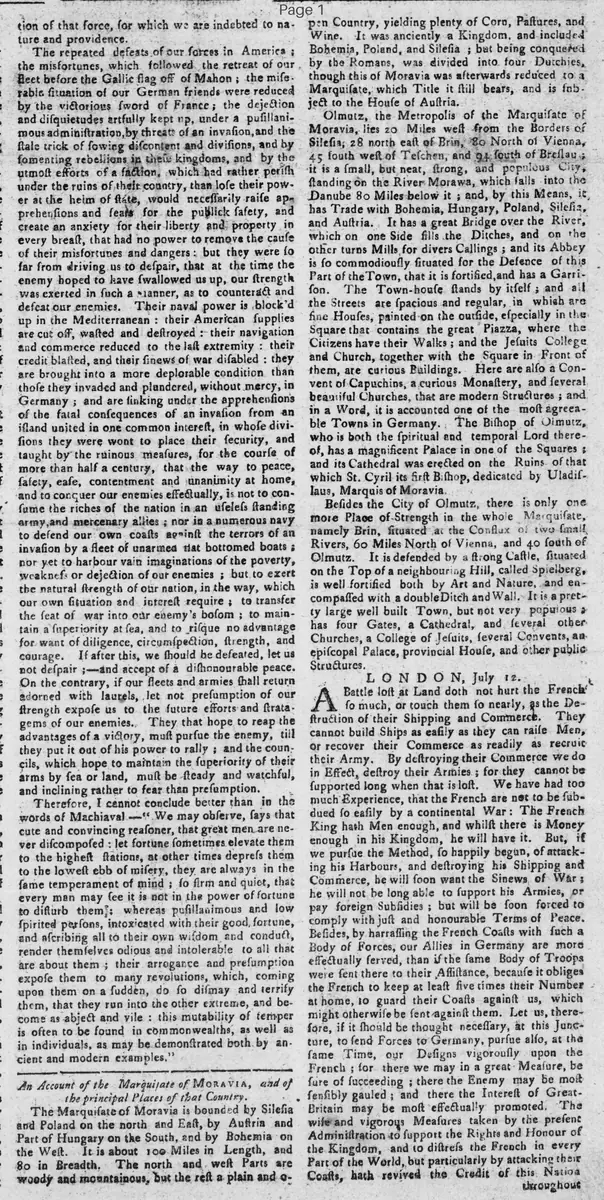
The Marquiate of Moravia is bounded by Sileia and Poland on the north and east, by Austria and part of Hungary on the south, and by Bohemia on the west. It is about 100 miles in length, and 80 in breadth. The north and west parts are woody and mountainous, but the rest a plain and open country, yielding plenty of corn, pastures, and wine. It was anciently a kingdom, and included Bohemia, Poland, and Sileia; but being conquered by the Romans, was divided into four dukedoms, though this of Moravia was afterwards reduced to a marquiate, which title it still bears, and is subject to the House of Austria.
Olmutz, the metropolis of the marquiate of Moravia, lies 20 miles west from the borders of Sileia: 28 north east of Brinn, 80 north of Vienna, 45 south west of Techen, and 94 south of Breslau; it is a small, but neat, strong, and populous city, standing on the river Morawa, which falls into the Danube 80 miles below it: and, by this means, it has trade with Bohemia, Hungary, Poland, Sileia, and Austria. It has a great bridge over the river, which on one side fills the ditches, and on the other turns mills for divers callings; and its abbey is so commodiously situated for the defence of this part of the town, that it is fortified, and has a garrison. The town-house stands by itself; and all the streets are spacious and regular, in which are fine houses, painted on the outside, especially in the square that contains the great piazza, where the citizens have their walks; and the Jesuits college and church, together with the square in front of them, are curious buildings. Here are also a convent of Capuchins, a curious monastery, and several beautiful churches, that are modern structures; and in a word, it is accounted one of the most agreeable towns in Germany. The bishop of Olmutz, who is both the spiritual and temporal lord thereof, has a magnificent palace in one of the squares: and its cathedral was erected on the ruins of that which St. Cyril its first bishop, dedicated by Uladislaus, marquis of Moravia.
Besides the city of Olmutz, there is only one more place of strength in the whole marquiate, namely Brinn, situated at the confluence of two small rivers, 60 miles north of Vienna, and 40 south of Olmutz. It is defended by a strong castle, situated on the top of a neighbouring hill, called Spielberg, is well fortified both by art and nature, and encompassed with a double ditch and wall. It is a pretty large well built town, but not very populous, has four gates, a cathedral, and several other churches, a college of Jesuits, several convents, an episcopal palace, provincial house, and other public structures.
The Marquiate of Moravia is bounded by Sileia and Poland on the north and east, by Austria and part of Hungary on the south, and by Bohemia on the west. It is about 100 miles in length, and 80 in breadth. The north and west parts are woody and mountainous, but the rest a plain and open country, yielding plenty of corn, pastures, and wine. It was anciently a kingdom, and included Bohemia, Poland, and Sileia; but being conquered by the Romans, was divided into four dukedoms, though this of Moravia was afterwards reduced to a marquiate, which title it still bears, and is subject to the House of Austria.
Olmutz, the metropolis of the marquiate of Moravia, lies 20 miles west from the borders of Sileia: 28 north east of Brinn, 80 north of Vienna, 45 south west of Techen, and 94 south of Breslau; it is a small, but neat, strong, and populous city, standing on the river Morawa, which falls into the Danube 80 miles below it: and, by this means, it has trade with Bohemia, Hungary, Poland, Sileia, and Austria. It has a great bridge over the river, which on one side fills the ditches, and on the other turns mills for divers callings; and its abbey is so commodiously situated for the defence of this part of the town, that it is fortified, and has a garrison. The town-house stands by itself; and all the streets are spacious and regular, in which are fine houses, painted on the outside, especially in the square that contains the great piazza, where the citizens have their walks; and the Jesuits college and church, together with the square in front of them, are curious buildings. Here are also a convent of Capuchins, a curious monastery, and several beautiful churches, that are modern structures; and in a word, it is accounted one of the most agreeable towns in Germany. The bishop of Olmutz, who is both the spiritual and temporal lord thereof, has a magnificent palace in one of the squares: and its cathedral was erected on the ruins of that which St. Cyril its first bishop, dedicated by Uladislaus, marquis of Moravia.
Besides the city of Olmutz, there is only one more place of strength in the whole marquiate, namely Brinn, situated at the confluence of two small rivers, 60 miles north of Vienna, and 40 south of Olmutz. It is defended by a strong castle, situated on the top of a neighbouring hill, called Spielberg, is well fortified both by art and nature, and encompassed with a double ditch and wall. It is a pretty large well built town, but not very populous, has four gates, a cathedral, and several other churches, a college of Jesuits, several convents, an episcopal palace, provincial house, and other public structures.
What sub-type of article is it?
Geographical Description
Historical Account
What keywords are associated?
Moravia
Olmutz
Brinn
Austria
Geography
History
Fortifications
What entities or persons were involved?
St. Cyril
Uladislaus
Where did it happen?
Marquiate Of Moravia
Foreign News Details
Primary Location
Marquiate Of Moravia
Key Persons
St. Cyril
Uladislaus
Event Details
The Marquiate of Moravia is described with its boundaries, dimensions, terrain, historical background from ancient kingdom to marquiate under the House of Austria. Olmutz is detailed as the metropolis with its location, river trade, fortifications, buildings, and religious sites. Brinn is noted as the other fortified place with its defenses and structures.