Thank you for visiting SNEWPapers!
Sign up free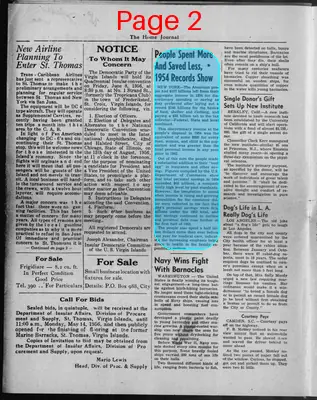
The Home Journal
Charlotte Amalie, Saint Thomas County, Virgin Islands
What is this article about?
In 1954, Americans had record $107B discretionary income after essentials and taxes, averaging $600 per person—higher than pre-1942. Savings hit $18B but fell from 1953; debt rose in 1955; medical spending up $0.5B.
Clipping
OCR Quality
Full Text
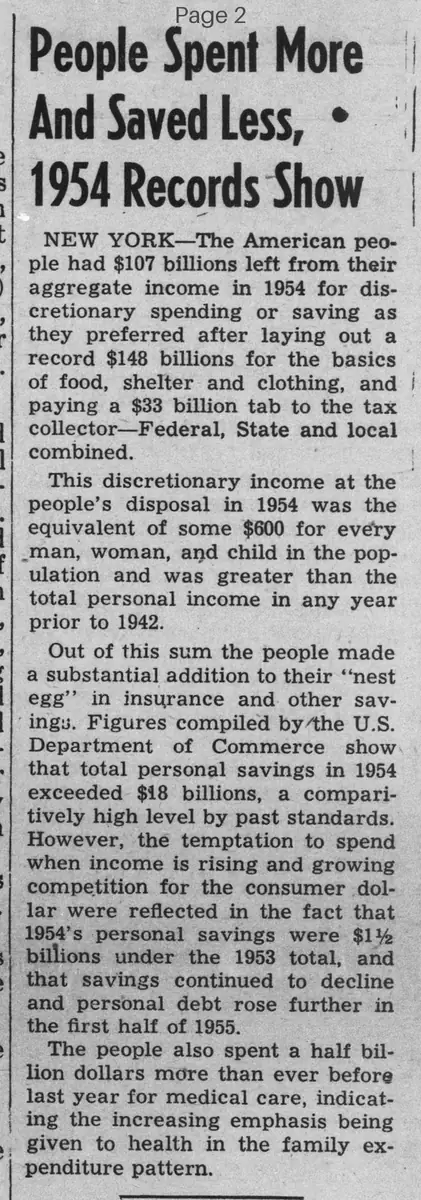
NEW YORK—The American people had $107 billions left from their aggregate income in 1954 for discretionary spending or saving as they preferred after laying out a record $148 billions for the basics of food, shelter and clothing, and paying a $33 billion tab to the tax collector—Federal, State and local combined.
This discretionary income at the people's disposal in 1954 was the equivalent of some $600 for every man, woman, and child in the population and was greater than the total personal income in any year prior to 1942.
Out of this sum the people made a substantial addition to their nest egg in insurance and other savings. Figures compiled by the U.S. Department of Commerce show that total personal savings in 1954 exceeded $18 billions, a comparatively high level by past standards.
However, the temptation to spend when income is rising and growing competition for the consumer dollar were reflected in the fact that 1954's personal savings were $11.5 billions under the 1953 total, and that savings continued to decline and personal debt rose further in the first half of 1955.
The people also spent a half billion dollars more than ever before last year for medical care, indicating the increasing emphasis being given to health in the family expenditure pattern.
What sub-type of article is it?
What keywords are associated?
Where did it happen?
Domestic News Details
Primary Location
New York
Event Date
1954
Outcome
total personal savings exceeded $18 billions, $11.5 billions under 1953 total; personal debt rose in first half of 1955; spent half billion more on medical care.
Event Details
American people had $107 billions discretionary income after $148 billions for basics and $33 billions in taxes; equivalent to $600 per person, greater than pre-1942 incomes; spent more and saved less amid rising income and competition.