Thank you for visiting SNEWPapers!
Sign up free
Story
December 2, 1834
The Daily Cincinnati Republican, And Commercial Register
Cincinnati, Hamilton County, Ohio
What is this article about?
Anecdotes about actor George Frederick Cooke's drunken, egotistical behavior, his keeper Mr. Beverly's control during a Brighton performance where Cooke escapes but is recaptured, and Cooke's jealous marriage to Miss Daniells ending in her rescue and divorce.
Clipping
OCR Quality
98%
Excellent
Full Text
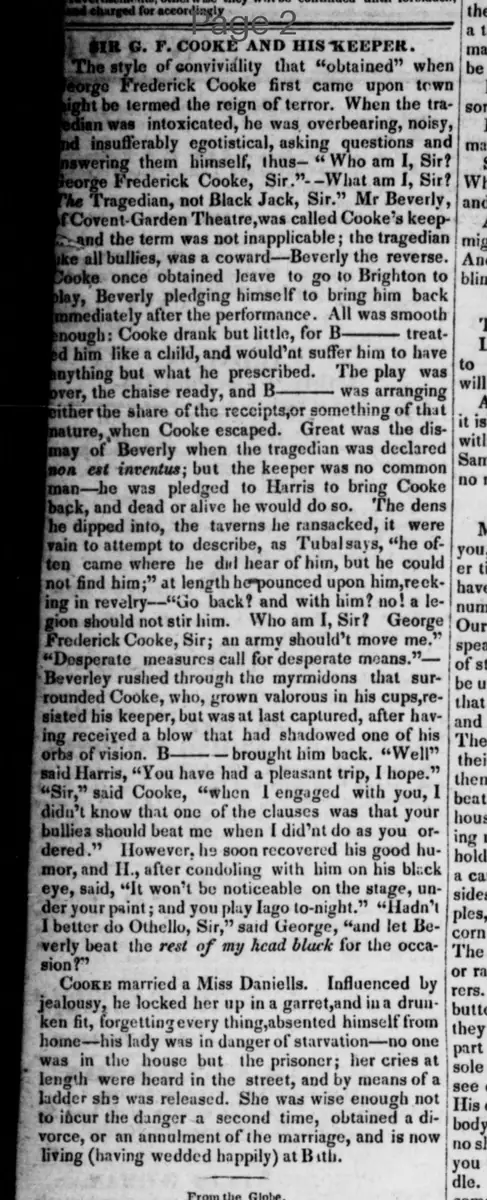
MR. G. F. COOKE AND HIS KEEPER.
The style of conviviality that 'obtained' when George Frederick Cooke first came upon town might be termed the reign of terror. When the tragedian was intoxicated, he was overbearing, noisy, and insufferably egotistical, asking questions and answering them himself, thus—'Who am I, Sir? George Frederick Cooke, Sir.'—'What am I, Sir? The Tragedian, not Black Jack, Sir.' Mr. Beverly, of Covent-Garden Theatre, was called Cooke's keeper—and the term was not inapplicable; the tragedian like all bullies, was a coward—Beverly the reverse.
Cooke once obtained leave to go to Brighton to play, Beverly pledging himself to bring him back immediately after the performance. All was smooth enough: Cooke drank but little, for Beverly treated him like a child, and would not suffer him to have anything but what he prescribed. The play was over, the chaise ready, and Beverly was arranging either the share of the receipts, or something of that nature, when Cooke escaped. Great was the dismay of Beverly when the tragedian was declared non est inventus; but the keeper was no common man—he was pledged to Harris to bring Cooke back, and dead or alive he would do so. The dens he dipped into, the taverns he ransacked, it were vain to attempt to describe, as Tubal says, 'he often came where he did hear of him, but he could not find him;' at length he pounced upon him, recking in revelry—'Go back? and with him? no! a legion should not stir him. Who am I, Sir? George Frederick Cooke, Sir; an army shouldn't move me.'
'Desperate measures call for desperate means.'—Beverly rushed through the myrmidons that surrounded Cooke, who, grown valorous in his cups, resisted his keeper, but was at last captured, after having received a blow that had shadowed one of his orbs of vision. Beverly brought him back. 'Well,' said Harris, 'You have had a pleasant trip, I hope.' 'Sir,' said Cooke, 'when I engaged with you, I didn't know that one of the clauses was that your bullies should beat me when I didn't do as you ordered.' However, he soon recovered his good humor, and Beverly, after condoling with him on his black eye, said, 'It won't be noticeable on the stage, under your paint; and you play Iago to-night.' 'Hadn't I better do Othello, Sir,' said George, 'and let Beverly beat the rest of my head black for the occasion?'
Cooke married a Miss Daniells. Influenced by jealousy, he locked her up in a garret, and in a drunken fit, forgetting everything, absented himself from home—his lady was in danger of starvation—no one was in the house but the prisoner; her cries at length were heard in the street, and by means of a ladder she was released. She was wise enough not to incur the danger a second time, obtained a divorce, or an annulment of the marriage, and is now living (having wedded happily) at Bath.
The style of conviviality that 'obtained' when George Frederick Cooke first came upon town might be termed the reign of terror. When the tragedian was intoxicated, he was overbearing, noisy, and insufferably egotistical, asking questions and answering them himself, thus—'Who am I, Sir? George Frederick Cooke, Sir.'—'What am I, Sir? The Tragedian, not Black Jack, Sir.' Mr. Beverly, of Covent-Garden Theatre, was called Cooke's keeper—and the term was not inapplicable; the tragedian like all bullies, was a coward—Beverly the reverse.
Cooke once obtained leave to go to Brighton to play, Beverly pledging himself to bring him back immediately after the performance. All was smooth enough: Cooke drank but little, for Beverly treated him like a child, and would not suffer him to have anything but what he prescribed. The play was over, the chaise ready, and Beverly was arranging either the share of the receipts, or something of that nature, when Cooke escaped. Great was the dismay of Beverly when the tragedian was declared non est inventus; but the keeper was no common man—he was pledged to Harris to bring Cooke back, and dead or alive he would do so. The dens he dipped into, the taverns he ransacked, it were vain to attempt to describe, as Tubal says, 'he often came where he did hear of him, but he could not find him;' at length he pounced upon him, recking in revelry—'Go back? and with him? no! a legion should not stir him. Who am I, Sir? George Frederick Cooke, Sir; an army shouldn't move me.'
'Desperate measures call for desperate means.'—Beverly rushed through the myrmidons that surrounded Cooke, who, grown valorous in his cups, resisted his keeper, but was at last captured, after having received a blow that had shadowed one of his orbs of vision. Beverly brought him back. 'Well,' said Harris, 'You have had a pleasant trip, I hope.' 'Sir,' said Cooke, 'when I engaged with you, I didn't know that one of the clauses was that your bullies should beat me when I didn't do as you ordered.' However, he soon recovered his good humor, and Beverly, after condoling with him on his black eye, said, 'It won't be noticeable on the stage, under your paint; and you play Iago to-night.' 'Hadn't I better do Othello, Sir,' said George, 'and let Beverly beat the rest of my head black for the occasion?'
Cooke married a Miss Daniells. Influenced by jealousy, he locked her up in a garret, and in a drunken fit, forgetting everything, absented himself from home—his lady was in danger of starvation—no one was in the house but the prisoner; her cries at length were heard in the street, and by means of a ladder she was released. She was wise enough not to incur the danger a second time, obtained a divorce, or an annulment of the marriage, and is now living (having wedded happily) at Bath.
What sub-type of article is it?
Biography
Family Drama
Curiosity
What themes does it cover?
Madness
Family
Misfortune
What keywords are associated?
George Frederick Cooke
Tragedian
Drunken Behavior
Keeper Beverly
Brighton Escape
Jealous Marriage
Divorce
What entities or persons were involved?
George Frederick Cooke
Mr. Beverly
Miss Daniells
Harris
Where did it happen?
Covent Garden Theatre, Brighton, Bath
Story Details
Key Persons
George Frederick Cooke
Mr. Beverly
Miss Daniells
Harris
Location
Covent Garden Theatre, Brighton, Bath
Story Details
Anecdotes of tragedian George Frederick Cooke's intoxicated egotism and cowardice, managed by keeper Mr. Beverly; an escape and recapture in Brighton after a performance, involving a fight and black eye; and Cooke's jealous locking up of wife Miss Daniells, leading to her starvation risk, rescue, and subsequent divorce.