Thank you for visiting SNEWPapers!
Sign up free
Story
December 12, 1928
The Milwaukee Leader
Milwaukee, Milwaukee County, Wisconsin
What is this article about?
An article discusses how machinery displaces labor across industries, focusing on the printing sector where the new 'teletypesetter' machine in Rochester, N.Y., automates type-setting, threatening jobs and union control, advocating for collective ownership.
Clipping
OCR Quality
98%
Excellent
Full Text
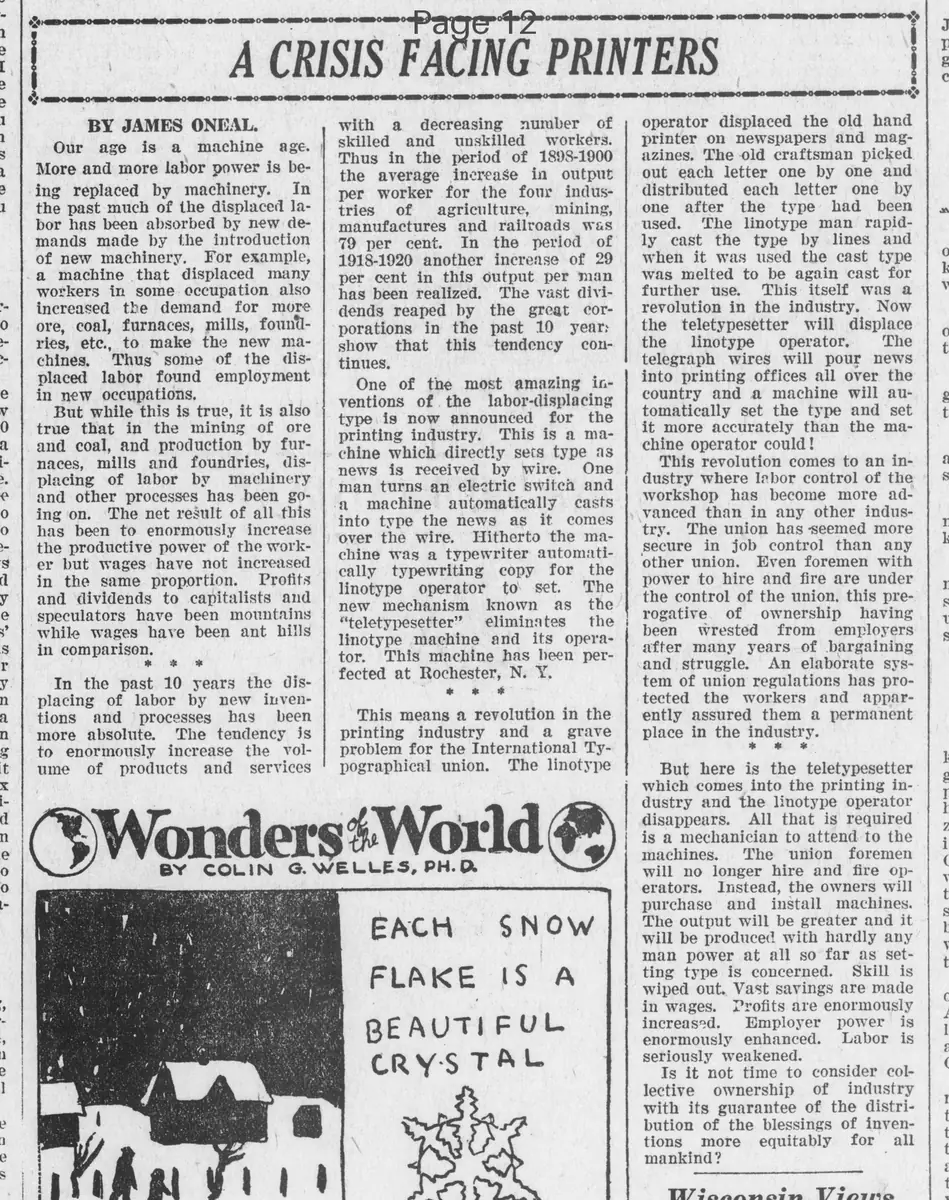
A CRISIS FACING PRINTERS
Our age is a machine age.
More and more labor power is being replaced by machinery. In the past much of the displaced labor has been absorbed by new demands made by the introduction of new machinery. For example, a machine that displaced many workers in some occupation also increased the demand for more ore, coal, furnaces, mills, foundries, etc., to make the new machines. Thus some of the displaced labor found employment in new occupations.
But while this is true, it is also true that in the mining of ore and coal, and production by furnaces, mills and foundries, displacing of labor by machinery and other processes has been going on. The net result of all this has been to enormously increase the productive power of the worker but wages have not increased in the same proportion. Profits and dividends to capitalists and speculators have been mountains while wages have been ant hills in comparison.
with a decreasing number of skilled and unskilled workers.
Thus in the period of 1890-1900 the average increase in output per worker for the four industries of agriculture, mining, manufactures and railroads was 79 per cent. In the period of 1918-1920 another increase of 29 per cent in this output per man has been realized. The vast dividends reaped by the great corporations in the past 10 years show that this tendency continues.
One of the most amazing inventions of the labor-displacing type is now announced for the printing industry. This is a machine which directly sets type as news is received by wire. One man turns an electric switch and a machine automatically casts into type the news as it comes over the wire. Hitherto the machine was a typewriter automatically typewriting copy for the linotype operator to set. The new mechanism known as the "teletypesetter" eliminates the linotype machine and its operator. This machine has been perfected at Rochester, N. Y.
In the past 10 years the displacing of labor by new inventions and processes has been more absolute. The tendency is to enormously increase the volume of products and services.
This means a revolution in the printing industry and a grave problem for the International Typographical union. The linotype
operator displaced the old hand printer on newspapers and magazines. The old craftsman picked out each letter one by one and distributed each letter one by one after the type had been used. The linotype man rapidly cast the type by lines and when it was used the cast type was melted to be again cast for further use. This itself was a revolution in the industry. Now the teletypesetter will displace the linotype operator.
The telegraph wires will pour news into printing offices all over the country and a machine will automatically set the type and set it more accurately than the machine operator could!
This revolution comes to an industry where labor control of the workshop has become more advanced than in any other industry. The union has seemed more secure in job control than any other union. Even foremen with power to hire and fire are under the control of the union, this prerogative of ownership having been wrested from employers after many years of bargaining and struggle. An elaborate system of union regulations has protected the workers and apparently assured them a permanent place in the industry.
But here is the teletypesetter which comes into the printing industry and the linotype operator disappears. All that is required is a mechanician to attend to the machines. The union foremen will no longer hire and fire operators. Instead, the owners will purchase and install machines. The output will be greater and it will be produced with hardly any man power at all so far as setting type is concerned. Skill is wiped out. Vast savings are made in wages. Profits are enormously increased.
Employer power is enormously enhanced. Labor is seriously weakened.
Is it not time to consider collective ownership of industry with its guarantee of the distribution of the blessings of inventions more equitably for all mankind?
Our age is a machine age.
More and more labor power is being replaced by machinery. In the past much of the displaced labor has been absorbed by new demands made by the introduction of new machinery. For example, a machine that displaced many workers in some occupation also increased the demand for more ore, coal, furnaces, mills, foundries, etc., to make the new machines. Thus some of the displaced labor found employment in new occupations.
But while this is true, it is also true that in the mining of ore and coal, and production by furnaces, mills and foundries, displacing of labor by machinery and other processes has been going on. The net result of all this has been to enormously increase the productive power of the worker but wages have not increased in the same proportion. Profits and dividends to capitalists and speculators have been mountains while wages have been ant hills in comparison.
with a decreasing number of skilled and unskilled workers.
Thus in the period of 1890-1900 the average increase in output per worker for the four industries of agriculture, mining, manufactures and railroads was 79 per cent. In the period of 1918-1920 another increase of 29 per cent in this output per man has been realized. The vast dividends reaped by the great corporations in the past 10 years show that this tendency continues.
One of the most amazing inventions of the labor-displacing type is now announced for the printing industry. This is a machine which directly sets type as news is received by wire. One man turns an electric switch and a machine automatically casts into type the news as it comes over the wire. Hitherto the machine was a typewriter automatically typewriting copy for the linotype operator to set. The new mechanism known as the "teletypesetter" eliminates the linotype machine and its operator. This machine has been perfected at Rochester, N. Y.
In the past 10 years the displacing of labor by new inventions and processes has been more absolute. The tendency is to enormously increase the volume of products and services.
This means a revolution in the printing industry and a grave problem for the International Typographical union. The linotype
operator displaced the old hand printer on newspapers and magazines. The old craftsman picked out each letter one by one and distributed each letter one by one after the type had been used. The linotype man rapidly cast the type by lines and when it was used the cast type was melted to be again cast for further use. This itself was a revolution in the industry. Now the teletypesetter will displace the linotype operator.
The telegraph wires will pour news into printing offices all over the country and a machine will automatically set the type and set it more accurately than the machine operator could!
This revolution comes to an industry where labor control of the workshop has become more advanced than in any other industry. The union has seemed more secure in job control than any other union. Even foremen with power to hire and fire are under the control of the union, this prerogative of ownership having been wrested from employers after many years of bargaining and struggle. An elaborate system of union regulations has protected the workers and apparently assured them a permanent place in the industry.
But here is the teletypesetter which comes into the printing industry and the linotype operator disappears. All that is required is a mechanician to attend to the machines. The union foremen will no longer hire and fire operators. Instead, the owners will purchase and install machines. The output will be greater and it will be produced with hardly any man power at all so far as setting type is concerned. Skill is wiped out. Vast savings are made in wages. Profits are enormously increased.
Employer power is enormously enhanced. Labor is seriously weakened.
Is it not time to consider collective ownership of industry with its guarantee of the distribution of the blessings of inventions more equitably for all mankind?
What sub-type of article is it?
Labor Displacement
Technological Innovation
What themes does it cover?
Misfortune
Fortune Reversal
What keywords are associated?
Labor Displacement
Printing Industry
Teletypesetter
Union Challenges
Machine Age
Worker Productivity
What entities or persons were involved?
International Typographical Union
Where did it happen?
Rochester, N. Y.
Story Details
Key Persons
International Typographical Union
Location
Rochester, N. Y.
Event Date
Past 10 Years
Story Details
Machinery displaces labor in industries, with the teletypesetter automating type-setting in printing, eliminating linotype operators and threatening union control, leading to calls for collective ownership.