Thank you for visiting SNEWPapers!
Sign up free
Letter to Editor
April 13, 1805
Virginia Argus
Richmond, Virginia
What is this article about?
A Richmond resident criticizes a monopoly by select dray owners who control most cartage business, excluding others who pay taxes, harming city revenue and fairness. Urges the Common Hall to regulate for equitable load distribution and security requirements. Signed A Plainman, April 3, 1805.
Clipping
OCR Quality
85%
Good
Full Text
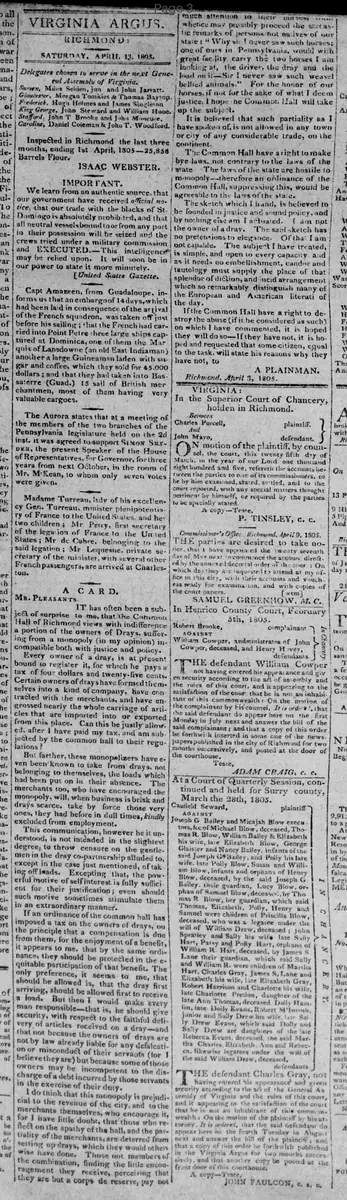
A CARD.
MR. PLEASANTS
IT has often been a subject of surprise to me, that the Common Hall of Richmond views with indifference a portion of the owners of Drays, suffering from a monopoly (in my opinion) incompatible both with justice and policy. Every owner of a dray, is at present bound to register it, for which he pays a tax of four dollars and twenty-five cents. Certain owners of drays have formed themselves into a kind of company, have contracted with the merchants, and have engrossed nearly the whole carriage of articles that are imported into or exported from this place. Can this be justly allowed, after I have paid my tax, and am subjected by the common hall to their regulations?
But farther, these monopolizers have even been known to take from drays, not belonging to themselves, the loads which had been put on in their absence. The merchants too, who have encouraged the monopoly, will, when business is brisk and drays scarce, take by force those very ones, they had before in dull times, kindly excluded from employment.
This communication, however be it understood, is not intended in the slightest degree, to throw censure on the gentlemen in the dray co-partnership alluded to, except in the case just mentioned, of taking off loads. Excepting that, the powerful motive of self-interest is fully sufficient for their justification; even should such motive sometimes stimulate them in an extraordinary manner.
If an ordinance of the common hall has imposed a tax on the owners of drays, on the principle that a compensation is due from them, for the enjoyment of a benefit, it appears to me, that by the same ordinance, they should be protected in the equitable participation of that benefit. The only preference, it seems to me, that should be allowed is, that the dray first arriving, should be allowed first to receive a load. But then I would make every man responsible-that is, he should give security, with respect to the faithful delivery of articles received on a dray-and that not because the owners of drays are not by law already liable for any defalcation or misconduct of their servants (for I believe they are) but because some of those owners may be incompetent to the discharge of a debt incurred by those servants in the exercise of their duty.
I do think that this monopoly is prejudicial to the revenue of the city, and to the merchants themselves, who encourage it, for I have little doubt, that those who reflect on the apathy of the hall, and the partiality of the merchants, are deterred from setting up drays, which they would otherwise have done. Those not members of the combination, finding the little encouragement they receive, perceiving that they are but a corps de reserve, pay not much attention to their nuts, whence may possibly proceed the sarcastic remarks of persons not natives of our state: "I never saw such horses; one of ours in Pennsylvania, would with great facility carry the two horses I am looking at, the driver, the dray and the load on it. Sir I never saw such weasel-bellied animals." For the honor of our horses, if not for the sake of what I deem justice, I hope the Common Hall will take up the subject.
It is believed that such partiality as I have spoken of, is not allowed in any town or city of any considerable trade, on the continent. The Common Hall have a right to make bye laws, not contrary to the laws of the state. The laws of the state are hostile to monopoly--therefore an ordinance of the Common Hall, suppressing this, would be agreeable to the laws of the state.
The sketch which I hand, is believed to be founded in justice and sound policy, and by nothing else am I actuated. I am not the owner of a dray. The said sketch has no pretensions to elegance. Of that I am not capable. The subject I have treated, is simple, and open to every capacity and as it needs no embellishment, candor and tautology must supply the place of that splendor of diction, and lucid arrangement which so remarkably distinguish many of the European and American literati of the day.
If the Common Hall have a right to destroy the abuse (if it be considered as such) on which I have commented, it is hoped they will do so--If they have not, it is hoped and requested that some citizen, equal to the task, will state his reasons why they have not, to
A PLAINMAN.
Richmond, April 3, 1805.
MR. PLEASANTS
IT has often been a subject of surprise to me, that the Common Hall of Richmond views with indifference a portion of the owners of Drays, suffering from a monopoly (in my opinion) incompatible both with justice and policy. Every owner of a dray, is at present bound to register it, for which he pays a tax of four dollars and twenty-five cents. Certain owners of drays have formed themselves into a kind of company, have contracted with the merchants, and have engrossed nearly the whole carriage of articles that are imported into or exported from this place. Can this be justly allowed, after I have paid my tax, and am subjected by the common hall to their regulations?
But farther, these monopolizers have even been known to take from drays, not belonging to themselves, the loads which had been put on in their absence. The merchants too, who have encouraged the monopoly, will, when business is brisk and drays scarce, take by force those very ones, they had before in dull times, kindly excluded from employment.
This communication, however be it understood, is not intended in the slightest degree, to throw censure on the gentlemen in the dray co-partnership alluded to, except in the case just mentioned, of taking off loads. Excepting that, the powerful motive of self-interest is fully sufficient for their justification; even should such motive sometimes stimulate them in an extraordinary manner.
If an ordinance of the common hall has imposed a tax on the owners of drays, on the principle that a compensation is due from them, for the enjoyment of a benefit, it appears to me, that by the same ordinance, they should be protected in the equitable participation of that benefit. The only preference, it seems to me, that should be allowed is, that the dray first arriving, should be allowed first to receive a load. But then I would make every man responsible-that is, he should give security, with respect to the faithful delivery of articles received on a dray-and that not because the owners of drays are not by law already liable for any defalcation or misconduct of their servants (for I believe they are) but because some of those owners may be incompetent to the discharge of a debt incurred by those servants in the exercise of their duty.
I do think that this monopoly is prejudicial to the revenue of the city, and to the merchants themselves, who encourage it, for I have little doubt, that those who reflect on the apathy of the hall, and the partiality of the merchants, are deterred from setting up drays, which they would otherwise have done. Those not members of the combination, finding the little encouragement they receive, perceiving that they are but a corps de reserve, pay not much attention to their nuts, whence may possibly proceed the sarcastic remarks of persons not natives of our state: "I never saw such horses; one of ours in Pennsylvania, would with great facility carry the two horses I am looking at, the driver, the dray and the load on it. Sir I never saw such weasel-bellied animals." For the honor of our horses, if not for the sake of what I deem justice, I hope the Common Hall will take up the subject.
It is believed that such partiality as I have spoken of, is not allowed in any town or city of any considerable trade, on the continent. The Common Hall have a right to make bye laws, not contrary to the laws of the state. The laws of the state are hostile to monopoly--therefore an ordinance of the Common Hall, suppressing this, would be agreeable to the laws of the state.
The sketch which I hand, is believed to be founded in justice and sound policy, and by nothing else am I actuated. I am not the owner of a dray. The said sketch has no pretensions to elegance. Of that I am not capable. The subject I have treated, is simple, and open to every capacity and as it needs no embellishment, candor and tautology must supply the place of that splendor of diction, and lucid arrangement which so remarkably distinguish many of the European and American literati of the day.
If the Common Hall have a right to destroy the abuse (if it be considered as such) on which I have commented, it is hoped they will do so--If they have not, it is hoped and requested that some citizen, equal to the task, will state his reasons why they have not, to
A PLAINMAN.
Richmond, April 3, 1805.
What sub-type of article is it?
Persuasive
Informative
Political
What themes does it cover?
Commerce Trade
Economic Policy
Social Issues
What keywords are associated?
Dray Monopoly
Richmond Common Hall
Tax On Drays
Fair Competition
City Revenue
Merchants Partiality
State Laws Monopoly
What entities or persons were involved?
A Plainman
Mr. Pleasants
Letter to Editor Details
Author
A Plainman
Recipient
Mr. Pleasants
Main Argument
the monopoly by a group of dray owners in richmond is unjust, as it excludes other taxed owners from business, harms city revenue, and should be regulated by the common hall for fair participation and security.
Notable Details
Monopolizers Take Loads From Other Drays
Merchants Exclude Non Monopolists In Dull Times But Use Them When Scarce
Sarcastic Remarks About Poor Horses Due To Neglect
Laws Hostile To Monopoly
Writer Not A Dray Owner