Thank you for visiting SNEWPapers!
Sign up free
The Bottineau Pioneer
Bottineau, Bottineau County, North Dakota
What is this article about?
Ex-President Chester A. Arthur died suddenly on Nov. 18, 1886, in his New York home from apoplexy and paralysis after years of illness. Detailed account of his final hours, family grief, and widespread tributes from officials and press honoring his service.
Merged-components note: Merged sequential components continuing the story on the death of ex-President Chester A. Arthur, including the image due to spatial overlap with the primary text block (bbox overlap calculated: significant intersection in y-range 687-1358 within story's 316-4561).
Clipping
OCR Quality
Full Text
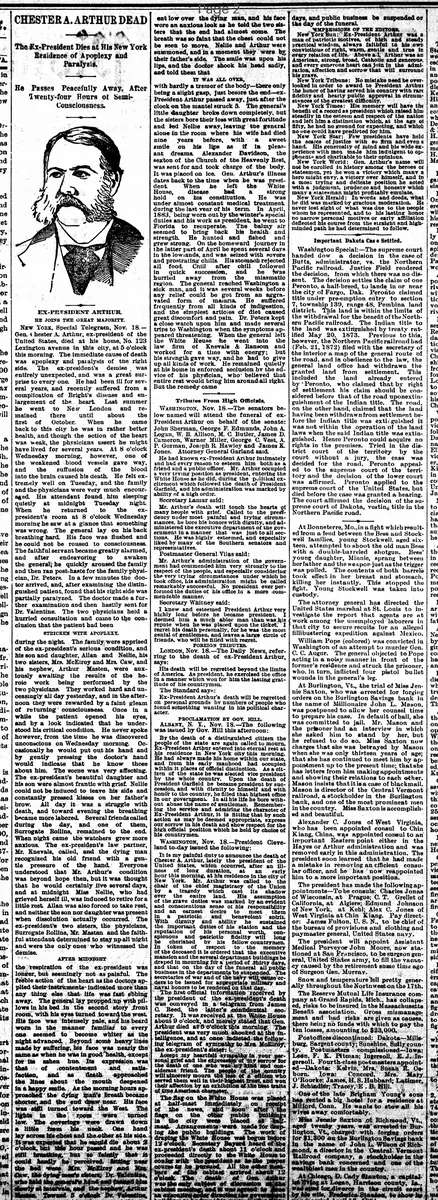
The Ex-President Dies at His New York Residence of Apoplexy and Paralysis.
He Passes Peacefully Away, After Twenty-four Hours of Semi-Consciousness.
EX-PRESIDENT ARTHUR
HE JOINS THE GREAT MAJORITY
New York, Special Telegram, Nov. 18.-
Gen. Chester A. Arthur, ex-president of the United States, died at his home, No. 123 Lexington avenue in this city, at 5 o'clock this morning. The immediate cause of death was apoplexy and paralysis of the right side.
The ex-president's demise was entirely unexpected, and was a great surprise to every one. He had been ill for several years, and recently suffered from a complication of Bright's disease and enlargement of the heart. Last summer he went to New London and remained there until about the first of October. When he came back to this city he was in rather better health, and though the action of the heart was weak, the physicians assert he might have lived for several years. At 8 o'clock Wednesday morning, however, one of the weakened blood vessels gave way, and the suffusion of the blood into the brain caused his death. He felt extremely well on Tuesday, and the family and the physicians were very much encouraged. His attendant found him sleeping quietly at midnight Tuesday night. When he returned to the ex-president's room at 8 o'clock Wednesday morning he saw at a glance that something was wrong. The general lay on his back breathing hard. His face was flushed and he could not be roused to consciousness. The faithful servant became greatly alarmed, and after endeavoring to awaken the general, he quickly aroused the family and then ran post-haste for the family physician, Dr. Peters. In a few minutes the doctor arrived, and, after examining the distinguished patient, found that his right side was partially paralyzed. The doctor made a further examination and then hastily sent for Dr. Valentine. The two physicians held a hurried consultation and came to the conclusion that the patient had been STRICKEN WITH APOPLEXY during the night. The family were apprised of the ex-president's serious condition, and his son and daughter, Allan and Nellie, his two sisters, Mrs. McElroy and Mrs. Caw, and his nephew, Arthur Masten, were anxiously awaiting the results of the heroic work being performed by the two physicians. They worked hard and unceasingly all day yesterday, and in the afternoon they were rewarded by a faint gleam of returning consciousness. Once in a while the patient opened his eyes, and by a look indicated that he understood his critical condition. He never spoke, however, from the time he was discovered unconscious on Wednesday morning. Occasionally he would put out his hand and by gently pressing the doctor's hand would indicate that he knew those about him. The scene was very affecting. The ex-president's beautiful daughter and his son were almost frantic with grief. Nellie could not be induced to leave his side and constantly pressed kisses on her father's brow. All day it was a struggle with death, and toward evening the breathing became more labored. Several friends called during the day, and one of them, Surrogate Rollins, remained to the end. When night came the watchers grew more anxious. The ex-president's law partner, Mr. Knevals, called, and the dying man recognized his old friend with a gentle pressure of the hand. Everyone understood that Mr. Arthur's condition was beyond hope then, but it was thought that he would certainly live several days, and at midnight Miss Nellie, who had grieved herself ill, was induced to retire for a little rest. Allan was also forced to take rest, and neither the son nor daughter was present when dissolution actually occurred. The ex-president's two sisters, the physicians, Surrogate Rollins, Mr. Masten and the faithful attendant determined to stay up all night and were the only ones who witnessed the demise.
AFTER MIDNIGHT the respiration of the ex-president was longer, but seemingly not as painful. The feeble action of the heart as the doctors applied their instruments indicated more than anything else that life was fast ebbing away. The general lay propped up with pillows in his bed in the second story front room, with his eyes turned toward the west. His face was intensely pale, and his beard, worn in the manner familiar to everyone, seemed to become whiter as the night advanced. Beyond some heavy lines made by suffering, his face was nearly the same as when he was in good health, except for its ashen hue. Its expression was that of contentment and satisfaction, and as death approached the lines about the mouth deepened in a happy smile. As the morning hours approached the dying man's breath became shorter and the end drew near. His face was still turned toward the West. The lights in the room were turned low. The coverings were drawn down a little from his neck. One hand lay across his chest and the other at his side. It was expected that he would die. About 5 o'clock his last hour passed and he was still breathing, but so faintly that it could hardly be perceived.
A gentle glow fell over the dying man, and his face wore an anxious look as he told the two sisters that the end had almost come. The breath was so faint that the chest could not be seen to move. Nellie and Arthur were summoned, and in a moment they were by their father's side. The smile was upon his lips, and the doctor shook his head sadly and told them that IT WAS ALL OVER, with hardly a tremor of the body—there only being a slight gasp, just before the end—ex-President Arthur passed away, just after the clock on the mantel struck 5. The general's little daughter broke down completely, but the sisters bore their loss with great fortitude and led Nellie away, leaving the general alone in the room where his wife had died nine years before, with a sweet smile on his lips as if in pleasant dreams.
Alexander Davidson, the sexton of the Church of the Heavenly Rest, was sent for and took charge of the body. It was placed on ice.
Gen. Arthur's illness dates back to the time when he was president. When he left the White House, disease had a strong hold on his constitution. He was under almost constant medical treatment during the last year of his term. In April 1883, being worn out by the winter's special duties and his work as president, he went to Florida to recuperate. The balmy air seemed to bring back his health and strength. He hunted and fished and grew strong. On the homeward journey in the latter part of April he spent several days in the lowlands, and was seized with severe and prostrating chills. His stomach rejected all food. Chill after chill followed in quick succession, and he was hurried away from the miasmatic region. The general reached Washington a sick man, and it was several weeks before any relief could be got from an aggravated form of malaria. He suffered frequently from all kinds of indigestion, and the simplest articles of diet caused great discomfort and pain. Dr. Peters kept a close watch upon him and made several trips to Washington when the symptoms appeared threatening. When the general left the White House he went into the law firm of Knevals & Ransom and worked for a time with energy, but his strength gave way, and he had to give up all kinds of work. He remained quietly at his home in enforced seclusion by the advice of his physician, who believed that entire rest would bring him around all right. But the remedy came too late.
Tributes From High Officials.
Washington, Nov. 18.—The senators below named will attend the funeral of ex-President Arthur on behalf of the senate: John Sherman, George F. Edmunds, John A. Logan, W. B. Allison, M. C. Butler, James D. Cameron, Warner Miller, George C. Vest, A. P. Gorman, Joseph R. Hawley and James K. Jones. Attorney General Garland said: He had known ex-President Arthur intimately and had every reason to esteem him both as a friend and a public officer. Mr. Arthur occupied a very trying position as president, entering the White House as he did, during the political excitement which followed the death of President Garfield, and his administration was marked by ability of a high order.
Secretary Lamar said: Mr. Arthur's death will touch the hearts of many people with grief. Called to the presidency under most painful and trying circumstances, he bore his honors with dignity, and administered the executive department of the government in a manner that was just to all sections. He was highly esteemed, and especially liked by many of the Southern senators and representatives.
Postmaster General Vilas said: Mr. Arthur's administration of the government had commended him very strongly to the respect of the people, and especially considering the very trying circumstances under which he took office, his administration might be called remarkably successful. No president ever performed the duties of his office in a more commendable manner.
Secretary Whitney said: I knew and esteemed President Arthur very highly long before he became president. I deemed him a much abler man than was his repute when he was placed upon the ticket. I regret his death personally, for he was the most genial of gentlemen, and leaves a large circle of friends, who will be filled with regret.
FOREIGN TRIBUTES
London, Nov. 18.—The Daily News, referring to the death of ex-President Arthur, says: His death will be regretted beyond the limits of America. As president, he exercised the office in a manner which won for him the lasting gratitude of his countrymen.
The Standard says: Ex-President Arthur's death will be regretted on personal grounds by numbers of people who found something wanting in his political character.
PROCLAMATION BY GOV. HILL
Albany, N. Y., Nov. 18.—The following was issued by Gov. Hill this afternoon: By the death of a distinguished citizen the people of the state are again called to mourn. Ex-President Arthur entered into eternal rest at his residence in New York city this morning. He had always made his home within our state, and from his early manhood had occupied within it places of official distinction. As a citizen of the state he was elected vice president by the whole country. Upon the death of President Garfield he became president by succession, and with dignity to himself and with honor to the country, he filled that highest office in our government. In all his life he bore without abuse the name of gentleman. Remembering the service and admiring the character of Ex-President Arthur, it is fitting that by such action as may be deemed appropriate, express our sorrow in his death and show respect for the high official position which he held by choice of his countrymen.
Washington, Nov. 18.—President Cleveland to-day issued the following: It is my painful duty to announce the death of Chester A. Arthur, lately the president of the United States, which occurred, after an illness of long duration, at an early hour this morning, at his residence in the city of New York. Mr. Arthur was called to the chair of the chief magistracy of the Union by a tragedy which cast its shadow over the entire land. His assumption of the grave duties was marked by an evident and conscientious sense of his responsibility and an earnest desire to meet them in a patriotic and benevolent spirit. With dignity and ability he sustained the important duties of his station and the reputation of his personal worth. Conspicuous and patriotic fidelity will long be cherished by his fellow countrymen. In token of respect to the memory of the deceased it is ordered that the executive mansion and the several department buildings be draped in mourning for a period of thirty days, and that on the day of the funeral all public business in the departments be suspended. The secretaries of war and of the navy will cause orders to be issued for appropriate military and naval honors to be rendered on that day.
The first official information received by the president of the ex-president's death was conveyed in a telegram from James C. Reed, the latter's confidential secretary. It was received at the White House about 9 o'clock, and merely stated that Gen. Arthur died at 5 o'clock this morning. The president was very much shocked at the intelligence, and at once indited the following telegram of sympathy to Mrs. McElroy, the ex-president's sister: Accept my heartfelt sympathy in your personal grief and the expression of my sorrow for the death of one who was my kind and considerate friend. The people of the country will sincerely mourn the loss of a citizen who served them well in their highest trust, and won their affection by an exhibition of the best traits of true American character.
The flag on the White House was placed at half-mast immediately on receipt of the news, and soon after the flags on the other public buildings in the city were at half-mast. Arrangements were made for draping the public buildings. The work draping the White House was begun about 12 o'clock.
The president received the news of the ex-president's death about 11 o'clock. A number of cabinet officers called to condole with him on the sad event.
The death of Gen. Arthur
thirty days, and public business be suspended on the day of the funeral.
IMPRESSIONS OF THE EDITORS.
A New York Sun: Ex-President Arthur was a man of patriotic motives, of high and steady practical wisdom, always faithful to his own conviction of right, warm, gentle and true in every relation of life. Above all, Arthur was an American, strong, broad, Catholic and generous, and every generous heart can join in the admiration, affection and sorrow that will surround his grave.
New York Tribune: No mistake need be overlooked in order to award to President Arthur the honor of having served his country with rare fidelity and hearty public approval in circumstances of the greatest difficulty.
New York Times: His memory will have the benefit of a record as president which raised him steadily in the esteem and respect of the nation and left him a distinction which, at the age of fifty, he had no ground for expecting, and which no one could have predicted for him.
New York Star: Few presidents have held the scales of justice with so firm and even a hand. His generosity of mind and his wide experience with men made him indulgent to opponents and charitable to their opinions.
New York World: Gen. Arthur's name will not be enrolled in history among the heroes or statesmen, yet he won a victory which many a hero might envy, a victory over himself, and in a most trying and delicate position he acted with a judgment, prudence and honesty which many a statesman might profitably emulate.
New York Herald: In words and deeds, what he did was marked by gracious moderation. He never lost sight of what was due to the people whom he represented, and to his lasting honor no narrow personal motives or early affiliations deflected his course from the straight and high-minded path he had determined to follow.
What sub-type of article is it?
What themes does it cover?
What keywords are associated?
What entities or persons were involved?
Where did it happen?
Story Details
Key Persons
Location
New York City, No. 123 Lexington Avenue
Event Date
Nov. 18
Story Details
Ex-President Chester A. Arthur died at 5 a.m. on November 18 from apoplexy and paralysis after a stroke while sleeping. He had been ill with Bright's disease and heart enlargement. Family and physicians attended him during his final 24 hours of semi-consciousness. Tributes from officials, newspapers, and President Cleveland praised his dignified administration.