Thank you for visiting SNEWPapers!
Sign up free
Literary
May 7, 1762
The New Hampshire Gazette
Portsmouth, Rockingham County, New Hampshire
What is this article about?
An essay emphasizing that the clergy's exemplary conduct outweighs rhetorical preaching in teaching moral and religious truths, supported by Latin quotes, Cicero, and biblical references to Timothy.
Clipping
OCR Quality
95%
Excellent
Full Text
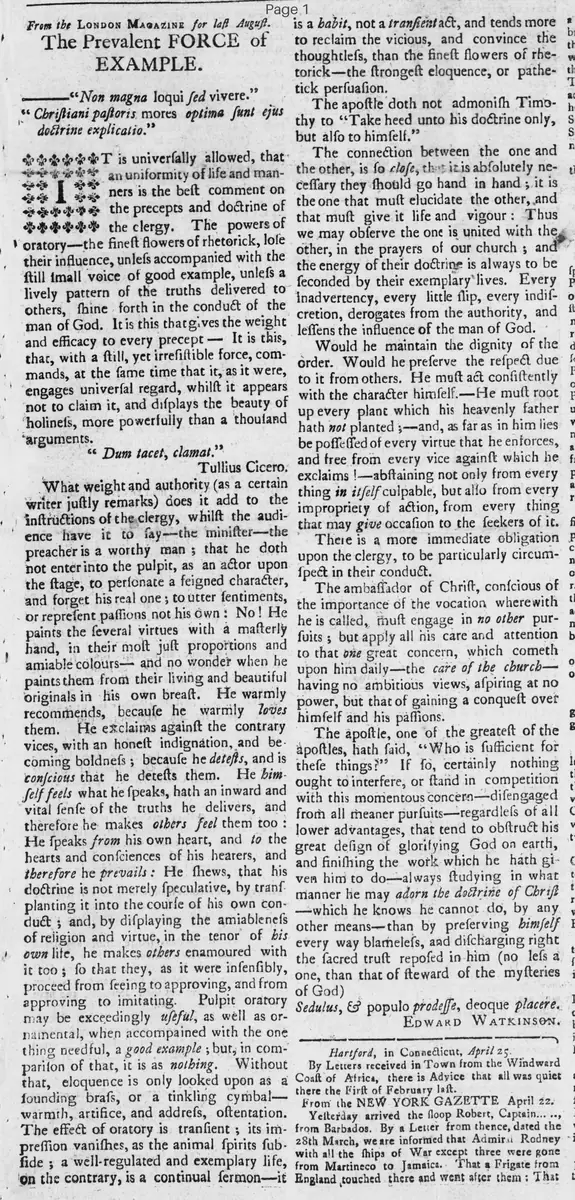
From the London Magazine for last August.
The Prevalent Force of
EXAMPLE.
"Non magna loqui sed vivere."
"Christiani pastoris mores optima sunt ejus
1*
doctrine explicatio."
It is universally allowed, that
an uniformity of life and manners
is the best comment on
the precepts and doctrine of
goodness the clergy. The powers of
oratory--the finest flowers of rhetorick, lose
their influence, unless accompanied with the
still small voice of good example, unless a
lively pattern of the truths delivered to
others, shine forth in the conduct of the
man of God. It is this that gives the weight
and efficacy to every precept - It is this.
that, with a still, yet irresistible force, com-
mands, at the same time that it, as it were,
engages universal regard, whilst it appears
not to claim it, and displays the beauty of
holiness, more powerfully than a thousand
arguments.
"Dum tacet, clamat."
Tullius Cicero.
What weight and authority (as a certain
writer justly remarks) does it add to the
instructions of the clergy, whilst the audi-
ence have it to say-the minister--the
preacher is a worthy man ; that he doth
not enter into the pulpit, as an actor upon
the stage, to personate a feigned character,
and forget his real one ; to utter sentiments,
or represent passions not his own : No ! He
paints the several virtues with a masterly
hand, in their most just proportions and
amiable colours-- and no wonder when he
paints them from their living and beautiful
originals in his own breast. He warmly
recommends, because he warmly loves
them. He exclaims against the contrary
vices, with an honest indignation, and be-
coming boldness ; because he detests, and is
conscious that he detests them. He him-
self feels what he speaks, hath an inward and
vital sense of the truths he delivers. and
therefore he makes others feel them too :
He speaks from his own heart, and to the
hearts and consciences of his hearers, and
therefore he prevails: He shews, that his
doctrine is not merely speculative, by trans-
planting it into the course of his own con-
duct ; and, by displaying the amiableness
of religion and virtue, in the tenor of his
own life, he makes others enamoured with
it too ; so that they, as it were insensibly,
proceed from seeing to approving, and from
approving to imitating. Pulpit oratory
may be exceedingly useful, as well as or-
namelital, when accompanied with the one
thing needful, a good example ; but, in com-
parison of that, it is as nothing. Without
that, eloquence is only looked upon as a
sounding brass, or a tinkling cymbal--
warmth, artifice, and address, ostentation.
The effect of oratory is transient ; its im-
pression vanishes, as the animal spirits sub-
side ; a well-regulated and exemplary life,
on the contrary, is a continual sermon--it
is a habit, not a transient act. and tends more
to reclaim the vicious, and convince the
thoughtless, than the finest flowers of rhe-
torick--the strongest eloquence, or pathe-
tick persuasion.
The apostle doth not admonish Timo-
thy to "Take heed unto his doctrine only,
but also to himself."
The connection between the one and
the other. is so close, that it is absolutely ne-
cessary they should go hand in hand ; it is
the one that must elucidate the other, and
that must give it life and vigour : Thus
we may observe the one is united with the
other, in the prayers of our church ; and
the energy of their doctrine is always to be
seconded by their exemplary lives. Every
inadvertency, every little slip, every indis-
cretion, derogates from the authority, and
lessens the influence of the man of God.
Would he maintain the dignity of the
order. Would he preserve the respect due
to it from others. He must act consistently
with the character himself.He must root
up every plant which his heavenly father
hath not planted ;--and, as far as in him lies
be possessed of every virtue that he enforces,
and free from every vice against which he
exclaims !--abstaining not only from every
thing in itself culpable, but also from every
impropriety of action, from every thing
that may give occasion to the seekers of it.
There is a more immediate obligation
upon the clergy, to be particularly circum-
spect in their conduct.
The ambassador of Christ. conscious of
the importance of the vocation wherewith
he is called, must engage in no other pur-
suits ; but apply all his care and attention
to that one great concern, which cometh
upon him daily--the care of the church--
having no ambitious views, aspiring at no
power, but that of gaining a conquest over
himself and his passions.
The apostle, one of the greatest of the
apostles, hath said, " Who is sufficient for
these things?" If so, certainly nothing
ought to interfere, or stand in competition
with this momentous concern--disengaged
from all meaner pursuits--regardless of all
lower advantages, that tend to obstruct his
great design of glorifying God on earth,
and finishing the work which he hath gi-
ven him to do--always studying in what
manner he may adorn the doctrine of Christ
--which he knows he cannot do, by any
other means--than by preserving himself
every way blameless, and discharging right
the sacred trust reposed in.him (no less a
one, than that of steward of the mysteries
of God)
Sedulus, & populo prodesse, deoque placere.
Edward Watkinson.
The Prevalent Force of
EXAMPLE.
"Non magna loqui sed vivere."
"Christiani pastoris mores optima sunt ejus
1*
doctrine explicatio."
It is universally allowed, that
an uniformity of life and manners
is the best comment on
the precepts and doctrine of
goodness the clergy. The powers of
oratory--the finest flowers of rhetorick, lose
their influence, unless accompanied with the
still small voice of good example, unless a
lively pattern of the truths delivered to
others, shine forth in the conduct of the
man of God. It is this that gives the weight
and efficacy to every precept - It is this.
that, with a still, yet irresistible force, com-
mands, at the same time that it, as it were,
engages universal regard, whilst it appears
not to claim it, and displays the beauty of
holiness, more powerfully than a thousand
arguments.
"Dum tacet, clamat."
Tullius Cicero.
What weight and authority (as a certain
writer justly remarks) does it add to the
instructions of the clergy, whilst the audi-
ence have it to say-the minister--the
preacher is a worthy man ; that he doth
not enter into the pulpit, as an actor upon
the stage, to personate a feigned character,
and forget his real one ; to utter sentiments,
or represent passions not his own : No ! He
paints the several virtues with a masterly
hand, in their most just proportions and
amiable colours-- and no wonder when he
paints them from their living and beautiful
originals in his own breast. He warmly
recommends, because he warmly loves
them. He exclaims against the contrary
vices, with an honest indignation, and be-
coming boldness ; because he detests, and is
conscious that he detests them. He him-
self feels what he speaks, hath an inward and
vital sense of the truths he delivers. and
therefore he makes others feel them too :
He speaks from his own heart, and to the
hearts and consciences of his hearers, and
therefore he prevails: He shews, that his
doctrine is not merely speculative, by trans-
planting it into the course of his own con-
duct ; and, by displaying the amiableness
of religion and virtue, in the tenor of his
own life, he makes others enamoured with
it too ; so that they, as it were insensibly,
proceed from seeing to approving, and from
approving to imitating. Pulpit oratory
may be exceedingly useful, as well as or-
namelital, when accompanied with the one
thing needful, a good example ; but, in com-
parison of that, it is as nothing. Without
that, eloquence is only looked upon as a
sounding brass, or a tinkling cymbal--
warmth, artifice, and address, ostentation.
The effect of oratory is transient ; its im-
pression vanishes, as the animal spirits sub-
side ; a well-regulated and exemplary life,
on the contrary, is a continual sermon--it
is a habit, not a transient act. and tends more
to reclaim the vicious, and convince the
thoughtless, than the finest flowers of rhe-
torick--the strongest eloquence, or pathe-
tick persuasion.
The apostle doth not admonish Timo-
thy to "Take heed unto his doctrine only,
but also to himself."
The connection between the one and
the other. is so close, that it is absolutely ne-
cessary they should go hand in hand ; it is
the one that must elucidate the other, and
that must give it life and vigour : Thus
we may observe the one is united with the
other, in the prayers of our church ; and
the energy of their doctrine is always to be
seconded by their exemplary lives. Every
inadvertency, every little slip, every indis-
cretion, derogates from the authority, and
lessens the influence of the man of God.
Would he maintain the dignity of the
order. Would he preserve the respect due
to it from others. He must act consistently
with the character himself.He must root
up every plant which his heavenly father
hath not planted ;--and, as far as in him lies
be possessed of every virtue that he enforces,
and free from every vice against which he
exclaims !--abstaining not only from every
thing in itself culpable, but also from every
impropriety of action, from every thing
that may give occasion to the seekers of it.
There is a more immediate obligation
upon the clergy, to be particularly circum-
spect in their conduct.
The ambassador of Christ. conscious of
the importance of the vocation wherewith
he is called, must engage in no other pur-
suits ; but apply all his care and attention
to that one great concern, which cometh
upon him daily--the care of the church--
having no ambitious views, aspiring at no
power, but that of gaining a conquest over
himself and his passions.
The apostle, one of the greatest of the
apostles, hath said, " Who is sufficient for
these things?" If so, certainly nothing
ought to interfere, or stand in competition
with this momentous concern--disengaged
from all meaner pursuits--regardless of all
lower advantages, that tend to obstruct his
great design of glorifying God on earth,
and finishing the work which he hath gi-
ven him to do--always studying in what
manner he may adorn the doctrine of Christ
--which he knows he cannot do, by any
other means--than by preserving himself
every way blameless, and discharging right
the sacred trust reposed in.him (no less a
one, than that of steward of the mysteries
of God)
Sedulus, & populo prodesse, deoque placere.
Edward Watkinson.
What sub-type of article is it?
Essay
What themes does it cover?
Religious
Moral Virtue
What keywords are associated?
Clergy
Example
Doctrine
Virtue
Preaching
Morality
Conduct
What entities or persons were involved?
Edward Watkinson.
Literary Details
Title
The Prevalent Force Of Example.
Author
Edward Watkinson.
Key Lines
"Non Magna Loqui Sed Vivere."
"Christiani Pastoris Mores Optima Sunt Ejus 1* Doctrine Explicatio."
"Dum Tacet, Clamat." Tullius Cicero.
The Apostle Doth Not Admonish Timothy To "Take Heed Unto His Doctrine Only, But Also To Himself."
Sedulus, & Populo Prodesse, Deoque Placere.