Thank you for visiting SNEWPapers!
Sign up free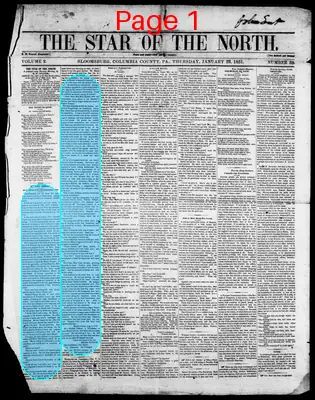
Story
January 23, 1851
The Star Of The North
Bloomsburg, Columbia County, Pennsylvania
What is this article about?
During the Revolutionary War in August 1777, British General Tryon sends Lieutenant Nathan Palmer, a Tory spy, to gather intelligence on General Putnam's forces near Peekskill, NY. Palmer's commission is discovered after his rejection by Rosa Milford, leading to his arrest, trial, and execution by hanging on 'Old Put's Gallows' despite Tryon's protests.
Clipping
OCR Quality
95%
Excellent
Full Text
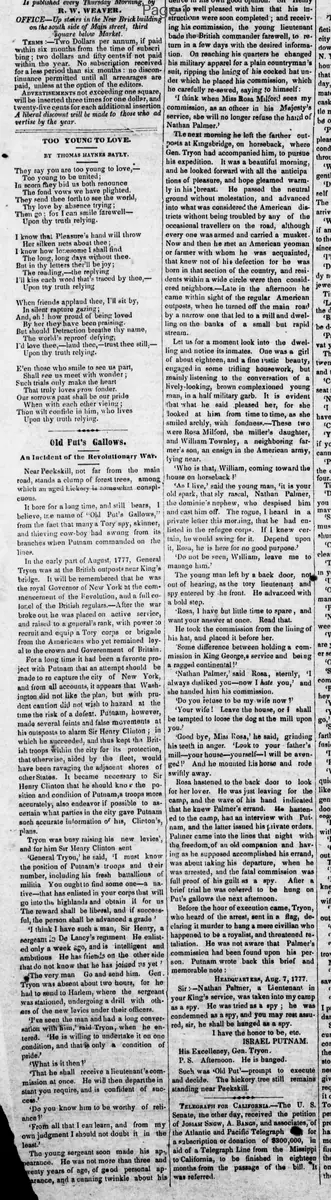
Old Put's Gallows.
An Incident of the Revolutionary War.
Near Peekskill, not far from the main road, stands a clump of forest trees, among which an aged hickory is somewhat conspicuous.
It bore for a long time, and still bears, I believe, the name of "Old Put's Gallows," from the fact that many a Tory spy, skinner, and thieving cow-boy had swung from its branches when Putnam commanded on the lines.
In the early part of August, 1777, General Tryon was at the British outposts near King's bridge. It will be remembered that he was the royal Governor of New York at the commencement of the Revolution, and a full colonel of the British regulars. After the war broke out he was placed on active service, and raised to a general's rank, with power to recruit and equip a Tory corps or brigade from the Americans who yet remained loyal to the crown and Government of Britain.
For a long time it had been a favorite project with Putnam that an attempt should be made to re-capture the city of New York. and from all accounts, it appears that Washington did not like the plan, but with prudent caution did not wish to hazard at the time the risk of a defeat. Putnam, however, made several feints and false movements at his outposts to alarm Sir Henry Clinton; in which he succeeded, and thus kept the British troops within the city for its protection, that otherwise, aided by the fleet, would have been ravaging the adjacent shores of other States. It became necessary to Sir Henry Clinton that he should know the position and condition of Putnam's troops more accurately, also endeavor if possible to ascertain what parties in the city gave Putnam such accurate information of his, Clinton's, plans.
Tryon was busy raising his new levies, and for him Sir Henry Clinton sent.
"General Tryon," he said, "I must know the position of Putnam's troops and their number, including his fresh battalions of militia. You ought to find some one—a native—that has enlisted in your corps that will go into the highlands and obtain it for us. The reward shall be liberal, and if successful, the person shall be advanced a grade."
"I think I have such a man, Sir Henry, a sergeant in De Lancey's regiment. He enlisted only a week ago, and is intelligent and ambitious. He has friends on the other side that do not know that he has joined us yet."
"The very man. Go and send him."
Gen. Tryon was absent about two hours, for he had to send to Harlem, where the sergeant was stationed, undergoing a drill with others of the new levies under their officers.
"I've seen the man and had a long conversation with him," said Tryon, when he entered. "He is willing to undertake it on one condition, and that is only a condition of pride.
"What is it then?"
"That he shall receive a lieutenant's commission at once. He will then depart the instant you require, and is confident of success."
"Do you know him to be worthy of reliance?"
"From all that I can learn, and from my own judgment I should not doubt it in the least."
The young sergeant soon made his appearance. He was not more than twenty-seven years of age, of good personal appearance, and a cunning twinkle about his instructions were soon completed; and receiving his commission, the young lieutenant bade the British commander farewell, to return in a few days with the desired information. On reaching his quarters he changed his military apparel for a plain countryman's suit, ripping the lining of his cocked hat under which he placed his commission, which he carefully re-sewed, saying to himself:
"I think when Miss Rosa Milford sees my commission, as an officer in his Majesty's service, she will no longer refuse the hand of Nathan Palmer."
The next morning he left the farther outposts at Kingsbridge, on horseback, where Gen. Tryon had accompanied him, to pursue his expedition. It was a beautiful morning, and he looked forward with all the anticipations of pleasure, and hope gleamed warmly in his breast. He passed the neutral ground without molestation, and advanced into what was considered the American districts without being troubled by any of the occasional travellers on the road, although every one was armed and carried a musket. Now and then he met an American yeoman or farmer with whom he was acquainted, that knew not of his defection for he was born in that section of the country, and residents within a wide circle were then considered neighbors. Late in the afternoon he came within sight of the regular American outposts, when he turned off the main road by a narrow one that led to a mill and dwelling on the banks of a small but rapid stream.
Let us for a moment look into the dwelling and notice its inmates. One was a girl of about eighteen, and a fine rustic beauty, engaged in some trifling housework, but mainly listening to the conversation of a lively-looking, brown complexioned young man, in a half military garb. It is evident that what he said pleased her, for she looked at him from time to time, as she smiled archly, with fondness. These two were Rosa Milford, the miller's daughter, and William Towpley, a neighboring farmer's son, an ensign in the American army, lying near.
"Who is that, William, coming toward the house on horseback?"
"As I live," said the young man, "it is your old spark, that sly rascal, Nathan Palmer, the dominie's nephew, who despised him and cast him off. The rogue, I heard in a private letter this morning, that he had enlisted in the refugee corps. If I knew certain, he would swing for it. Depend upon it, Rosa, he is here for no good purpose."
"Do not be seen, William, leave me to manage him."
The young man left by a back door, not out of hearing, as the tory lieutenant and spy entered by the front. He advanced with a bold step.
"Rosa, I have but little time to spare, and want your answer at once. Read that."
He took the commission from the lining of his hat, and placed it before her.
"Some difference between holding a commission in King George's service and being a ragged continental!"
"Nathan Palmer," said Rosa, sternly, "I always disliked you—now I hate you," and she handed him his commission.
"Do you refuse to be my wife now?"
"Your wife! Leave the house, or I shall be tempted to loose the dog at the mill upon you."
"Good bye, Miss Rosa," he said, grinding his teeth in anger. "Look to your father's mill—your house—yourself—I will be avenged!" And he mounted his horse and rode swiftly away.
Rosa hastened to the back door to look for her lover. He was just leaving for the camp, and the wave of his hand indicated that he knew Palmer's errand. He hastened to the camp, had an interview with Putnam, and the latter issued his private orders.
Palmer came into the lines that night with the freedom of an old companion and having as he supposed accomplished his errand, was about taking his departure, when he was arrested, and the fatal commission was full proof of his guilt as a spy. After a brief trial he was ordered to be hung on Put's gallows the next afternoon.
Before the hour of execution came, Tryon, who heard of the arrest, sent in a flag, declaring it murder to hang a mere civilian who happened to be a royalist, and threatened retaliation. He was not aware that Palmer's commission had been found upon his person. Putnam wrote back this brief and memorable note:
Headquarters, Aug. 7, 1777.
Sir:—Nathan Palmer, a Lieutenant in your King's service, was taken into my camp as a spy. He was tried as a spy; he was condemned as a spy, and you may rest assured, sir, he shall be hanged as a spy.
I have the honor to be, etc.
ISRAEL PUTNAM.
His Excellency, Gen. Tryon.
P. S. Afternoon. He is hanged.
Such was Old Put's—prompt to execute and decide. The hickory tree still remains standing near Peekskill.
An Incident of the Revolutionary War.
Near Peekskill, not far from the main road, stands a clump of forest trees, among which an aged hickory is somewhat conspicuous.
It bore for a long time, and still bears, I believe, the name of "Old Put's Gallows," from the fact that many a Tory spy, skinner, and thieving cow-boy had swung from its branches when Putnam commanded on the lines.
In the early part of August, 1777, General Tryon was at the British outposts near King's bridge. It will be remembered that he was the royal Governor of New York at the commencement of the Revolution, and a full colonel of the British regulars. After the war broke out he was placed on active service, and raised to a general's rank, with power to recruit and equip a Tory corps or brigade from the Americans who yet remained loyal to the crown and Government of Britain.
For a long time it had been a favorite project with Putnam that an attempt should be made to re-capture the city of New York. and from all accounts, it appears that Washington did not like the plan, but with prudent caution did not wish to hazard at the time the risk of a defeat. Putnam, however, made several feints and false movements at his outposts to alarm Sir Henry Clinton; in which he succeeded, and thus kept the British troops within the city for its protection, that otherwise, aided by the fleet, would have been ravaging the adjacent shores of other States. It became necessary to Sir Henry Clinton that he should know the position and condition of Putnam's troops more accurately, also endeavor if possible to ascertain what parties in the city gave Putnam such accurate information of his, Clinton's, plans.
Tryon was busy raising his new levies, and for him Sir Henry Clinton sent.
"General Tryon," he said, "I must know the position of Putnam's troops and their number, including his fresh battalions of militia. You ought to find some one—a native—that has enlisted in your corps that will go into the highlands and obtain it for us. The reward shall be liberal, and if successful, the person shall be advanced a grade."
"I think I have such a man, Sir Henry, a sergeant in De Lancey's regiment. He enlisted only a week ago, and is intelligent and ambitious. He has friends on the other side that do not know that he has joined us yet."
"The very man. Go and send him."
Gen. Tryon was absent about two hours, for he had to send to Harlem, where the sergeant was stationed, undergoing a drill with others of the new levies under their officers.
"I've seen the man and had a long conversation with him," said Tryon, when he entered. "He is willing to undertake it on one condition, and that is only a condition of pride.
"What is it then?"
"That he shall receive a lieutenant's commission at once. He will then depart the instant you require, and is confident of success."
"Do you know him to be worthy of reliance?"
"From all that I can learn, and from my own judgment I should not doubt it in the least."
The young sergeant soon made his appearance. He was not more than twenty-seven years of age, of good personal appearance, and a cunning twinkle about his instructions were soon completed; and receiving his commission, the young lieutenant bade the British commander farewell, to return in a few days with the desired information. On reaching his quarters he changed his military apparel for a plain countryman's suit, ripping the lining of his cocked hat under which he placed his commission, which he carefully re-sewed, saying to himself:
"I think when Miss Rosa Milford sees my commission, as an officer in his Majesty's service, she will no longer refuse the hand of Nathan Palmer."
The next morning he left the farther outposts at Kingsbridge, on horseback, where Gen. Tryon had accompanied him, to pursue his expedition. It was a beautiful morning, and he looked forward with all the anticipations of pleasure, and hope gleamed warmly in his breast. He passed the neutral ground without molestation, and advanced into what was considered the American districts without being troubled by any of the occasional travellers on the road, although every one was armed and carried a musket. Now and then he met an American yeoman or farmer with whom he was acquainted, that knew not of his defection for he was born in that section of the country, and residents within a wide circle were then considered neighbors. Late in the afternoon he came within sight of the regular American outposts, when he turned off the main road by a narrow one that led to a mill and dwelling on the banks of a small but rapid stream.
Let us for a moment look into the dwelling and notice its inmates. One was a girl of about eighteen, and a fine rustic beauty, engaged in some trifling housework, but mainly listening to the conversation of a lively-looking, brown complexioned young man, in a half military garb. It is evident that what he said pleased her, for she looked at him from time to time, as she smiled archly, with fondness. These two were Rosa Milford, the miller's daughter, and William Towpley, a neighboring farmer's son, an ensign in the American army, lying near.
"Who is that, William, coming toward the house on horseback?"
"As I live," said the young man, "it is your old spark, that sly rascal, Nathan Palmer, the dominie's nephew, who despised him and cast him off. The rogue, I heard in a private letter this morning, that he had enlisted in the refugee corps. If I knew certain, he would swing for it. Depend upon it, Rosa, he is here for no good purpose."
"Do not be seen, William, leave me to manage him."
The young man left by a back door, not out of hearing, as the tory lieutenant and spy entered by the front. He advanced with a bold step.
"Rosa, I have but little time to spare, and want your answer at once. Read that."
He took the commission from the lining of his hat, and placed it before her.
"Some difference between holding a commission in King George's service and being a ragged continental!"
"Nathan Palmer," said Rosa, sternly, "I always disliked you—now I hate you," and she handed him his commission.
"Do you refuse to be my wife now?"
"Your wife! Leave the house, or I shall be tempted to loose the dog at the mill upon you."
"Good bye, Miss Rosa," he said, grinding his teeth in anger. "Look to your father's mill—your house—yourself—I will be avenged!" And he mounted his horse and rode swiftly away.
Rosa hastened to the back door to look for her lover. He was just leaving for the camp, and the wave of his hand indicated that he knew Palmer's errand. He hastened to the camp, had an interview with Putnam, and the latter issued his private orders.
Palmer came into the lines that night with the freedom of an old companion and having as he supposed accomplished his errand, was about taking his departure, when he was arrested, and the fatal commission was full proof of his guilt as a spy. After a brief trial he was ordered to be hung on Put's gallows the next afternoon.
Before the hour of execution came, Tryon, who heard of the arrest, sent in a flag, declaring it murder to hang a mere civilian who happened to be a royalist, and threatened retaliation. He was not aware that Palmer's commission had been found upon his person. Putnam wrote back this brief and memorable note:
Headquarters, Aug. 7, 1777.
Sir:—Nathan Palmer, a Lieutenant in your King's service, was taken into my camp as a spy. He was tried as a spy; he was condemned as a spy, and you may rest assured, sir, he shall be hanged as a spy.
I have the honor to be, etc.
ISRAEL PUTNAM.
His Excellency, Gen. Tryon.
P. S. Afternoon. He is hanged.
Such was Old Put's—prompt to execute and decide. The hickory tree still remains standing near Peekskill.
What sub-type of article is it?
Historical Event
Deception Fraud
Crime Story
What themes does it cover?
Justice
Deception
Betrayal
What keywords are associated?
Revolutionary War
Tory Spy
Putnam Execution
Peekskill Gallows
Military Espionage
What entities or persons were involved?
Israel Putnam
Nathan Palmer
General Tryon
Sir Henry Clinton
Rosa Milford
William Towpley
Where did it happen?
Near Peekskill
Story Details
Key Persons
Israel Putnam
Nathan Palmer
General Tryon
Sir Henry Clinton
Rosa Milford
William Towpley
Location
Near Peekskill
Event Date
August 1777
Story Details
British send Tory spy Nathan Palmer to infiltrate American lines under General Putnam; rejected by Rosa Milford, he is arrested with his commission, tried as a spy, and executed on Old Put's Gallows despite Tryon's flag of truce.