Thank you for visiting SNEWPapers!
Sign up free
Alexandria Daily Gazette, Commercial & Political
Alexandria, Virginia
What is this article about?
U.S. House of Representatives on January 16 debated the gag rule restricting petitions, with opponents arguing it silences minorities and encroaches on free speech; motion to reconvene committee lost. Also addressed petition for rarifying air-stove heating.
Clipping
OCR Quality
Full Text
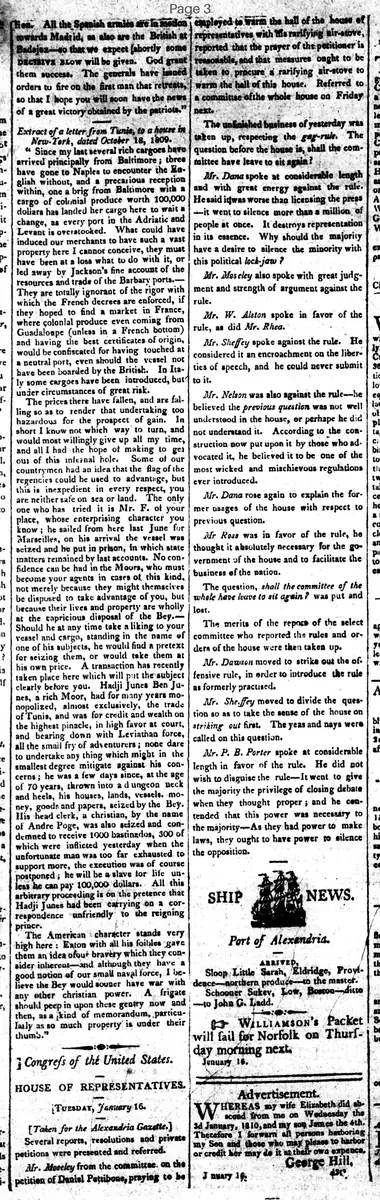
HOUSE OF REPRESENTATIVES.
Tuesday, January 16.
[Taken for the Alexandria Gazette.]
Several reports, resolutions and private petitions were presented and referred.
Mr. Moseley from the committee on the petition of Daniel Pettibone, praying to be employed to warm the hall of the house of representatives with his rarifying air-stove, reported that the prayer of the petitioner is reasonable and that measures ought to be taken to procure a rarifying air-stove to warm the hall of this house: Referred to a committee of the whole house on Friday next.
The unfinished business of yesterday was taken up, respecting the gag-rule. The question before the house is, shall the committee have leave to sit again?
Mr. Dana spoke at considerable length and with great energy against the rule. He said it was worse than licensing the press--it went to silence more than a million of people at once. It destroys representation in its essence. Why should the majority have a desire to silence the minority with this political lock-jaw?
Mr. Moseley also spoke with great judgment and strength of argument against the rule.
Mr. W. Alston spoke in favor of the rule, as did Mr. Rhea.
Mr. Sheffey spoke against the rule. He considered it an encroachment on the liberties of speech, and he could never submit to it.
Mr. Nelson was also against the rule--he believed the previous question was not well understood in the house, or perhaps he did not understand it. According to the construction now put upon it by those who advocated it, he believed it to be one of the most wicked and mischievous regulations ever introduced.
Mr. Dana rose again to explain the former usages of the house with respect to previous question.
Mr. Ross was in favor of the rule, he thought it absolutely necessary for the government of the house and to facilitate the business of the nation.
The question, shall the committee of the whole have leave to sit again? was put and lost.
The merits of the report of the select committee who reported the rules and order of the house were then taken up.
Mr. Dawson moved to strike out the offensive rule, in order to introduce the rule as formerly practised.
Mr. Sheffey moved to divide the question so as to take the sense of the house on striking out first. The yeas and nays were called on this question.
Mr. P. B. Porter spoke at considerable length in favor of the rule. He did not wish to disguise the rule. It went to give the majority the privilege of closing debate when they thought proper; and he contended that this power was necessary to the majority--As they had power to make laws, they ought to have power to silence the opposition.
What sub-type of article is it?
What keywords are associated?
What entities or persons were involved?
Domestic News Details
Event Date
Tuesday, January 16
Key Persons
Outcome
the question on whether the committee of the whole should have leave to sit again was put and lost. the merits of the report on the rules were then taken up, with motions to strike out the offensive rule and to divide the question.
Event Details
Several reports, resolutions, and private petitions were presented and referred. Mr. Moseley reported on the petition of Daniel Pettibone for employment to warm the hall with a rarifying air-stove, recommending measures to procure one, referred to committee of the whole on Friday. Unfinished business on the gag-rule was taken up, with debate: Mr. Dana, Mr. Moseley, Mr. Sheffey, and Mr. Nelson spoke against the rule; Mr. W. Alston, Mr. Rhea, and Mr. Ross spoke in favor. Mr. Dana explained former usages. Mr. Dawson moved to strike out the rule to restore former practice. Mr. Sheffey moved to divide the question, yeas and nays called. Mr. P. B. Porter spoke in favor of the rule.