Thank you for visiting SNEWPapers!
Sign up free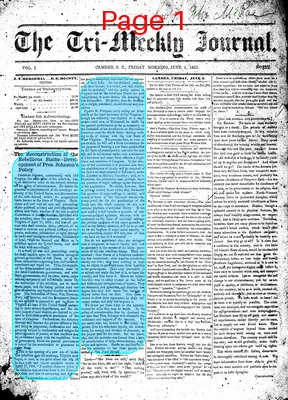
The Tri Weekly Journal
Camden, Kershaw County, South Carolina
What is this article about?
President Johnson's policy for reconstructing Virginia after the Civil War nullifies rebel acts since April 17, 1861, enforces U.S. laws, punishes traitors, and supports Provisional Governor Francis H. Pierpont in forming a new state constitution based on emancipation, advocating for negro suffrage.
Clipping
OCR Quality
Full Text
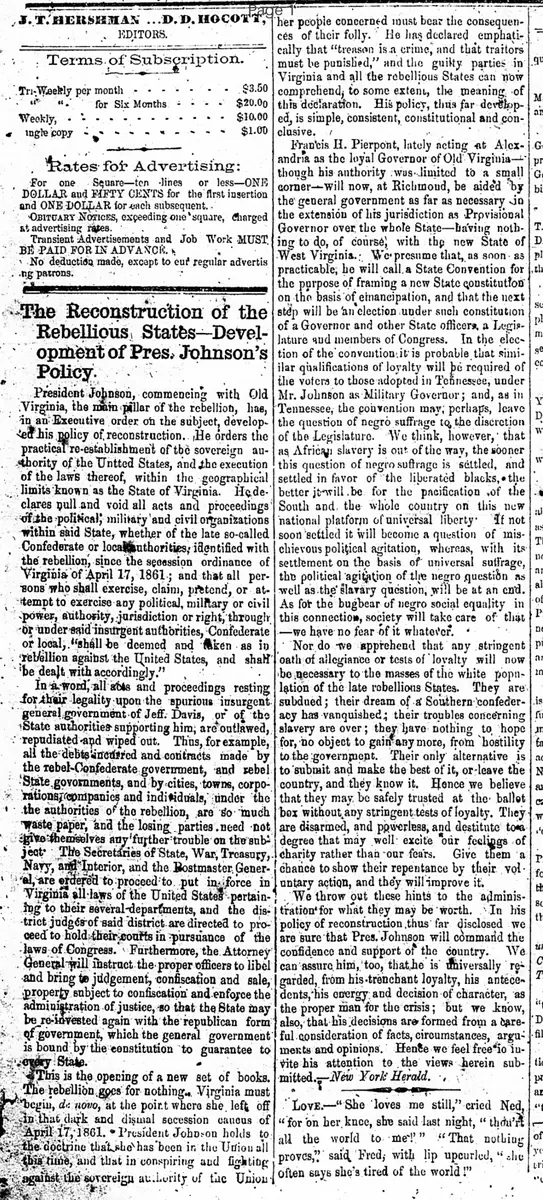
President Johnson, commencing with Old Virginia, the main pillar of the rebellion, has, in an Executive order on the subject, developed his policy of reconstruction. He orders the practical re-establishment of the sovereign authority of the United States, and the execution of the laws thereof, within the geographical limits known as the State of Virginia. He declares null and void all acts and proceedings of the political, military and civil organizations within said State, whether of the late so-called Confederate or local authorities, identified with the rebellion, since the secession ordinance of Virginia of April 17, 1861; and that all persons who shall exercise, claim, pretend, or attempt to exercise any political, military or civil power, authority, jurisdiction or right, through or under said insurgent authorities, Confederate or local, shall be deemed and taken as in rebellion against the United States, and shall be dealt with accordingly.
In a word, all acts and proceedings resting for their legality upon the spurious insurgent general government of Jeff. Davis, or of the State authorities supporting him, are outlawed, repudiated and wiped out. Thus, for example, all the debts incurred and contracts made by the rebel Confederate government, and rebel State governments, and by cities, towns, corporations, companies and individuals, under the authorities of the rebellion, are so much waste paper, and the losing parties need not give themselves any further trouble on the subject. The Secretaries of State, War, Treasury, Navy, and Interior, and the Postmaster General, are ordered to proceed to put in force in Virginia all laws of the United States pertaining to their several departments, and the district judges of said district are directed to proceed to hold their courts in pursuance of the laws of Congress. Furthermore, the Attorney General will instruct the proper officers to libel and bring to judgement, confiscation and sale, property subject to confiscation and enforce the administration of justice, so that the State may be re-invested again with the republican form of government, which the general government is bound by the constitution to guarantee to every State.
This is the opening of a new set of books. The rebellion goes for nothing. Virginia must begin de novo, at the point where she left off in that dark and dismal secession caucus of April 17, 1861. President Johnson holds to the doctrine that she has been in the Union all this time, and that in conspiring and fighting against the sovereign authority of the Union her people concerned must bear the consequences of their folly. He has declared emphatically that "treason is a crime, and that traitors must be punished," and the guilty parties in Virginia and all the rebellious States can now comprehend, to some extent, the meaning of this declaration. His policy, thus far developed, is simple, consistent, constitutional and conclusive.
Francis H. Pierpont, lately acting at Alexandria as the loyal Governor of Old Virginia—though his authority was limited to a small corner—will now, at Richmond, be aided by the general government as far as necessary in the extension of his jurisdiction as Provisional Governor over the whole State—having nothing to do, of course, with the new State of West Virginia. We presume that, as soon as practicable, he will call a State Convention for the purpose of framing a new State constitution on the basis of emancipation, and that the next step will be an election under such constitution of a Governor and other State officers, a Legislature and members of Congress. In the election of the convention it is probable that similar qualifications of loyalty will be required of the voters to those adopted in Tennessee, under Mr. Johnson as Military Governor; and, as in Tennessee, the convention may, perhaps, leave the question of negro suffrage to the discretion of the Legislature. We think, however, that as African slavery is out of the way, the sooner this question of negro suffrage is settled, and settled in favor of the liberated blacks, the better it will be for the pacification of the South and the whole country on this new national platform of universal liberty. If not soon settled it will become a question of mischievous political agitation, whereas, with its settlement on the basis of universal suffrage, the political agitation of the negro question as well as the slavery question, will be at an end.
As for the bugbear of negro social equality in this connection, society will take care of that—we have no fear of it whatever. Nor do we apprehend that any stringent oath of allegiance or tests of loyalty will now be necessary to the masses of the white population of the late rebellious States. They are subdued; their dream of a Southern confederacy has vanished; their troubles concerning slavery are over; they have nothing to hope for, no object to gain any more, from hostility to the government. Their only alternative is to submit and make the best of it, or leave the country, and they know it. Hence we believe that they may be safely trusted at the ballot box without any stringent tests of loyalty. They are disarmed, and powerless, and destitute to a degree that may well excite our feelings of charity rather than our fears. Give them a chance to show their repentance by their voluntary action, and they will improve it.
We throw out these hints to the administration for what they may be worth. In his policy of reconstruction thus far disclosed we are sure that Pres. Johnson will command the confidence and support of the country. We can assure him, too, that he is universally regarded, from his trenchant loyalty, his antecedents, his energy and decision of character, as the proper man for the crisis; but we know, also, that his decisions are formed from a careful consideration of facts, circumstances, arguments and opinions. Hence we feel free to invite his attention to the views herein submitted.—New York Herald.
What sub-type of article is it?
What themes does it cover?
What keywords are associated?
What entities or persons were involved?
Where did it happen?
Story Details
Key Persons
Location
Virginia, Richmond, Alexandria
Event Date
April 17, 1861
Story Details
President Johnson issues an executive order nullifying all rebel acts in Virginia since secession, enforcing U.S. laws, punishing traitors, and supporting Provisional Governor Pierpont in reconstructing the state with a new constitution based on emancipation and advocating universal suffrage.