Thank you for visiting SNEWPapers!
Sign up free
The New York Journal, And Weekly Register
New York, New York County, New York
What is this article about?
In the New York House of Assembly on March 21, 1787, Mr. Harrison continued his speech opposing a bill to recognize Vermont's independence, arguing it ignores past failed overtures and fails to secure compensation for New York property owners' claims in Vermont.
Clipping
OCR Quality
Full Text
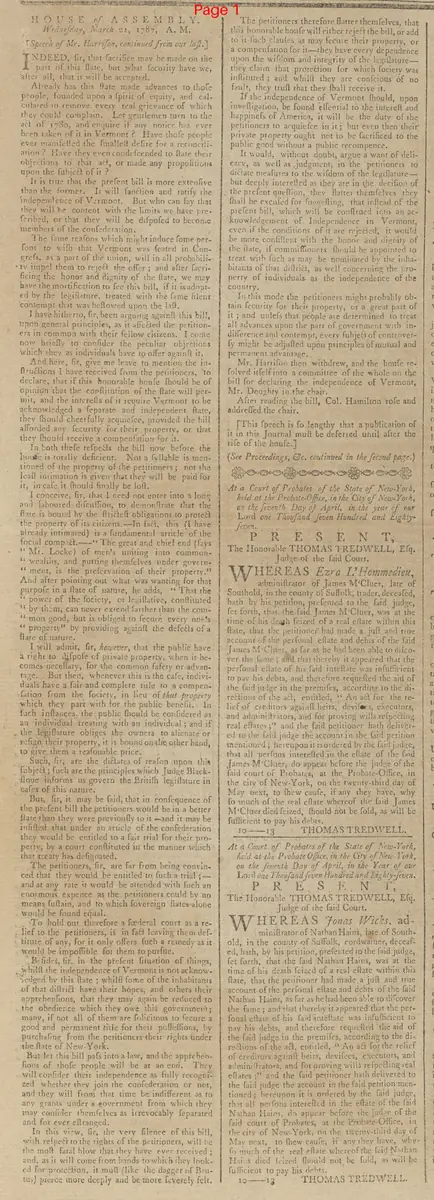
Wednesday, March 21, 1787, A. M.
[Speech of Mr. Harrison, continued from our last.]
INDEED, sir, that sacrifice may be made on the part of this state, but what security have we, after all, that it will be accepted.
Already has this state made advances to those people, founded upon a spirit of equity, and calculated to remove every real grievance of which they could complain. Let gentlemen turn to the act of 1780, and enquire if any notice has ever been taken of it in Vermont? Have those people ever manifested the smallest desire for a reconciliation? Have they even condescended to state their objections to that act, or made any propositions upon the subject of it?
It is true that the present bill is more extensive than the former. It will sanction and ratify the independence of Vermont. But who can say that they will be content with the limits we have prescribed, or that they will be disposed to become members of the confederation.
The same reasons which might induce some persons to wish that Vermont was seated in Congress, as a part of the union, will in all probability impel them to reject the offer; and after sacrificing the honor and dignity of the state, we may have the mortification to see this bill, if it is adopted by the legislature, treated with the same silent contempt that was bestowed upon the last.
I have hitherto, sir, been arguing against this bill, upon general principles, as it affected the petitioners in common with their fellow citizens. I come now briefly to consider the peculiar objections which they as individuals have to offer against it.
And here, sir, give me leave to mention the instructions I have received from the petitioners, to declare, that if this honorable house should be of opinion that the constitution of the state will permit, and the interests of it require Vermont to be acknowledged a separate and independent state, they should cheerfully acquiesce, provided the bill afforded any security for their property, or that they should receive a compensation for it.
In both these respects the bill now before the house is totally deficient. Not a syllable is mentioned of the property of the petitioners; not the least intimation is given that they will be paid for it, in case it should finally be lost.
I conceive, sir, that I need not enter into a long and laboured discussion, to demonstrate that the state is bound by the strictest obligations to protect the property of its citizens.--In fact, this (I have already intimated is a fundamental article of the social compact.-- "The great and chief end (says Mr. Locke) of men's uniting into commonwealths, and putting themselves under government, is the preservation of their property."
And after pointing out what was wanting for that purpose in a state of nature, he adds, "That the power of the society, or legislative, constituted by them, can never extend farther than the common good, but is obliged to secure every one's property" by providing against the defects of a state of nature.
I will admit, sir, however, that the public have a right to dispose of private property, when it becomes necessary, for the common safety or advantage. But then, whenever this is the case, individuals have a fair and complete title to a compensation from the society, in lieu of that property which they part with for the public benefit. In such instances, the public should be considered as an individual treating with an individual; and if the legislature obliges the owners to alienate or resign their property, it is bound on the other hand, to give them a reasonable price.
Such, sir, are the dictates of reason upon this subject; such are the principles which Judge Blacktouze informs us govern the British legislature in cases of this nature.
But, sir, it may be said, that in consequence of the present bill the petitioners would be in a better state than they were previously to it -and it may be insisted that under an article of the confederation they would be entitled to a fair trial for their property, by a court constituted in the manner which that treaty has designated.
The petitioners, sir, are far from being convinced that they would be entitled to such a trial;- and at any rate it would be attended with such an enormous expense as the petitioners could by no means sustain, and to which sovereign states alone would be found equal.
To hold out therefore a federal court as a relief to the petitioners, is in fact leaving them destitute of any, for it only offers such a remedy as it would be impossible for them to pursue.
Besides, sir, in the present situation of things, whilst the independence of Vermont is not acknowledged by this state; whilst some of the inhabitants of that district have their hopes, and others their apprehensions, that they may again be reduced to the obedience which they owe this government; many, if not all of them are solicitous to secure a good and permanent title for their possessions, by purchasing from the petitioners their rights under the state of New-York.
But let this bill pass into a law, and the apprehensions of those people will be at an end. They will consider their independence as fully recognized whether they join the confederation or not, and they will from that time be indifferent as to any grants under a government from which they may consider themselves as irrevocably separated and for ever estranged.
In this view, sir, the very silence of this bill. with respect to the rights of the petitioners, will be the most fatal blow that they have ever received : and, as it will come from hands to which they looked for protection. it must (like the dagger of Brutus) pierce more deeply and be more severely felt.
What sub-type of article is it?
What keywords are associated?
What entities or persons were involved?
Where did it happen?
Domestic News Details
Primary Location
New York
Event Date
March 21, 1787
Key Persons
Event Details
Mr. Harrison continues his speech in the House of Assembly opposing a bill to recognize Vermont's independence, arguing that previous advances like the act of 1780 were ignored, Vermont may reject the offer despite prescribed limits, and the bill provides no security or compensation for the petitioners' property rights in Vermont. He emphasizes the state's obligation to protect citizens' property, quoting Locke, and notes that a federal court trial would be too expensive for individuals. Passage of the bill would end purchases of New York rights by Vermonters, delivering a fatal blow to the petitioners.