Thank you for visiting SNEWPapers!
Sign up free
Editorial
January 18, 1850
New Hampshire Statesman
Concord, Merrimack County, New Hampshire
What is this article about?
Editorial critiques a pro-slavery speech by Alabama Senator Clemens, accusing the Democratic (Locofoco) party of endorsing such views without rebuke. It defends Northern factory workers in New Hampshire against claims of worse conditions than Southern slaves and rebuts Southern crime allegations.
Clipping
OCR Quality
85%
Good
Full Text
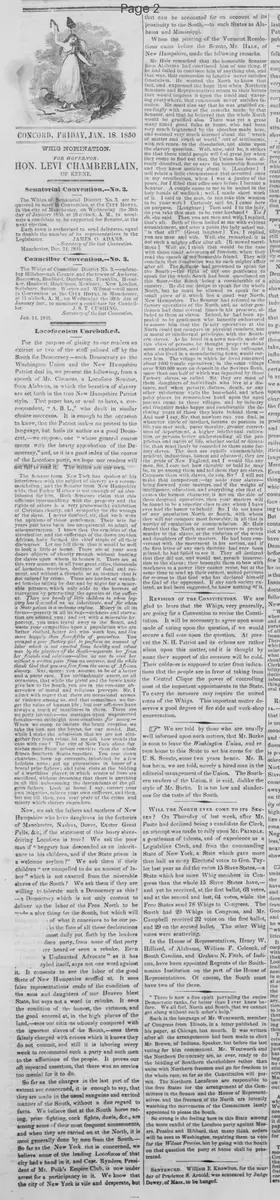
Locofocoism Unrebuked.
For the purpose of giving to our readers an extract or two of the stuff palmed off by the South for Democracy—such Democracy as the Washington Union and the New Hampshire Patriot deal in, we present the following, from a speech of Mr. Clemens, a Locofoco Senator, from Alabama, in which the beauties of slavery are set forth in the true New Hampshire Patriot style. That paper has, or used to have, a correspondent, "A. B. L," who dealt in similar choice morceaux. It is enough to the occasion to know, that the Patriot makes no protest to the language, but hails its author as a good Democrat,—we suppose, one "whose general course meets with the hearty approbation of the Democracy," and, as it is a good index of the course of the Locofoco party, we hope our readers will not fail to read it. The italics are our own.
The Senator from New York has spoken of his interference with the subject of slavery as a recommendation: and the Senator from New Hampshire adds, that Father Mathew is not enough of an abolitionist for him. Both Senators claim that this officious intermeddling with the property and the rights of others is a very praiseworthy exhibition of Christian charity, and sympathy for the wrongs of the slave. I never doubted, sir, that such were the opinions of those gentlemen. Their acts for years past have been too unequivocal to admit of misconstruction. I know that the cruelties of the slaveholder, and the sufferings of the down-trodden African, have formed the chief staple of all their discourses. Let me tell them that it would be well to look a little at home. There are at your own doors objects of charity enough without hunting for slaves upon whom to bestow it. There are at this very moment, in all your great cities, thousands of homeless wretches, destitute of food and raiment, and without a thought or an instinct that is not colored by crime. There are hordes of wretched females toiling by day and by night for a miserable pittance, which only adds to the horrors of starvation by protracting the agonies of the sufferer. There are bands of little children to whom beggary has descended as an inheritance, and for whom a State prison is a welcome asylum. Misery in all its forms—poverty in all its rags—sickness and starvation are around you; and yet with a miserable hypocrisy, you must travel away to the South, and waste your sympathies upon a population who are better clothed, better fed, who work less, and live more happily than four-fifths of yourselves. You compel a poor factory girl to perform an amount of labor which is not exacted from healthy and robust men by the planters of the South—separate her from her friends and relations—allow no one to visit her without a written pass from an overseer, and the while thank God that you are free from the curse of African slavery. Nay, more: you assume to be of a better and a purer race. You unblushingly assert, on all occasions, that while the pistol and the bowie knife give law to the South, you are in the constant observance of moral and religious precepts. Sir, I admit with regret that there are occasional scenes of violence among us, and that sometimes we forget the value of human life; but our offences have always a touch of manliness in them. There are no petty larcenies—no outrages upon unprotected females—no midnight assassinations for money.—When we stoop to imitate the brute creation, we take the lion, not the hyena, for our model. But, while I make the admission that we are not altogether free from crime, let me ask how stands the case with you? The city of New York alone, furnishes more State prison convicts than the whole fifteen Southern States together. You tear down churches; burn up convents, inhabited by a few helpless nuns: get up processions in honor of a brutal prize fighter; and raise riots at the bidding of a worthless player, in which scores of lives are sacrificed, without dreaming that there is anything in all this unbecoming the descendants of the pilgrim fathers. Look at home, I say, correct your own iniquities, relieve your own sufferers, and then, but not till then, you may prate of the crime and misery which slavery engenders.
Now, we ask the fathers and mothers of New Hampshire who have daughters in the factories of Manchester, Nashua, Dover, Exeter, Great Falls, &c., if the statement of this hoary slave-driving Locofoco is true? We ask the poor man if "beggary has descended as an inheritance to his children, and if the State prison is a welcome asylum?" We ask them if their children "are compelled to do an amount of labor" which is not exacted from the miserable slaves of the South? We ask them if they are willing to tolerate such a Democracy as this?—a Democracy which is not only content to deliver up the labor of the Free North to be made a play thing for the South, but which will [illegible or truncated] of what it conceives to be our po-
in the face of all these declarations most daily put forth by the leaders [of the] foco party, from none of that party [have we] ver heard or seen a rebuke. Even ['s Undaunted Advocate] as it has [s]tyled itself, says not one word against it. It consents to see the labor of the good State of New Hampshire scoffed at. It sees false representations made of the condition of the sons and daughters of our Heaven blest State, but says not a word in rebuke. It sees the condition of the honest, the virtuous, and the good sneered at, in the high places of the land,—sees our citizens odiously compared with the ignorant slaves of the South, sees them falsely charged with crimes which it knows they do not commit, and still it is laboring every week to recommend such a party and such men to the affections of the people. It proves our oft repeated assertion, that there was no service too menial for it to do.
So far as the charges in the last part of the extract are concerned, it is enough to say, that they are made in the usual sanguine and excited manner of the South, without a due regard to facts. We believe that at the South horse racing, prize fighting, cock fights, duels, &c., are among some of their most frequent amusements, and when they are carried on at the North, it is most generally done by men from the South.—So far as the New York riot is concerned, we believe some of the leading Locofocos of that city had a hand in it, and Capt. Rynders, President of Mr. Polk's Empire Club, is now under arrest for a participancy in it. We know that the city of New York is vile and desperate, but that can be accounted for on account of its proximity to the South,—to such States as Alabama and Mississippi.
For the purpose of giving to our readers an extract or two of the stuff palmed off by the South for Democracy—such Democracy as the Washington Union and the New Hampshire Patriot deal in, we present the following, from a speech of Mr. Clemens, a Locofoco Senator, from Alabama, in which the beauties of slavery are set forth in the true New Hampshire Patriot style. That paper has, or used to have, a correspondent, "A. B. L," who dealt in similar choice morceaux. It is enough to the occasion to know, that the Patriot makes no protest to the language, but hails its author as a good Democrat,—we suppose, one "whose general course meets with the hearty approbation of the Democracy," and, as it is a good index of the course of the Locofoco party, we hope our readers will not fail to read it. The italics are our own.
The Senator from New York has spoken of his interference with the subject of slavery as a recommendation: and the Senator from New Hampshire adds, that Father Mathew is not enough of an abolitionist for him. Both Senators claim that this officious intermeddling with the property and the rights of others is a very praiseworthy exhibition of Christian charity, and sympathy for the wrongs of the slave. I never doubted, sir, that such were the opinions of those gentlemen. Their acts for years past have been too unequivocal to admit of misconstruction. I know that the cruelties of the slaveholder, and the sufferings of the down-trodden African, have formed the chief staple of all their discourses. Let me tell them that it would be well to look a little at home. There are at your own doors objects of charity enough without hunting for slaves upon whom to bestow it. There are at this very moment, in all your great cities, thousands of homeless wretches, destitute of food and raiment, and without a thought or an instinct that is not colored by crime. There are hordes of wretched females toiling by day and by night for a miserable pittance, which only adds to the horrors of starvation by protracting the agonies of the sufferer. There are bands of little children to whom beggary has descended as an inheritance, and for whom a State prison is a welcome asylum. Misery in all its forms—poverty in all its rags—sickness and starvation are around you; and yet with a miserable hypocrisy, you must travel away to the South, and waste your sympathies upon a population who are better clothed, better fed, who work less, and live more happily than four-fifths of yourselves. You compel a poor factory girl to perform an amount of labor which is not exacted from healthy and robust men by the planters of the South—separate her from her friends and relations—allow no one to visit her without a written pass from an overseer, and the while thank God that you are free from the curse of African slavery. Nay, more: you assume to be of a better and a purer race. You unblushingly assert, on all occasions, that while the pistol and the bowie knife give law to the South, you are in the constant observance of moral and religious precepts. Sir, I admit with regret that there are occasional scenes of violence among us, and that sometimes we forget the value of human life; but our offences have always a touch of manliness in them. There are no petty larcenies—no outrages upon unprotected females—no midnight assassinations for money.—When we stoop to imitate the brute creation, we take the lion, not the hyena, for our model. But, while I make the admission that we are not altogether free from crime, let me ask how stands the case with you? The city of New York alone, furnishes more State prison convicts than the whole fifteen Southern States together. You tear down churches; burn up convents, inhabited by a few helpless nuns: get up processions in honor of a brutal prize fighter; and raise riots at the bidding of a worthless player, in which scores of lives are sacrificed, without dreaming that there is anything in all this unbecoming the descendants of the pilgrim fathers. Look at home, I say, correct your own iniquities, relieve your own sufferers, and then, but not till then, you may prate of the crime and misery which slavery engenders.
Now, we ask the fathers and mothers of New Hampshire who have daughters in the factories of Manchester, Nashua, Dover, Exeter, Great Falls, &c., if the statement of this hoary slave-driving Locofoco is true? We ask the poor man if "beggary has descended as an inheritance to his children, and if the State prison is a welcome asylum?" We ask them if their children "are compelled to do an amount of labor" which is not exacted from the miserable slaves of the South? We ask them if they are willing to tolerate such a Democracy as this?—a Democracy which is not only content to deliver up the labor of the Free North to be made a play thing for the South, but which will [illegible or truncated] of what it conceives to be our po-
in the face of all these declarations most daily put forth by the leaders [of the] foco party, from none of that party [have we] ver heard or seen a rebuke. Even ['s Undaunted Advocate] as it has [s]tyled itself, says not one word against it. It consents to see the labor of the good State of New Hampshire scoffed at. It sees false representations made of the condition of the sons and daughters of our Heaven blest State, but says not a word in rebuke. It sees the condition of the honest, the virtuous, and the good sneered at, in the high places of the land,—sees our citizens odiously compared with the ignorant slaves of the South, sees them falsely charged with crimes which it knows they do not commit, and still it is laboring every week to recommend such a party and such men to the affections of the people. It proves our oft repeated assertion, that there was no service too menial for it to do.
So far as the charges in the last part of the extract are concerned, it is enough to say, that they are made in the usual sanguine and excited manner of the South, without a due regard to facts. We believe that at the South horse racing, prize fighting, cock fights, duels, &c., are among some of their most frequent amusements, and when they are carried on at the North, it is most generally done by men from the South.—So far as the New York riot is concerned, we believe some of the leading Locofocos of that city had a hand in it, and Capt. Rynders, President of Mr. Polk's Empire Club, is now under arrest for a participancy in it. We know that the city of New York is vile and desperate, but that can be accounted for on account of its proximity to the South,—to such States as Alabama and Mississippi.
What sub-type of article is it?
Partisan Politics
Slavery Abolition
Labor
What keywords are associated?
Locofocoism
Slavery Defense
Northern Factories
Democratic Party
Southern Hypocrisy
New Hampshire Labor
Political Rebuke
What entities or persons were involved?
Mr. Clemens
Locofoco Party
New Hampshire Patriot
Washington Union
Father Mathew
Senator From New York
Senator From New Hampshire
Capt. Rynders
Editorial Details
Primary Topic
Criticism Of Locofoco Tolerance For Pro Slavery Rhetoric
Stance / Tone
Anti Democratic Party, Defensive Of Northern Free Labor
Key Figures
Mr. Clemens
Locofoco Party
New Hampshire Patriot
Washington Union
Father Mathew
Senator From New York
Senator From New Hampshire
Capt. Rynders
Key Arguments
Locofoco Party Fails To Rebuke Pro Slavery Speeches Like Clemens'
Northern Factory Workers In New Hampshire Face Better Conditions Than Claimed Compared To Slaves
Southerners Engage In Violent Amusements Like Duels And Prize Fighting
New York Crimes And Riots Influenced By Southern Elements And Locofocos
Hypocrisy Of Northern Democrats Supporting Southern Views On Slavery