Thank you for visiting SNEWPapers!
Sign up free
The New Hampshire Gazette And Historical Chronicle
Portsmouth, Greenland, Rockingham County, New Hampshire
What is this article about?
Extract of a letter from London (Feb. 8, 1765) to Charles-Town details colonial agents' opposition to the Stamp Bill. Agents met with Chancellor of the Exchequer, who proposed stamp duties on America. Debate in committee affirmed parliamentary power; motion passed 245-49.
Clipping
OCR Quality
Full Text
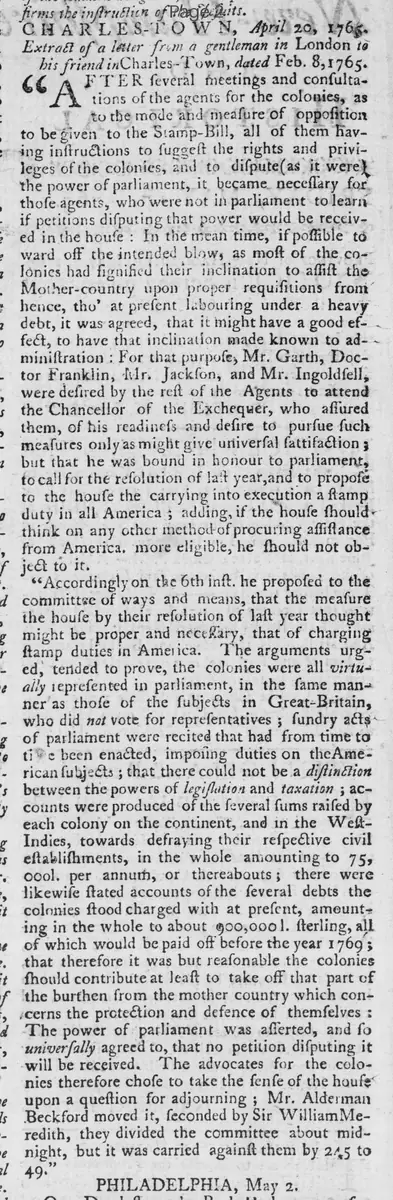
Extract of a letter from a gentleman in London to his friend in Charles-Town, dated Feb. 8, 1765.
After several meetings and consultations of the agents for the colonies, as to the mode and measure of opposition to be given to the Stamp-Bill, all of them having instructions to assert the rights and privileges of the colonies, and to dispute (as it were) the power of parliament, it became necessary for those agents, who were not in parliament to learn if petitions disputing that power would be received in the house: In the mean time, if possible to ward off the intended blow, as most of the colonies had signified their inclination to assist the Mother-country upon proper requisitions from hence, tho' at present labouring under a heavy debt, it was agreed, that it might have a good effect, to have that inclination made known to administration: For that purpose, Mr. Garth, Doctor Franklin, Mr. Jackson, and Mr. Ingoldesby, were desired by the rest of the Agents to attend the Chancellor of the Exchequer, who assured them, of his readiness and desire to pursue such measures only as might give universal satisfaction; but that he was bound in honour to parliament, to call for the resolution of last year, and to propose to the house the carrying into execution a stamp duty in all America; adding, if the house should think of any other method of procuring assistance from America more eligible, he should not object to it.
Accordingly on the 6th inst. he proposed to the committee of ways and means, that the measure the house by their resolution of last year thought might be proper and necessary, that of charging stamp duties in America. The arguments urged, tended to prove, the colonies were all virtually represented in parliament, in the same manner as those of the subjects in Great-Britain, who did not vote for representatives; sundry acts of parliament were recited that had from time to time been enacted, imposing duties on the American subjects; that there could not be a distinction between the powers of legislation and taxation; accounts were produced of the several sums raised by each colony on the continent, and in the West-Indies, towards defraying their respective civil establishments, in the whole amounting to 75,000l. per annum, or thereabouts; there were likewise stated accounts of the several debts the colonies stood charged with at present, amounting in the whole to about 900,000l. sterling, all of which would be paid off before the year 1769; that therefore it was but reasonable the colonies should contribute at least to take off that part of the burthen from the mother country which concerns the protection and defence of themselves: - The power of parliament was asserted, and so universally agreed to, that no petition disputing it will be received. The advocates for the colonies therefore chose to take the sense of the house upon a question for adjourning; Mr. Alderman Beckford moved it, seconded by Sir William Meredith, they divided the committee about midnight, but it was carried against them by 245 to 49.
What sub-type of article is it?
What keywords are associated?
What entities or persons were involved?
Where did it happen?
Domestic News Details
Primary Location
London
Event Date
Feb. 6, 1765
Key Persons
Outcome
the proposal to charge stamp duties in america was carried in the committee by 245 to 49; no petitions disputing parliamentary power will be received.
Event Details
Colonial agents consulted on opposing the Stamp-Bill and met with the Chancellor of the Exchequer, who proposed stamp duties despite their efforts. Arguments in committee asserted virtual representation, past duties, and the need for colonial contribution to defense, leading to the measure's approval.