Thank you for visiting SNEWPapers!
Sign up free
Editorial
November 8, 1946
Tabor City Tribune
Tabor City, Columbus County, North Carolina
What is this article about?
The editorial advises American farmers to save their record-high wartime income by buying U.S. Savings Bonds, warning of potential future income drops based on post-WWI experiences and rising production costs.
Clipping
OCR Quality
98%
Excellent
Full Text
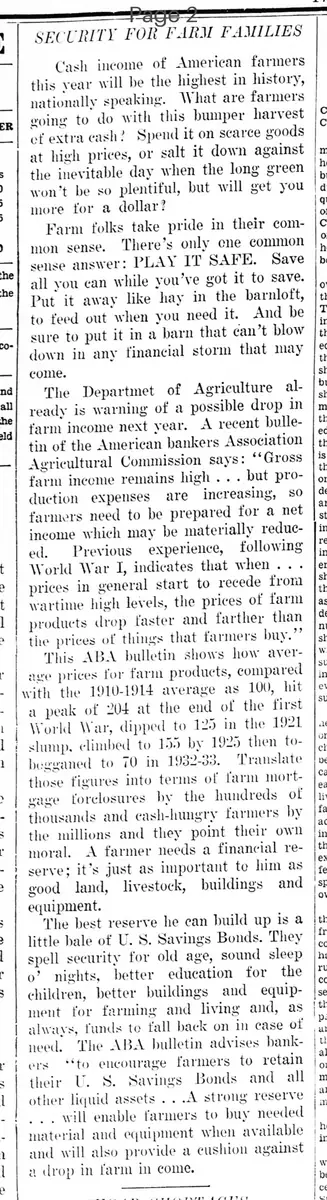
SECURITY FOR FARM FAMILIES
Cash income of American farmers this year will be the highest in history, nationally speaking. What are farmers going to do with this bumper harvest of extra cash? Spend it on scarce goods at high prices, or salt it down against the inevitable day when the long green won't be so plentiful, but will get you more for a dollar?
Farm folks take pride in their common sense. There's only one common sense answer: PLAY IT SAFE. Save all you can while you've got it to save. Put it away like hay in the barnloft, to feed out when you need it. And be sure to put it in a barn that can't blow down in any financial storm that may come.
The Department of Agriculture already is warning of a possible drop in farm income next year. A recent bulletin of the American Bankers Association Agricultural Commission says: "Gross farm income remains high . . . but production expenses are increasing, so farmers need to be prepared for a net income which may be materially reduced. Previous experience, following World War I, indicates that when . . . prices in general start to recede from wartime high levels, the prices of farm products drop faster and farther than the prices of things that farmers buy."
This ABA bulletin shows how average prices for farm products, compared with the 1910-1914 average as 100, hit a peak of 201 at the end of the first World War, dipped to 125 in the 1921 slump, climbed to 155 by 1925 then to 70 in 1932-33. Translate those figures into terms of farm mortgage foreclosures by the hundreds of thousands and cash-hungry farmers by the millions and they point their own moral. A farmer needs a financial reserve; it's just as important to him as good land, livestock, buildings and equipment.
The best reserve he can build up is a little bale of U. S. Savings Bonds. They spell security for old age, sound sleep nights, better education for the children, better buildings and equipment for farming and living and, as always, funds to fall back on in case of need. The ABA bulletin advises bankers to encourage farmers to retain their U. S. Savings Bonds and all other liquid assets . . . A strong reserve . . . will enable farmers to buy needed material and equipment when available and will also provide a cushion against a drop in farm income.
Cash income of American farmers this year will be the highest in history, nationally speaking. What are farmers going to do with this bumper harvest of extra cash? Spend it on scarce goods at high prices, or salt it down against the inevitable day when the long green won't be so plentiful, but will get you more for a dollar?
Farm folks take pride in their common sense. There's only one common sense answer: PLAY IT SAFE. Save all you can while you've got it to save. Put it away like hay in the barnloft, to feed out when you need it. And be sure to put it in a barn that can't blow down in any financial storm that may come.
The Department of Agriculture already is warning of a possible drop in farm income next year. A recent bulletin of the American Bankers Association Agricultural Commission says: "Gross farm income remains high . . . but production expenses are increasing, so farmers need to be prepared for a net income which may be materially reduced. Previous experience, following World War I, indicates that when . . . prices in general start to recede from wartime high levels, the prices of farm products drop faster and farther than the prices of things that farmers buy."
This ABA bulletin shows how average prices for farm products, compared with the 1910-1914 average as 100, hit a peak of 201 at the end of the first World War, dipped to 125 in the 1921 slump, climbed to 155 by 1925 then to 70 in 1932-33. Translate those figures into terms of farm mortgage foreclosures by the hundreds of thousands and cash-hungry farmers by the millions and they point their own moral. A farmer needs a financial reserve; it's just as important to him as good land, livestock, buildings and equipment.
The best reserve he can build up is a little bale of U. S. Savings Bonds. They spell security for old age, sound sleep nights, better education for the children, better buildings and equipment for farming and living and, as always, funds to fall back on in case of need. The ABA bulletin advises bankers to encourage farmers to retain their U. S. Savings Bonds and all other liquid assets . . . A strong reserve . . . will enable farmers to buy needed material and equipment when available and will also provide a cushion against a drop in farm income.
What sub-type of article is it?
Agriculture
Economic Policy
What keywords are associated?
Farm Income
Savings Bonds
Financial Security
Agriculture
Post War Economy
Price Drops
Farm Foreclosures
What entities or persons were involved?
Department Of Agriculture
American Bankers Association Agricultural Commission
U.S. Savings Bonds
Editorial Details
Primary Topic
Urging Farmers To Save In U.S. Savings Bonds For Future Financial Security
Stance / Tone
Advisory And Cautionary
Key Figures
Department Of Agriculture
American Bankers Association Agricultural Commission
U.S. Savings Bonds
Key Arguments
Cash Income Of American Farmers Is At Historic High This Year
Farmers Should Save Extra Cash Rather Than Spend On Scarce Goods
Department Of Agriculture Warns Of Possible Drop In Farm Income Next Year
Post Wwi Experience Shows Farm Product Prices Drop Faster Than Other Prices
Farmers Need Financial Reserve As Important As Land And Equipment
U.S. Savings Bonds Provide Security For Old Age, Education, And Emergencies
Bankers Advised To Encourage Farmers To Retain Savings Bonds And Liquid Assets