Thank you for visiting SNEWPapers!
Sign up free
Letter to Editor
November 13, 1816
Daily National Intelligencer
Washington, District Of Columbia
What is this article about?
Joseph Vannini defends his patent for an improved lottery drawing system against criticism in the National Advocate, arguing it is an innovation over European methods used for raising funds, and offers it for authorized use in the United States.
Clipping
OCR Quality
95%
Excellent
Full Text
[United States Gaz.
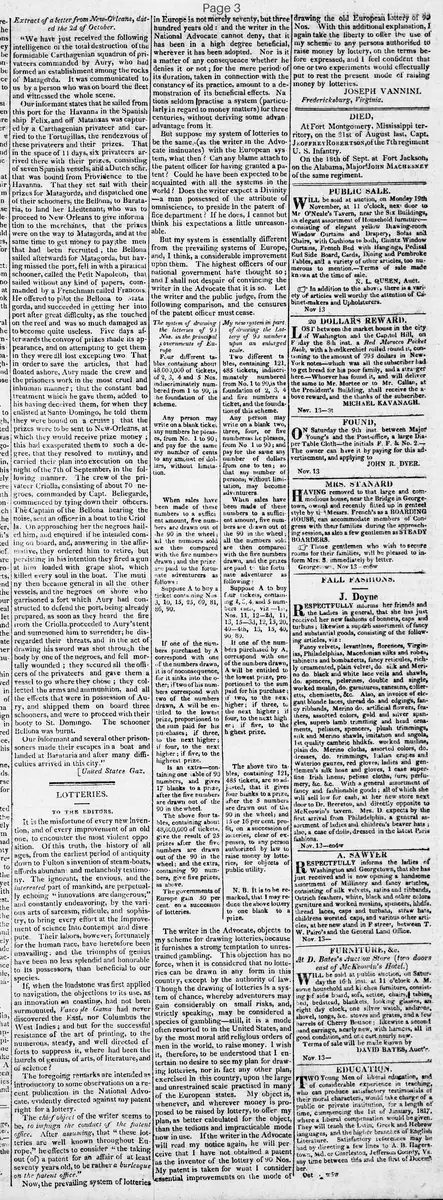
LOTTERIES.
TO THE EDITORS.
It is the misfortune of every new invention, and of every improvement of an old one, to encounter the most violent opposition. Of this truth, the history of all ages, from the earliest period of antiquity down to Fulton's invention of steam-boats, affords abundant and melancholy testimony. The ignorant, the envious, and the interested part of mankind, are perpetually echoing "innovations are dangerous;" and constantly endeavoring, by the various arts of sarcasm, ridicule, and sophistry, to bring every effort at the improvement of science into contempt and disrepute. Their labors, however; fortunately for the human race, have heretofore been unavailing; and the triumphs of genius have been no less splendid and honorable to its possessors, than beneficial to our species.
If, when the loadstone was first applied to navigation, the objections to its use, as an innovation on coasting, had not been surmounted, Vasco de Gama had never discovered the East, nor Columbus the West Indies; and but for the successful resistance of the art of printing, to the numerous, steady, and well directed efforts to suppress it, where had been the laurels of genius, of arts, of literature, and of science?
The foregoing remarks are intended as introductory to some observations on a recent publication in the National Advocate, evidently directed against my patent right for a lottery.
The chief object of the writer seems to be, to impugn the conduct of the patent office. After assuming, that "these lotteries are well known throughout Europe," he affects to consider "the taking out (of) a patent for an affair of at least seventy years old, to be rather a burlesque on the patent office."
Now, the prevailing system of lotteries in Europe is not merely seventy, but three hundred years old: and the writer in the National Advocate cannot deny, that it has been in a high degree beneficial, wherever it has been adopted. Nor is it a matter of any consequence whether he denies it or not ; for the mere period of its duration, taken in connection with the constancy of its practice, amount to a demonstration of its beneficial effects. Nations seldom practise a system (particularly in regard to money matters) for three centuries, without deriving some advantage from it.
But suppose my system of lotteries to be the same, (as the writer in the Advocate insinuates) with the European system, what then ? Can any blame attach to the patent officer for having granted a patent? Could he have been expected to be acquainted with all the systems in the world ? Does the writer expect a Divinity, a man possessed of the attribute of omniscience, to preside in the patent office department? If he does, I cannot but think his expectations a little unreasonable.
But my system is essentially different from the prevailing systems of Europe, and, I think, a considerable improvement upon them. The highest officers of our national government have thought so; and I shall not despair of convincing the writer in the Advocate that it is so. Let the writer and the public judge, from the following comparison, and the censures of the patent officer must cease.
The system of drawing the lotteries of governments of Europe is not merely seventy, but three hundred years old: and the writer in the National Advocate cannot deny, that it has been in a high degree beneficial, wherever it has been adopted.
Four different tables containing about 48,000,000 of tickets, of 2, 3, 4 and 5 Nos. indiscriminately numbered from 1 to 90, is the foundation of the scheme.
Any person may write on a blank ticket any numbers he pleases, from No. 1 to 90; and pay for the same any number of cents to any amount of dollars, without limitation, so that any number of persons, without limitation, may become adventurers.
When sales have been made of these numbers to a sufficient amount, five numbers are drawn out of the 90 in the wheel; all the numbers sold are then compared with the five numbers drawn; and the prizes are paid to the fortunate adventurers as follows:
Suppose A to buy a ticket containing Nos. 3, 10, 15, 25, 69, 81, 86, 90.
Nos. 1st, 12, 9d, 11, 13. 15d, 12, 15, 20. 40-4th, 13, 15, 40, 90,80.
If one of the numbers purchased by A correspond with one of the numbers drawn, it is of no consequence, for it sinks into the other; if two of his numbers correspond with two of the numbers drawn, A will be entitled to the lowest prize, proportioned to the sum paid for his purchase; if three, to the next higher; if four, to the next higher; if five, to the highest prize.
The above two tables, containing 121,485 tickets, are so adjusted, that it gives 17 blanks to a prize, after the five numbers are drawn out of the 90 in the wheel.
The above four tables, containing about 48,000,000 of tickets, give the result of 25 prizes after the five numbers are drawn out of the 90 in the wheel; and the extra, containing 90 numbers, give five prizes, as above.
The governments of Europe gain 50 per cent. on a succession of lotteries.
N. B. It is to be remarked, that I may reduce the above lottery to one blank to a prize.
The writer in the Advocate, objects to my scheme for drawing lotteries, because it furnishes a strong temptation to unrestrained gambling. This objection has no force, when it is considered that no lotteries can be drawn in any form in this country, except by the authority of law.
Though the drawing of lotteries is a system of chance, whereby adventurers may gain considerably on small risks, and, strictly speaking, may be considered a species of gambling—still, it is a mode often resorted to in the United States, and by the most moral and religious orders of men in the world, to raise money. I wish it, therefore, to be understood that I entertain no desire to see my plan for drawing lotteries, nor in fact any other plan, exercised in this country, upon the large and unrestrained scale practised in many of the European states. My object is, whenever, and wherever money is proposed to be raised by lottery, to offer my plan, as better calculated for the object, than the tedious and impracticable mode now in use. If the writer in the Advocate will read my notice again, he will perceive that I have not obtained a patent as the inventor of the lottery of 90 Nos. My patent is taken for what I consider essential improvements on the mode of drawing the old European lottery of 90 Nos. With this additional explanation, I again take the liberty to offer the use of my scheme to any persons authorised to raise money by lottery, on the terms before expressed, and I feel confident that one or two experiments would effectually put to rest the present mode of raising money by lotteries.
JOSEPH VANNINI.
Fredericksburg, Virginia
LOTTERIES.
TO THE EDITORS.
It is the misfortune of every new invention, and of every improvement of an old one, to encounter the most violent opposition. Of this truth, the history of all ages, from the earliest period of antiquity down to Fulton's invention of steam-boats, affords abundant and melancholy testimony. The ignorant, the envious, and the interested part of mankind, are perpetually echoing "innovations are dangerous;" and constantly endeavoring, by the various arts of sarcasm, ridicule, and sophistry, to bring every effort at the improvement of science into contempt and disrepute. Their labors, however; fortunately for the human race, have heretofore been unavailing; and the triumphs of genius have been no less splendid and honorable to its possessors, than beneficial to our species.
If, when the loadstone was first applied to navigation, the objections to its use, as an innovation on coasting, had not been surmounted, Vasco de Gama had never discovered the East, nor Columbus the West Indies; and but for the successful resistance of the art of printing, to the numerous, steady, and well directed efforts to suppress it, where had been the laurels of genius, of arts, of literature, and of science?
The foregoing remarks are intended as introductory to some observations on a recent publication in the National Advocate, evidently directed against my patent right for a lottery.
The chief object of the writer seems to be, to impugn the conduct of the patent office. After assuming, that "these lotteries are well known throughout Europe," he affects to consider "the taking out (of) a patent for an affair of at least seventy years old, to be rather a burlesque on the patent office."
Now, the prevailing system of lotteries in Europe is not merely seventy, but three hundred years old: and the writer in the National Advocate cannot deny, that it has been in a high degree beneficial, wherever it has been adopted. Nor is it a matter of any consequence whether he denies it or not ; for the mere period of its duration, taken in connection with the constancy of its practice, amount to a demonstration of its beneficial effects. Nations seldom practise a system (particularly in regard to money matters) for three centuries, without deriving some advantage from it.
But suppose my system of lotteries to be the same, (as the writer in the Advocate insinuates) with the European system, what then ? Can any blame attach to the patent officer for having granted a patent? Could he have been expected to be acquainted with all the systems in the world ? Does the writer expect a Divinity, a man possessed of the attribute of omniscience, to preside in the patent office department? If he does, I cannot but think his expectations a little unreasonable.
But my system is essentially different from the prevailing systems of Europe, and, I think, a considerable improvement upon them. The highest officers of our national government have thought so; and I shall not despair of convincing the writer in the Advocate that it is so. Let the writer and the public judge, from the following comparison, and the censures of the patent officer must cease.
The system of drawing the lotteries of governments of Europe is not merely seventy, but three hundred years old: and the writer in the National Advocate cannot deny, that it has been in a high degree beneficial, wherever it has been adopted.
Four different tables containing about 48,000,000 of tickets, of 2, 3, 4 and 5 Nos. indiscriminately numbered from 1 to 90, is the foundation of the scheme.
Any person may write on a blank ticket any numbers he pleases, from No. 1 to 90; and pay for the same any number of cents to any amount of dollars, without limitation, so that any number of persons, without limitation, may become adventurers.
When sales have been made of these numbers to a sufficient amount, five numbers are drawn out of the 90 in the wheel; all the numbers sold are then compared with the five numbers drawn; and the prizes are paid to the fortunate adventurers as follows:
Suppose A to buy a ticket containing Nos. 3, 10, 15, 25, 69, 81, 86, 90.
Nos. 1st, 12, 9d, 11, 13. 15d, 12, 15, 20. 40-4th, 13, 15, 40, 90,80.
If one of the numbers purchased by A correspond with one of the numbers drawn, it is of no consequence, for it sinks into the other; if two of his numbers correspond with two of the numbers drawn, A will be entitled to the lowest prize, proportioned to the sum paid for his purchase; if three, to the next higher; if four, to the next higher; if five, to the highest prize.
The above two tables, containing 121,485 tickets, are so adjusted, that it gives 17 blanks to a prize, after the five numbers are drawn out of the 90 in the wheel.
The above four tables, containing about 48,000,000 of tickets, give the result of 25 prizes after the five numbers are drawn out of the 90 in the wheel; and the extra, containing 90 numbers, give five prizes, as above.
The governments of Europe gain 50 per cent. on a succession of lotteries.
N. B. It is to be remarked, that I may reduce the above lottery to one blank to a prize.
The writer in the Advocate, objects to my scheme for drawing lotteries, because it furnishes a strong temptation to unrestrained gambling. This objection has no force, when it is considered that no lotteries can be drawn in any form in this country, except by the authority of law.
Though the drawing of lotteries is a system of chance, whereby adventurers may gain considerably on small risks, and, strictly speaking, may be considered a species of gambling—still, it is a mode often resorted to in the United States, and by the most moral and religious orders of men in the world, to raise money. I wish it, therefore, to be understood that I entertain no desire to see my plan for drawing lotteries, nor in fact any other plan, exercised in this country, upon the large and unrestrained scale practised in many of the European states. My object is, whenever, and wherever money is proposed to be raised by lottery, to offer my plan, as better calculated for the object, than the tedious and impracticable mode now in use. If the writer in the Advocate will read my notice again, he will perceive that I have not obtained a patent as the inventor of the lottery of 90 Nos. My patent is taken for what I consider essential improvements on the mode of drawing the old European lottery of 90 Nos. With this additional explanation, I again take the liberty to offer the use of my scheme to any persons authorised to raise money by lottery, on the terms before expressed, and I feel confident that one or two experiments would effectually put to rest the present mode of raising money by lotteries.
JOSEPH VANNINI.
Fredericksburg, Virginia
What sub-type of article is it?
Persuasive
Informative
What themes does it cover?
Commerce Trade
Economic Policy
What keywords are associated?
Lottery Patent
European Lotteries
Patent Office
Money Raising
Gambling
Innovations
National Advocate
What entities or persons were involved?
Joseph Vannini
The Editors
Letter to Editor Details
Author
Joseph Vannini
Recipient
The Editors
Main Argument
the patent for the improved lottery system is valid and beneficial for raising funds, differing from and improving upon european methods, and criticism of the patent office is unreasonable.
Notable Details
References Historical Innovations Like Loadstone Navigation, Printing, Vasco De Gama, Columbus
Describes Lottery Scheme With Tables Of Tickets Numbered 1 To 90
Compares To European Systems Gaining 50 Percent
Addresses Gambling Concerns By Noting Legal Restrictions In The Us