Thank you for visiting SNEWPapers!
Sign up free
Alexandria Daily Advertiser
Alexandria, Virginia
What is this article about?
King George III of Britain issues a formal declaration from Windsor on April 29, 1806, protesting Prussia's occupation and administration of the Electorate of Hanover, accusing Berlin of betrayal, violating neutrality, and allying secretly with France amid the Napoleonic Wars, while appealing to Europe for support and aid as Elector of Brunswick-Lüneburg.
Clipping
OCR Quality
Full Text
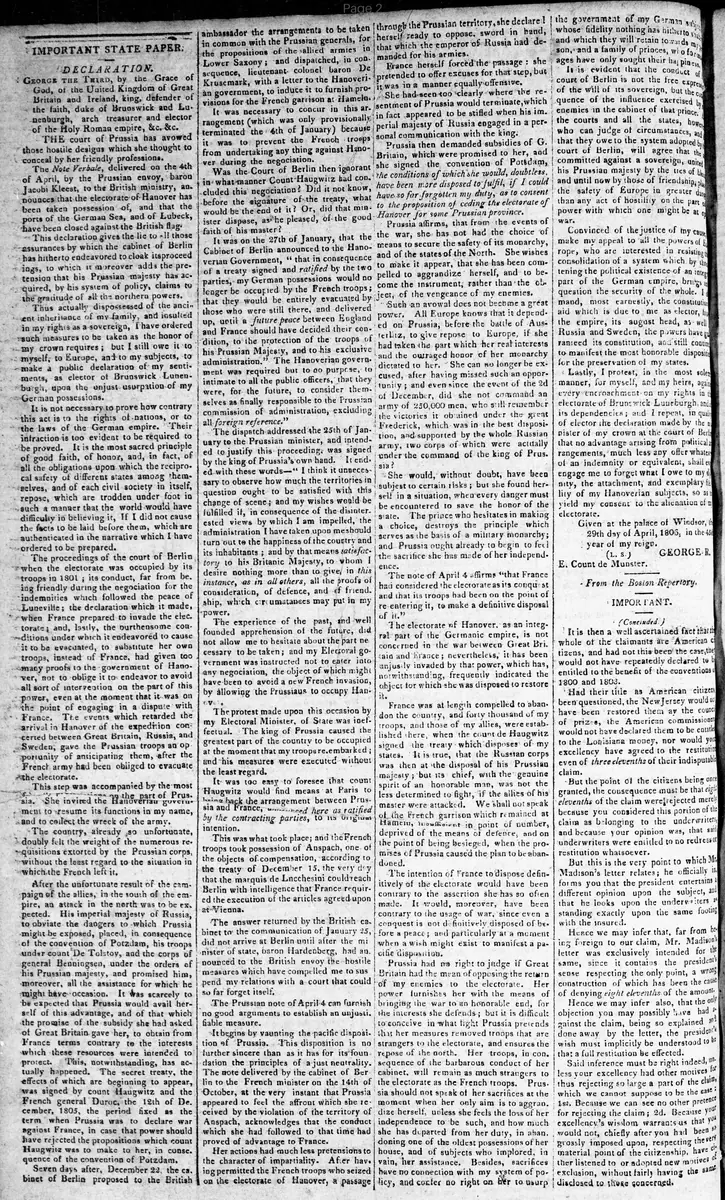
A DECLARATION.
GEORGE THE THIRD, by the Grace of God, of the United Kingdom of Great Britain and Ireland, King, Defender of the Faith, Duke of Brunswick and Lunenburg, Arch Treasurer and Elector of the Holy Roman Empire, &c. &c.
The court of Prussia has avowed those hostile designs which she thought to conceal by her friendly professions. The Note Verbale, delivered on the 4th of April, by the Prussian envoy, Baron Jacobi Kleest, to the British ministry, announces that the Electorate of Hanover has been taken possession of, and that the ports of the German Sea, and of Lubeck, have been closed against the British flag.
This declaration gives the lie to all those assurances by which the cabinet of Berlin has hitherto endeavored to cloak its proceedings, to which it moreover adds the pretension that his Prussian Majesty has acquired, by his system of policy, claims to the gratitude of all the northern powers.
Thus actually dispossessed of the ancient inheritance of my family, and insulted in my rights as a sovereign, I have ordered such measures to be taken as the honor of my crown requires; but I still owe it to myself, to Europe, and to my subjects, to make a public declaration of my sentiments, as elector of Brunswick Lunenburg, upon the unjust usurpation of my German possessions.
It is not necessary to prove how contrary this act is to the rights of nations, or to the laws of the German Empire. Their infraction is too evident to be required to be proved. It is the most sacred principle of good faith, of honor, and, in fact, of all the obligations upon which the reciprocal safety of different states among themselves, and of each civil society in itself, repose, which are trodden under foot in such a manner that the world would have difficulty in believing it, if I did not cause the facts to be laid before them, which are authenticated in the narrative which I have ordered to be prepared.
The proceedings of the court of Berlin, when the Electorate was occupied by its troops in 1801; its conduct, far from being friendly during the negotiation for the indemnities which followed the peace of Luneville; the declaration which it made, when France prepared to invade the Electorate; and, lastly, the burdensome conditions under which it endeavored to cause it to be evacuated, to substitute her own troops, instead of France, had given too many proofs to the government of Hanover, not to oblige it to endeavor to avoid all sort of intervention on the part of this power, even at the moment that it was on the point of engaging in a dispute with France. The events which retarded the arrival in Hanover of the expedition concerted between Great Britain, Russia, and Sweden, gave the Prussian troops an opportunity of anticipating them, after the French army had been obliged to evacuate the Electorate.
This step was accompanied by the most oppressive measures on the part of Prussia. She invited the Hanoverian government to resume its functions in my name, and to collect the wreck of the army. The country, already so unfortunate, I doubly felt the weight of the numerous requisitions extorted by the Prussian corps, without the least regard to the situation in which the French left it.
After the unfortunate result of the campaign of the allies, in the south of the Empire, an attack in the north was to be expected. His Imperial Majesty of Russia, to obviate the dangers to which Prussia might be exposed, placed, in consequence of the convention of Potsdam, his troops under Count de Tolstoy, and the corps of General Bennigsen, under the orders of his Prussian Majesty, and promised him, moreover, all the assistance for which he might have occasion. It was scarcely to be expected that Prussia would avail herself of this advantage, and of that which the promise of the subsidy she had asked of Great Britain gave her, to obtain from France terms contrary to the interests which these resources were intended to protect. This, notwithstanding, has actually happened. The secret treaty, the effects of which are beginning to appear, was signed by Count Haugwitz and the French General Duroc, the 12th of December, 1805, the period fixed as the term when Prussia was to declare war against France, in case that power should have rejected the propositions which Count Haugwitz was to make to her, in consequence of the convention of Potsdam.
Seven days after, December 22, the cabinet of Berlin proposed to the British ambassador the arrangements to be taken in common with the Prussian generals, for the positions of the allied armies in Lower Saxony; and dispatched, in consequence, Lieutenant Colonel Baron de Krusemark, with a letter to the Hanoverian government, to induce it to furnish provisions for the French garrison at Hameln.
It was necessary to concur in this arrangement (which was only provisionally terminated the 4th of January) because it was to prevent the French troops from undertaking anything against Hanover during the negotiation.
Was the Court of Berlin then ignorant in what manner Count Haugwitz had concluded this negotiation? Did it not know, before the signature of the treaty, what would be the end of it? Or, did that minister dispose, as he pleased, of the good faith of his master?
It was on the 27th of January, that the Cabinet of Berlin announced to the Hanoverian Government, 'that in consequence of a treaty signed and ratified by the two parties, my German possessions would no longer be occupied by the French troops; that they would be entirely evacuated by those who were still there, and delivered up, until a future peace between England and France should have decided their condition, to the protection of the troops of his Prussian Majesty, and to his exclusive administration.' The Hanoverian government was required but to conform, to intimate to all the public officers, that they were, for the future, to consider themselves as finally responsible to the Prussian commission of administration, excluding all foreign reference.
The dispatch addressed the 25th of January to the Prussian minister, and intended to justify this proceeding, was signed by the King of Prussia's own hand. It ended with these words - 'I think it unnecessary to observe how much the territories in question ought to be satisfied with this change of scene; and my wishes would be fulfilled if, in consequence of the disinterested views by which I am impelled, the administration I have taken upon me should turn out to the happiness of the country and its inhabitants; and by that means satisfactory to his Britannic Majesty, to whom I desire nothing more than to give, in this instance, as in all others, all the proofs of consideration, of defence, and of friendship, which circumstances may put in my power.'
The experience of the past, and well founded apprehension of the future, did not allow me to hesitate about the part necessary to be taken; and my Electoral government was instructed not to enter into any negotiation, the object of which might have been to avoid a new French invasion, by allowing the Prussians to occupy Hanover.
The protest made upon this occasion by my Electoral Minister, of State was ineffectual. The King of Prussia caused the greatest part of the country to be occupied at the moment that my troops re-embarked; and his measures were executed without the least regard.
It was too easy to foresee that Count Haugwitz would find means at Paris to bring back the arrangement between Prussia and France, announced here as ratified by the contracting parties, to its original intention.
This was what took place; and the French troops took possession of Anspach, one of the objects of compensation, according to the treaty of December 15, the very day that the Marquis de Lucquesini could reach Berlin with intelligence that France required the execution of the articles agreed upon at Vienna.
The answer returned by the British cabinet to the communication of January 25, did not arrive at Berlin until after the minister of state, Baron Hardenberg, had announced to the British envoy the hostile measures which have compelled me to suspend my relations with a court that could so far forget itself.
The Prussian note of April 4 can furnish no good arguments to establish an unjustifiable measure.
It begins by vaunting the pacific disposition of Prussia. This disposition is no further sincere than as it has for its foundation the principles of a just neutrality.
The note delivered by the cabinet of Berlin to the French minister on the 14th of October, at the very instant that Prussia appeared to feel the affront which she received by the violation of the territory of Anspach, acknowledges that the conduct which she had followed to that time had proved of advantage to France.
Her actions had much less pretensions to the character of impartiality. After having permitted the French troops who seized on the Electorate of Hanover, a passage through the Prussian territory, she declared herself ready to oppose, sword in hand, that which the Emperor of Russia had demanded for his armies.
France herself forced the passage: she pretended to offer excuses for that step, but it was in a manner equally offensive.
She had seen too clearly where the resentment of Prussia would terminate, which in fact appeared to be stifled when his Imperial Majesty of Russia engaged in a personal communication with the King.
Prussia then demanded subsidies of G. Britain, which were promised to her, and she signed the convention of Potsdam, the conditions of which she would, doubtless, have been more disposed to fulfil, if I could have so far forgotten my duty, as to consent to the proposition of ceding the Electorate of Hanover for some Prussian province.
Prussia affirms, that from the events of the war, she has not had the choice of means to secure the safety of its monarchy, and of the states of the North. She wishes to make it appear, that she has been compelled to aggrandize herself, and to become the instrument, rather than the object, of the vengeance of my enemies.
Such an avowal does not become a great power. All Europe knows that it depended on Prussia, before the battle of Austerlitz, to give repose to Europe, if she had taken the part which her real interests and the outraged honor of her monarchy dictated to her. She can no longer be excused, after having missed such an opportunity; and even since the event of the 2d of December, did she not command an army of 250,000 men, who still remember the victories it obtained under the great Frederick, which was in the best disposition, and supported by the whole Russian army, two corps of which were actually under the command of the King of Prussia?
She would, without doubt, have been subject to certain risks; but she found herself in a situation, when every danger must be encountered to save the honor of the state. The prince who hesitates in making a choice, destroys the principle which serves as the basis of a military monarchy; and Prussia ought already to begin to feel the sacrifice she has made of her independence.
The note of April 4 affirms 'that France had considered the Electorate as its conquest, and that its troops had been on the point of re-entering it, to make a definitive disposal of it.'
The Electorate of Hanover, as an integral part of the Germanic Empire, is not concerned in the war between Great Britain and France: nevertheless, it has been unjustly invaded by that power, which has, notwithstanding, frequently indicated the object for which she was disposed to restore it.
France was at length compelled to abandon the country, and forty thousand of my troops, and those of my allies, were established there, when the Count de Haugwitz signed the treaty which disposes of my states. It is true, that the Russian corps was then at the disposal of his Prussian Majesty; but its chief, with the genuine spirit of an honorable man, was not the less determined to fight, if the allies of his master were attacked. We shall not speak of the French garrison which remained at Hameln, insufficient in point of number, deprived of the means of defence, and on the point of being besieged, when the promises of Prussia caused the plan to be abandoned.
The intention of France to dispose definitively of the Electorate would have been contrary to the assertion she has so often made. It would, moreover, have been contrary to the usage of war, since even a conquest is not definitively disposed of before a peace; and particularly at a moment when a wish might exist to manifest a pacific disposition.
Prussia had no right to judge if Great Britain had the means of opposing the return of my enemies to the Electorate. Her power furnishes her with the means of bringing the war to an honorable end, for the interests she defends: but it is difficult to conceive in what right Prussia pretends that her measures removed troops that are strangers to the Electorate, and ensures the repose of the north. Her troops, in consequence of the barbarous conduct of her cabinet, will remain as much strangers to the Electorate as the French troops. Prussia should not speak of her sacrifices at the moment when her only aim is to aggrandize herself, unless she feels the loss of her independence to be such, and how much she has departed from her duty, in abandoning one of the oldest possessions of her house, and of subjects who implored, in vain, her assistance. Besides, sacrifices have no connection with my system of policy, and confer no right on her to usurp the government of my German subjects, whose fidelity nothing has hitherto shaken, and which they will retain towards my son, and a family of princes, who for ages have only sought their happiness.
It is evident that the conduct of the court of Berlin is not the free expression of the will of its sovereign, but the consequence of the influence exercised by my enemies in the cabinet of that prince: the courts and all the states, however, who can judge of circumstances, and that they owe to the system adopted by the court of Berlin, will agree that the outrages committed against a sovereign, united to his Prussian Majesty by the ties of blood, and until now by those of friendship, place the safety of Europe in greater danger than any act of hostility on the part of a power with which one might be at war.
Convinced of the justice of my cause, I make my appeal to all the powers of Europe, who are interested in resisting the consolidation of a system which by threatening the political existence of an integral part of the German Empire, brings it in question the security of the whole. I demand, most earnestly, the constitution aid which is due to me as elector, from the Empire, its august head, as well as from Russia and Sweden, the powers who have guaranteed its constitution, and still continue to manifest the most honorable dispositions for the preservation of my states.
Lastly, I protest, in the most solemn manner, for myself, and my heirs, against every encroachment on my rights in the Electorate of Brunswick Luneburgh, and its dependencies; and I repeat, in quality of elector, the declaration made by the minister of my crown at the court of Berlin, that no advantage arising from political arrangements, much less any offer whatever of an indemnity or equivalent, shall ever engage me to forget what I owe to my dignity, the attachment, and exemplary fidelity of my Hanoverian subjects, so as to yield my consent to the alienation of my Electorate.
Given at the Palace of Windsor, the 29th day of April, 1806, in the 46th year of my reign.
(L. S.)
GEORGE R.
E. Count de Munster.
- From the Boston Repertory.
What sub-type of article is it?
What keywords are associated?
What entities or persons were involved?
Where did it happen?
Foreign News Details
Primary Location
Electorate Of Hanover
Event Date
29th Day Of April, 1806
Key Persons
Outcome
prussian occupation of hanover; british suspension of relations with prussia; appeal to europe, empire, russia, and sweden for aid; solemn protest against encroachments on hanoverian rights.
Event Details
King George III declares Prussia's occupation of the Electorate of Hanover unjust, citing betrayal of alliances, secret treaty with France on December 12, 1805, violation of neutrality, and historical hostilities; details Prussian actions from 1801 onward, including troop occupations, requisitions, and false assurances; protests the usurpation and demands restoration as Elector of Brunswick-Lüneburg.