Thank you for visiting SNEWPapers!
Sign up free
The Sully County Watchman
Onida, Clifton, Sully County, South Dakota
What is this article about?
The Cork Incorporated Chamber of Commerce and Shipping requested the First Lord of the Admiralty to utilize Haulbowline docks for employment in Ireland, but was refused as it would involve unnecessary public expenditure without desired effect. Commentary criticizes unequal taxation on Irish and notes Irish voting for free trade in the US.
Clipping
OCR Quality
Full Text
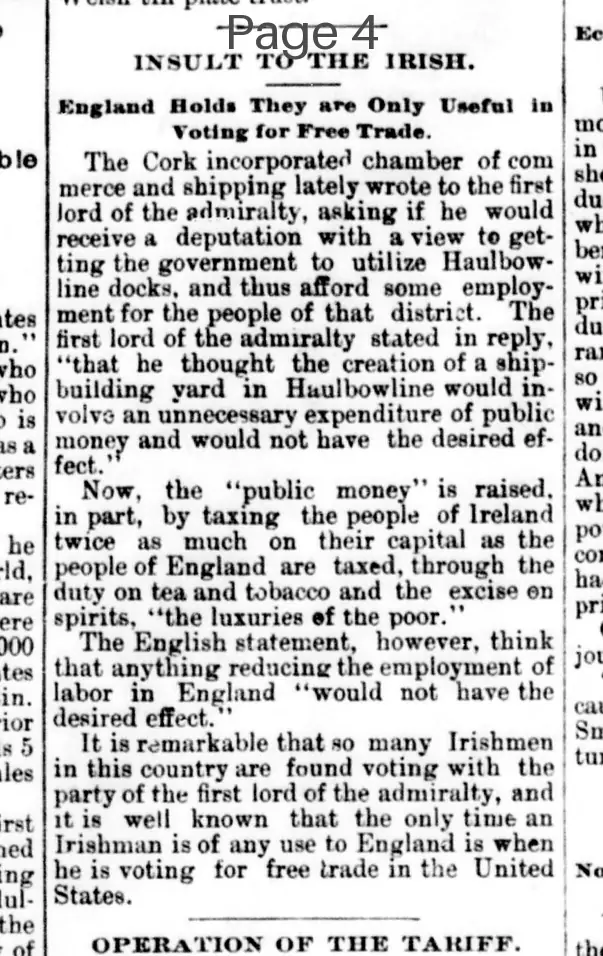
England Holds They are Only Useful in Voting for Free Trade.
The Cork incorporated chamber of commerce and shipping lately wrote to the first Lord of the admiralty, asking if he would receive a deputation with a view to getting the government to utilize Haulbowline docks, and thus afford some employment for the people of that district. The first lord of the admiralty stated in reply, "that he thought the creation of a ship-building yard in Haulbowline would involve an unnecessary expenditure of public money and would not have the desired effect."
Now, the "public money" is raised in part, by taxing the people of Ireland twice as much on their capital as the people of England are taxed, through the duty on tea and tobacco and the excise on spirits, "the luxuries of the poor."
The English statement, however, thinks that anything reducing the employment of labor in England "would not have the desired effect."
It is remarkable that so many Irishmen in this country are found voting with the party of the first lord of the admiralty, and it is well known that the only time an Irishman is of any use to England is when he is voting for free trade in the United States.
What sub-type of article is it?
What keywords are associated?
What entities or persons were involved?
Where did it happen?
Foreign News Details
Primary Location
Cork, Ireland
Event Date
Lately
Key Persons
Outcome
refusal to create ship-building yard at haulbowline due to unnecessary expenditure and lack of desired effect
Event Details
The Cork incorporated chamber of commerce and shipping wrote to the first Lord of the admiralty requesting a deputation to utilize Haulbowline docks for employment. The reply stated that creating a ship-building yard would involve unnecessary public money expenditure and not achieve the desired effect. Commentary notes unequal taxation on Irish people via duties on tea, tobacco, and spirits excise, and criticizes the policy's impact on English labor employment. It also remarks on Irishmen voting with the admiralty's party and their utility to England in voting for free trade in the United States.