Thank you for visiting SNEWPapers!
Sign up free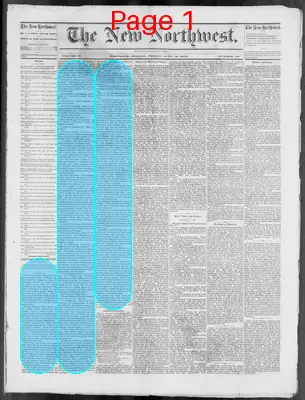
Literary
July 18, 1873
The New Northwest
Portland, Multnomah County, Oregon
What is this article about?
In a rural court, Ellen Dowd defends against her husband Peter's divorce suit on false adultery charges. Despite biased witnesses and jury, she reveals Jacob Graham's will in her favor and a notarized denial of the accusations, leading the judge to dismiss the case.
Clipping
OCR Quality
98%
Excellent
Full Text
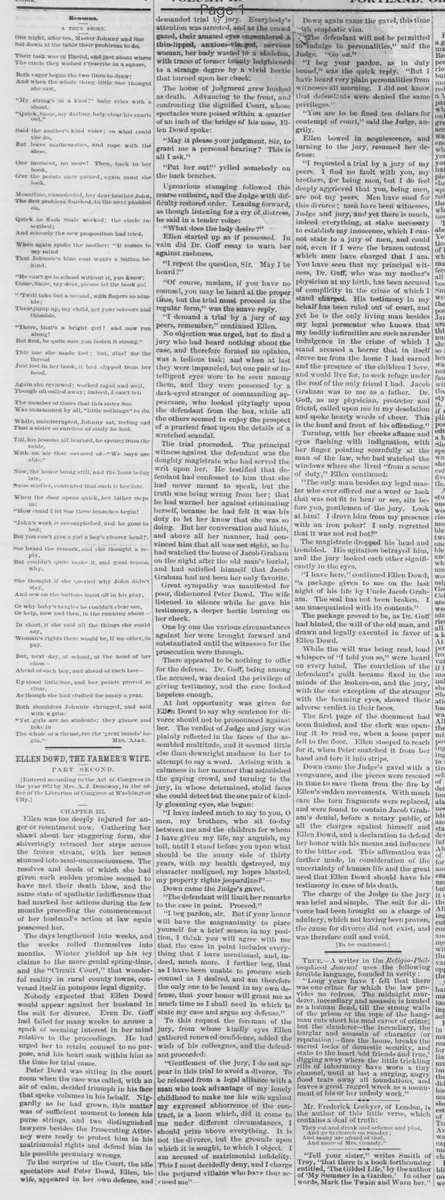
ELLEN DOWD, THE FARMER'S WIFE.
PART SECOND.
[Entered according to the Act of Congress in
the year 1872 by Mrs. A. J. Duniway, in the of-
fice of the Librarian of Congress at Washington
City.]
CHAPTER III.
Ellen was too deeply injured for anger or resentment now. Gathering her
shawl about her staggering form, she
shiveringly retraced her steps across
the frozen stream, with her senses
stunned into semi-unconsciousness. The
resolves and deeds of which she had
given such sudden promise seemed to
have met their death blow, and the
same state of apathetic indifference that
had marked her actions during the few
months preceding the commencement
of her husband's action at law again
possessed her.
The days lengthened into weeks, and
the weeks rolled themselves into
months. Winter yielded up his icy
claims to the more genial spring-time,
and the "Circuit Court," that wonderful
reality in rural county towns, convened
itself in pompous legal dignity.
Nobody expected that Ellen Dowd
would appear against her husband in
the suit for divorce. Even Dr. Goff
had failed for many weeks to arouse a
spark of seeming interest in her mind
relative to the proceedings. He had
urged her to retain counsel to no purpose,
and his heart sank within him as
the time for trial came.
Peter Dowd was sitting in the court
room when the case was called, with an
air of calm, decided triumph in his face
that spoke volumes in his behalf. Niggardly
as he had grown, this matter
was of sufficient moment to loosen his
purse strings, and two distinguished
lawyers besides the Prosecuting Attorney
were ready to protect him in his
matrimonial rights and defend him in
his possible pecuniary wrongs.
To the surprise of the Court, the idle
spectators and Peter Dowd, Ellen, his
wife, appeared in her own defense, and
demanded trial by jury. Everybody's
attention was arrested, and as the crowd
gazed, their amazed eyes encountered a
thin-lipped, anxious-visaged, nervous
woman, her body wasted to a skeleton,
with traces of former beauty heightened
to a strange degree by a vivid hectic
that burned upon her cheek.
The house of judgment grew hushed
as death. Advancing to the front, and
confronting the dignified Court, whose
spectacles were poised within a quarter
of an inch of the bridge of his nose, Ellen
Dowd spoke:
"May it please your judgment, Sir, to
grant me a personal hearing? This is
all I ask."
"Put her out!" yelled somebody on
the back benches.
Uproarious stamping followed this
coarse outburst, and the Judge with difficulty
restored order. Leaning forward,
as though listening for a cry of distress,
he said in a tender voice:
"What does the lady desire?"
Ellen started up as if possessed. In
vain did Dr. Goff essay to warn her
against rashness.
"I repeat the question, Sir. May I be
heard?"
"Of course, madam, if you have no
counsel, you may be heard at the proper
time, but the trial must proceed in the
regular form," was the suave reply.
"I demand a trial by a jury of my
peers, remember," continued Ellen.
No objection was urged, but to find a
jury who had heard nothing about the
case, and therefore formed no opinion,
was a tedious task; and when at last
they were impaneled, but one pair of intelligent
eyes were to be seen among
them, and they were possessed by a
dark-eyed stranger of commanding appearance,
who looked pityingly upon
the defendant from the box, while all
the others seemed to enjoy the prospect
of a prurient feast upon the details of a
wretched scandal.
The trial proceeded. The principal
witness against the defendant was the
doughty magistrate who had served the
writ upon her. He testified that defendant
had confessed to him that she
had never meant to speak, but the
truth was being wrung from her; that
he had warned her against criminating
herself, because he had felt it was his
duty to let her know that she was so
doing. But her conversation and hints,
and above all her manner, had convinced
him that all was not right, so he
had watched the house of Jacob Graham
on the night after the old man's burial,
and had satisfied himself that Jacob
Graham had not been her only favorite.
Great sympathy was manifested for
poor, dishonored Peter Dowd. The wife
listened in silence while he gave his
testimony, a deeper hectic burning on
her cheek.
One by one the various circumstances
against her were brought forward and
substantiated until the witnesses for the
prosecution were through.
There appeared to be nothing to offer
for the defense. Dr. Goff, being among
the accused, was denied the privilege of
giving testimony, and the case looked
hopeless enough.
At last opportunity was given for
Ellen Dowd to say why sentence for divorce
should not be pronounced against
her. The verdict of Judge and jury was
plainly reflected in the faces of the assembled
multitude, and it seemed little
else than downright madness in her to
attempt to say a word. Arising with a
calmness in her manner that astonished
the gaping crowd, and turning to the
jury, in whose determined, stolid faces
she could detect but the one pair of kindly
gleaming eyes, she began:
"I have indeed much to say to you, O
men, my brothers, who sit to-day
between me and the children for whom
I have given my life, my anguish, my
toil, until I stand before you upon what
should be the sunny side of thirty
years, with my health destroyed, my
character maligned, my hopes blasted,
my property rights jeopardized"-
Down came the Judge's gavel.
"The defendant will limit her remarks
to the case in point. Proceed."
"I beg pardon, sir. But if your honor
will have the magnanimity to place
yourself for a brief season in my position,
I think you will agree with me
that the case in point includes everything
that I have mentioned, and, indeed,
much more. I further beg, that
as I have been unable to procure such
counsel as I desired, and am therefore
the only one to be heard in my own defense,
that your honor will grant me as
much time as I shall need in which to
state my case and argue my defense."
To this request the foreman of the
jury, from whose kindly eyes Ellen
gathered renewed confidence, added the
wish of his colleagues, and the defendant
proceeded:
"Gentlemen of the jury, I do not appear
in this trial to avoid a divorce. To
be released from a legal alliance with a
man who took advantage of my lonely
childhood to make me his wife against
my expressed abhorrence of the contract,
is a boon which, did it come to
me under different circumstances, I
should prize above everything. It is
not the divorce, but the grounds upon
which it is sought, to which I object. I
am accused of matrimonial infidelity.
This I most decidedly deny, and I charge
the perjured villains who have thus accused
me"
Down again came the gavel, this time
with emphatic vim.
"The defendant will not be permitted
to indulge in personalities," said the
Judge. "Go on."
"I beg your pardon, as in duty
bound," was the quick reply. "But I
have heard very plain personalities from
witnesses all morning. I did not know
that defendants were denied the same
privileges."
"You are to be fined ten dollars for
contempt of court," said the Judge, angrily.
Ellen bowed in acquiescence, and
turning to the jury, resumed her defense:
"I requested a trial by a jury of my
peers. I find no fault with you, my
brothers, for being men, but I do feel
deeply aggrieved that you, being men,
are not my peers. Men have sued for
this divorce; men have been witnesses,
Judge and jury, and yet there is much,
indeed everything, at stake necessary
to establish my innocence, which I cannot
state to a jury of men, and could
not, even if I were the brazen outcast
which men have charged that I am.
You have seen that my principal witness,
Dr. Goff, who was my mother's
physician at my birth, has been accused
of complicity in the crime of which I
stand charged. His testimony in my
behalf has been ruled out of court, and
yet he is the only living man besides
my legal persecutor who knows that
my bodily infirmities are such as render
indulgence in the crime of which I
stand accused a horror that in itself
drove me from the home I had earned
and the presence of the children I love,
and would live for, to seek refuge under
the roof of the only friend I had. Jacob
Graham was to me as a father. Dr.
Goff, as my physician, protector and
friend, called upon me in my desolation
and spoke hearty words of cheer. This
is the head and front of his offending."
Turning, with her cheeks aflame and
eyes flashing with indignation, with
her finger pointing scornfully at the
man of the law, who had watched the
windows where she lived "from a sense
of duty," Ellen continued:
"The only man besides my legal master
who ever offered me a word or look
that was not fit to hear or see, sits before
you, gentlemen of the jury. Look
at him! I drove him from my presence
with an iron poker! I only regretted
that it was not red hot!"
The magistrate dropped his head and
trembled. His agitation betrayed him,
and the jury looked each other significantly
in the eyes.
"I have here," continued Ellen Dowd,
"a package given to me on the last
night of his life by Uncle Jacob Graham.
The seal has not been broken. I
am unacquainted with its contents."
The package proved to be, as Dr. Goff
had hinted, the will of the old man, and
drawn and legally executed in favor of
Ellen Dowd.
While the will was being read, loud
whispers of "I told you so," were heard
on every hand. The conviction of the
defendant's guilt became fixed in the
minds of the lookers-on, and the jury,
with the one exception of the stranger
with the beaming eyes, showed their
adverse verdict in their faces.
The first page of the document had
been finished, and the clerk was opening
it to read on, when a loose paper
fell to the floor. Ellen stooped to reach
for it, when Peter snatched it from her
hand and tore it into strips.
Down came the Judge's gavel with a
vengeance, and the pieces were rescued
in time to save them from the fire by
Ellen's sudden movements. With much
care the torn fragments were replaced,
and were found to contain Jacob Graham's
denial, before a notary public, of
all the charges against himself and
Ellen Dowd, and a declaration to defend
her honor with his means and influence
to the bitter end. This affirmation was
further made, in consideration of the
uncertainty of human life and the great
need that Ellen Dowd should have his
testimony in case of his death.
The charge of the Judge to the jury
was brief and simple. The suit for divorce
had been brought on a charge of
adultery, which not having been proven,
the cause for divorce did not exist, and
was therefore null and void.
[To be continued.]
PART SECOND.
[Entered according to the Act of Congress in
the year 1872 by Mrs. A. J. Duniway, in the of-
fice of the Librarian of Congress at Washington
City.]
CHAPTER III.
Ellen was too deeply injured for anger or resentment now. Gathering her
shawl about her staggering form, she
shiveringly retraced her steps across
the frozen stream, with her senses
stunned into semi-unconsciousness. The
resolves and deeds of which she had
given such sudden promise seemed to
have met their death blow, and the
same state of apathetic indifference that
had marked her actions during the few
months preceding the commencement
of her husband's action at law again
possessed her.
The days lengthened into weeks, and
the weeks rolled themselves into
months. Winter yielded up his icy
claims to the more genial spring-time,
and the "Circuit Court," that wonderful
reality in rural county towns, convened
itself in pompous legal dignity.
Nobody expected that Ellen Dowd
would appear against her husband in
the suit for divorce. Even Dr. Goff
had failed for many weeks to arouse a
spark of seeming interest in her mind
relative to the proceedings. He had
urged her to retain counsel to no purpose,
and his heart sank within him as
the time for trial came.
Peter Dowd was sitting in the court
room when the case was called, with an
air of calm, decided triumph in his face
that spoke volumes in his behalf. Niggardly
as he had grown, this matter
was of sufficient moment to loosen his
purse strings, and two distinguished
lawyers besides the Prosecuting Attorney
were ready to protect him in his
matrimonial rights and defend him in
his possible pecuniary wrongs.
To the surprise of the Court, the idle
spectators and Peter Dowd, Ellen, his
wife, appeared in her own defense, and
demanded trial by jury. Everybody's
attention was arrested, and as the crowd
gazed, their amazed eyes encountered a
thin-lipped, anxious-visaged, nervous
woman, her body wasted to a skeleton,
with traces of former beauty heightened
to a strange degree by a vivid hectic
that burned upon her cheek.
The house of judgment grew hushed
as death. Advancing to the front, and
confronting the dignified Court, whose
spectacles were poised within a quarter
of an inch of the bridge of his nose, Ellen
Dowd spoke:
"May it please your judgment, Sir, to
grant me a personal hearing? This is
all I ask."
"Put her out!" yelled somebody on
the back benches.
Uproarious stamping followed this
coarse outburst, and the Judge with difficulty
restored order. Leaning forward,
as though listening for a cry of distress,
he said in a tender voice:
"What does the lady desire?"
Ellen started up as if possessed. In
vain did Dr. Goff essay to warn her
against rashness.
"I repeat the question, Sir. May I be
heard?"
"Of course, madam, if you have no
counsel, you may be heard at the proper
time, but the trial must proceed in the
regular form," was the suave reply.
"I demand a trial by a jury of my
peers, remember," continued Ellen.
No objection was urged, but to find a
jury who had heard nothing about the
case, and therefore formed no opinion,
was a tedious task; and when at last
they were impaneled, but one pair of intelligent
eyes were to be seen among
them, and they were possessed by a
dark-eyed stranger of commanding appearance,
who looked pityingly upon
the defendant from the box, while all
the others seemed to enjoy the prospect
of a prurient feast upon the details of a
wretched scandal.
The trial proceeded. The principal
witness against the defendant was the
doughty magistrate who had served the
writ upon her. He testified that defendant
had confessed to him that she
had never meant to speak, but the
truth was being wrung from her; that
he had warned her against criminating
herself, because he had felt it was his
duty to let her know that she was so
doing. But her conversation and hints,
and above all her manner, had convinced
him that all was not right, so he
had watched the house of Jacob Graham
on the night after the old man's burial,
and had satisfied himself that Jacob
Graham had not been her only favorite.
Great sympathy was manifested for
poor, dishonored Peter Dowd. The wife
listened in silence while he gave his
testimony, a deeper hectic burning on
her cheek.
One by one the various circumstances
against her were brought forward and
substantiated until the witnesses for the
prosecution were through.
There appeared to be nothing to offer
for the defense. Dr. Goff, being among
the accused, was denied the privilege of
giving testimony, and the case looked
hopeless enough.
At last opportunity was given for
Ellen Dowd to say why sentence for divorce
should not be pronounced against
her. The verdict of Judge and jury was
plainly reflected in the faces of the assembled
multitude, and it seemed little
else than downright madness in her to
attempt to say a word. Arising with a
calmness in her manner that astonished
the gaping crowd, and turning to the
jury, in whose determined, stolid faces
she could detect but the one pair of kindly
gleaming eyes, she began:
"I have indeed much to say to you, O
men, my brothers, who sit to-day
between me and the children for whom
I have given my life, my anguish, my
toil, until I stand before you upon what
should be the sunny side of thirty
years, with my health destroyed, my
character maligned, my hopes blasted,
my property rights jeopardized"-
Down came the Judge's gavel.
"The defendant will limit her remarks
to the case in point. Proceed."
"I beg pardon, sir. But if your honor
will have the magnanimity to place
yourself for a brief season in my position,
I think you will agree with me
that the case in point includes everything
that I have mentioned, and, indeed,
much more. I further beg, that
as I have been unable to procure such
counsel as I desired, and am therefore
the only one to be heard in my own defense,
that your honor will grant me as
much time as I shall need in which to
state my case and argue my defense."
To this request the foreman of the
jury, from whose kindly eyes Ellen
gathered renewed confidence, added the
wish of his colleagues, and the defendant
proceeded:
"Gentlemen of the jury, I do not appear
in this trial to avoid a divorce. To
be released from a legal alliance with a
man who took advantage of my lonely
childhood to make me his wife against
my expressed abhorrence of the contract,
is a boon which, did it come to
me under different circumstances, I
should prize above everything. It is
not the divorce, but the grounds upon
which it is sought, to which I object. I
am accused of matrimonial infidelity.
This I most decidedly deny, and I charge
the perjured villains who have thus accused
me"
Down again came the gavel, this time
with emphatic vim.
"The defendant will not be permitted
to indulge in personalities," said the
Judge. "Go on."
"I beg your pardon, as in duty
bound," was the quick reply. "But I
have heard very plain personalities from
witnesses all morning. I did not know
that defendants were denied the same
privileges."
"You are to be fined ten dollars for
contempt of court," said the Judge, angrily.
Ellen bowed in acquiescence, and
turning to the jury, resumed her defense:
"I requested a trial by a jury of my
peers. I find no fault with you, my
brothers, for being men, but I do feel
deeply aggrieved that you, being men,
are not my peers. Men have sued for
this divorce; men have been witnesses,
Judge and jury, and yet there is much,
indeed everything, at stake necessary
to establish my innocence, which I cannot
state to a jury of men, and could
not, even if I were the brazen outcast
which men have charged that I am.
You have seen that my principal witness,
Dr. Goff, who was my mother's
physician at my birth, has been accused
of complicity in the crime of which I
stand charged. His testimony in my
behalf has been ruled out of court, and
yet he is the only living man besides
my legal persecutor who knows that
my bodily infirmities are such as render
indulgence in the crime of which I
stand accused a horror that in itself
drove me from the home I had earned
and the presence of the children I love,
and would live for, to seek refuge under
the roof of the only friend I had. Jacob
Graham was to me as a father. Dr.
Goff, as my physician, protector and
friend, called upon me in my desolation
and spoke hearty words of cheer. This
is the head and front of his offending."
Turning, with her cheeks aflame and
eyes flashing with indignation, with
her finger pointing scornfully at the
man of the law, who had watched the
windows where she lived "from a sense
of duty," Ellen continued:
"The only man besides my legal master
who ever offered me a word or look
that was not fit to hear or see, sits before
you, gentlemen of the jury. Look
at him! I drove him from my presence
with an iron poker! I only regretted
that it was not red hot!"
The magistrate dropped his head and
trembled. His agitation betrayed him,
and the jury looked each other significantly
in the eyes.
"I have here," continued Ellen Dowd,
"a package given to me on the last
night of his life by Uncle Jacob Graham.
The seal has not been broken. I
am unacquainted with its contents."
The package proved to be, as Dr. Goff
had hinted, the will of the old man, and
drawn and legally executed in favor of
Ellen Dowd.
While the will was being read, loud
whispers of "I told you so," were heard
on every hand. The conviction of the
defendant's guilt became fixed in the
minds of the lookers-on, and the jury,
with the one exception of the stranger
with the beaming eyes, showed their
adverse verdict in their faces.
The first page of the document had
been finished, and the clerk was opening
it to read on, when a loose paper
fell to the floor. Ellen stooped to reach
for it, when Peter snatched it from her
hand and tore it into strips.
Down came the Judge's gavel with a
vengeance, and the pieces were rescued
in time to save them from the fire by
Ellen's sudden movements. With much
care the torn fragments were replaced,
and were found to contain Jacob Graham's
denial, before a notary public, of
all the charges against himself and
Ellen Dowd, and a declaration to defend
her honor with his means and influence
to the bitter end. This affirmation was
further made, in consideration of the
uncertainty of human life and the great
need that Ellen Dowd should have his
testimony in case of his death.
The charge of the Judge to the jury
was brief and simple. The suit for divorce
had been brought on a charge of
adultery, which not having been proven,
the cause for divorce did not exist, and
was therefore null and void.
[To be continued.]
What sub-type of article is it?
Prose Fiction
What themes does it cover?
Moral Virtue
Social Manners
Liberty Freedom
What keywords are associated?
Divorce Trial
Adultery Accusation
Courtroom Defense
False Testimony
Women's Testimony
What entities or persons were involved?
By Mrs. A. J. Duniway
Literary Details
Title
Ellen Dowd, The Farmer's Wife. Part Second. Chapter Iii.
Author
By Mrs. A. J. Duniway
Subject
Divorce Trial On Charges Of Adultery
Form / Style
Narrative Prose Chapter
Key Lines
"May It Please Your Judgment, Sir, To Grant Me A Personal Hearing? This Is All I Ask."
"I Requested A Trial By A Jury Of My Peers. I Find No Fault With You, My Brothers, For Being Men, But I Do Feel Deeply Aggrieved That You, Being Men, Are Not My Peers."
"The Only Man Besides My Legal Master Who Ever Offered Me A Word Or Look That Was Not Fit To Hear Or See, Sits Before You, Gentlemen Of The Jury. Look At Him! I Drove Him From My Presence With An Iron Poker! I Only Regretted That It Was Not Red Hot!"