Thank you for visiting SNEWPapers!
Sign up free
Editorial
October 6, 1829
Providence Daily Advertiser
Providence, Providence County, Rhode Island
What is this article about?
Exchange between Providence Daily Advertiser and New York Morning Herald over accusations of biased, puffing reviews for booksellers Harpers and Carvills, with defenses of editorial independence and fairness.
Clipping
OCR Quality
95%
Excellent
Full Text
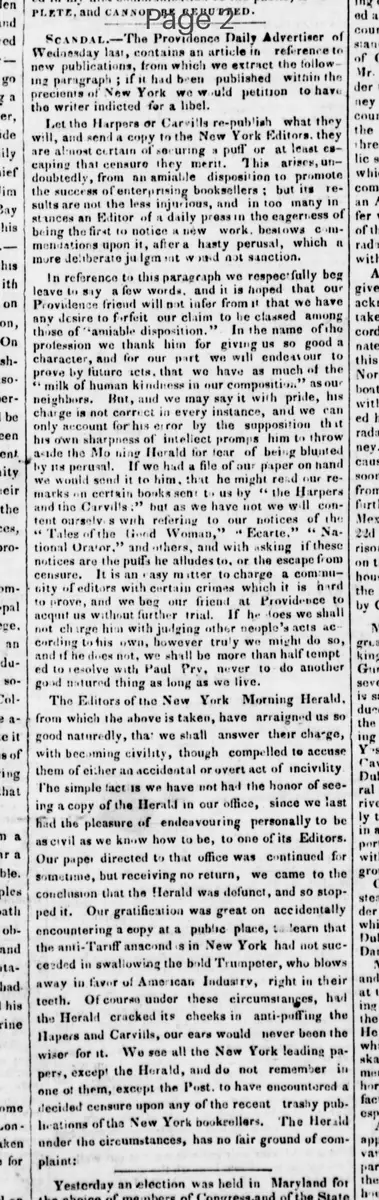
SCANDAL.—The Providence Daily Advertiser of Wednesday last, contains an article in reference to new publications, from which we extract the following paragraph; if it had been published within the precincts of New York we would petition to have the writer indicted for a libel.
Let the Harpers or Carvills re-publish what they will, and send a copy to the New York Editors, they are almost certain of securing a puff' or at least escaping that censure they merit. This arises, undoubtedly, from an amiable disposition to promote the success of enterprising booksellers; but its results are not the less injurious, and in too many instances an Editor of a daily press in the eagerness of being the first to notice a new work, bestows commendations upon it, after a hasty perusal, which a more deliberate judgment would not sanction.
In reference to this paragraph we respectfully beg leave to say a few words, and it is hoped that our Providence friend will not infer from it that we have any desire to forfeit our claim to be classed among those of 'amiable disposition.' In the name of the profession we thank him for giving us so good a character, and for our part we will endeavour to prove by future acts, that we have as much of the 'milk of human kindness in our composition,' as our neighbors. But, and we may say it with pride, his charge is not correct in every instance, and we can only account for his error by the supposition that his own sharpness of intellect prompts him to throw aside the Morning Herald for fear of being blunted by its perusal. If we had a file of our paper on hand we would send it to him, that he might read our remarks on certain books sent to us by 'the Harpers and the Carvills,' but as we have not we will content ourselves with referring to our notices of the 'Tales of the Good Woman,' 'Beatrice,' 'National Orator,' and others, and with asking if these notices are the puffs he alludes to, or the escape from censure. It is an easy matter to charge a community of editors with certain crimes which it is hard to prove, and we beg our friend at Providence to acquit us without further trial. If he does we shall not charge him with judging other people's acts according to his own, however truly we might do so, and if he does not, we shall be more than half tempted to resolve with Paul Pry, never to do another good natured thing as long as we live.
The Editors of the New York Morning Herald, from which the above is taken, have arraigned us so good naturedly, that we shall answer their charge, with becoming civility, though compelled to accuse them of either an accidental or overt act of incivility. The simple fact is we have not had the honor of seeing a copy of the Herald in our office, since we last had the pleasure of endeavouring personally to be as civil as we know how to be, to one of its Editors. Our paper directed to that office was continued for sometime, but receiving no return, we came to the conclusion that the Herald was defunct, and so stopped it. Our gratification was great on accidentally encountering a copy at a public place, to learn that the anti-Tariff anacondas in New York had not succeeded in swallowing the bold Trumpeter, who blows away in favor of American Industry, right in their teeth. Of course under these circumstances, had the Herald cracked its cheeks in anti-puffing the Harpers and Carvills, our ears would never been the wiser for it. We see all the New York leading papers, except the Herald, and do not remember in one of them, except the Post, to have encountered a decided censure upon any of the recent trashy publications of the New York booksellers. The Herald under the circumstances, has no fair ground of complaint.
Let the Harpers or Carvills re-publish what they will, and send a copy to the New York Editors, they are almost certain of securing a puff' or at least escaping that censure they merit. This arises, undoubtedly, from an amiable disposition to promote the success of enterprising booksellers; but its results are not the less injurious, and in too many instances an Editor of a daily press in the eagerness of being the first to notice a new work, bestows commendations upon it, after a hasty perusal, which a more deliberate judgment would not sanction.
In reference to this paragraph we respectfully beg leave to say a few words, and it is hoped that our Providence friend will not infer from it that we have any desire to forfeit our claim to be classed among those of 'amiable disposition.' In the name of the profession we thank him for giving us so good a character, and for our part we will endeavour to prove by future acts, that we have as much of the 'milk of human kindness in our composition,' as our neighbors. But, and we may say it with pride, his charge is not correct in every instance, and we can only account for his error by the supposition that his own sharpness of intellect prompts him to throw aside the Morning Herald for fear of being blunted by its perusal. If we had a file of our paper on hand we would send it to him, that he might read our remarks on certain books sent to us by 'the Harpers and the Carvills,' but as we have not we will content ourselves with referring to our notices of the 'Tales of the Good Woman,' 'Beatrice,' 'National Orator,' and others, and with asking if these notices are the puffs he alludes to, or the escape from censure. It is an easy matter to charge a community of editors with certain crimes which it is hard to prove, and we beg our friend at Providence to acquit us without further trial. If he does we shall not charge him with judging other people's acts according to his own, however truly we might do so, and if he does not, we shall be more than half tempted to resolve with Paul Pry, never to do another good natured thing as long as we live.
The Editors of the New York Morning Herald, from which the above is taken, have arraigned us so good naturedly, that we shall answer their charge, with becoming civility, though compelled to accuse them of either an accidental or overt act of incivility. The simple fact is we have not had the honor of seeing a copy of the Herald in our office, since we last had the pleasure of endeavouring personally to be as civil as we know how to be, to one of its Editors. Our paper directed to that office was continued for sometime, but receiving no return, we came to the conclusion that the Herald was defunct, and so stopped it. Our gratification was great on accidentally encountering a copy at a public place, to learn that the anti-Tariff anacondas in New York had not succeeded in swallowing the bold Trumpeter, who blows away in favor of American Industry, right in their teeth. Of course under these circumstances, had the Herald cracked its cheeks in anti-puffing the Harpers and Carvills, our ears would never been the wiser for it. We see all the New York leading papers, except the Herald, and do not remember in one of them, except the Post, to have encountered a decided censure upon any of the recent trashy publications of the New York booksellers. The Herald under the circumstances, has no fair ground of complaint.
What sub-type of article is it?
Press Freedom
Satire
What keywords are associated?
Book Puffing
Editorial Libel
Newspaper Exchange
Book Reviews
Harpers Carvills
What entities or persons were involved?
Providence Daily Advertiser
New York Morning Herald
Harpers
Carvills
Editorial Details
Primary Topic
Defense Against Accusations Of Biased Book Reviews
Stance / Tone
Defensive And Civil Rebuttal
Key Figures
Providence Daily Advertiser
New York Morning Herald
Harpers
Carvills
Key Arguments
New York Editors Often Puff Books From Harpers And Carvills Without Censure
Providence Paper Denies Charge Of Puffing, Cites Specific Fair Reviews
Lack Of Herald Copies Explains Unawareness Of Their Criticisms
Accusation Of Libel If Published In New York
Editors Judge Others By Their Own Standards