Thank you for visiting SNEWPapers!
Sign up free
Literary
January 27, 1845
American Republican And Baltimore Daily Clipper
Baltimore, Maryland
What is this article about?
Rev. Albert Barnes' sermon reviews 1844's prosperity, emphasizing the ideal 'American Home' as an abode of liberty, neatness, intelligence, contentment, kindness, safety, and religion, which underpins the republic's virtue and stability.
Clipping
OCR Quality
95%
Excellent
Full Text
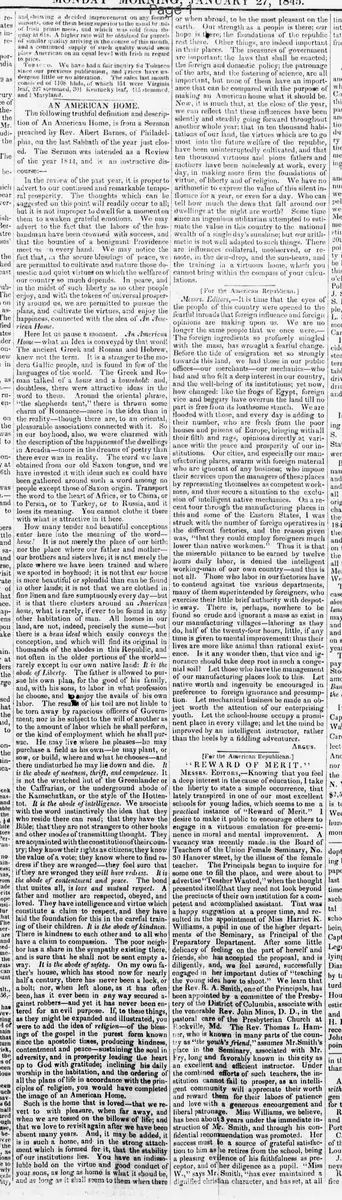
AN AMERICAN HOME.
The following truthful definition and description of An American Home, is from a Sermon preached by Rev. Albert Barnes, of Philadelphia, on the last Sabbath of the year just closed. The Sermon was intended as a Review of the year 1844, and is an instructive discourse:—
In the review of the past year, it is proper to advert to our continued and remarkable temporal prosperity. The thoughts which can be suggested on this point will readily occur to all but it is not improper to dwell for a moment on them to awaken grateful emotions. We may advert to the fact that the labors of the husbandman have been crowned with success, and that the bounties of a benignant Providence meet us in every hand. We may notice the fact that, in the secure blessings of peace, we are permitted to cultivate and nurture those domestic and quiet virtues on which the welfare of our country so much depends. In peace, and in the midst of such liberty as no other people enjoy, and with the tokens of universal prosperity around us, we are permitted to pursue the plans, and cultivate the virtues, and enjoy the happiness, connected with the idea of An American Home.
Here let us pause a moment. An American Home—what an Idea is conveyed by that word! The ancient Greek and Roman and Hebrew, knew not the term. It is a stranger to the modern Gallic people, and is found in few of the languages of the world. The Greek and Roman talked of a house and a household: and, doubtless, there were attractive ideas in the word to them. Around the oriental phrase, "the shepherd's tent," there is thrown some charm of Romance—more in the idea than in the reality—though there are, to an oriental, pleasurable associations connected with it. So in our boyhood, also, we were charmed with the description of the happiness of the dwellings in Arcadia—more in the dreams of poetry than there ever was in reality. The word we have obtained from our old Saxon tongue, and we have invested it with ideas such as could have been gathered around such a word among no people except those of Saxon origin. Transport the word to the heart of Africa, or to China, or to Persia, or to Turkey, or to Russia, and it loses its meaning. You cannot clothe it there with what is attractive in it here.
How many tender and beautiful conceptions enter here into the meaning of the word—home! It is not merely the place of our birth: nor the place where our father and mother—our brothers and sisters live; it is not merely the place where we have been trained and where we sported in boyhood; it is not that our house is more beautiful or splendid than can be found in other lands; it is not that we are clothed in fine linen and fare sumptuously every day—but it is that there clusters around an American home, what is rarely, if ever to be found in any other habitation of man. All homes in our land, are not, indeed, precisely the same—but there is a beau ideal which easily conveys the conception, and which will find its original in thousands of the abodes in this Republic, and not often in the older portions of the world—rarely except in our own native land: It is the abode of Liberty. The father is allowed to pursue his own plan, for the good of his family. and, with his sons, to labor in what profession he choose, and to enjoy the avails of his own labor. The results of his toil are not liable to be torn away by rapacious officers of Government; nor is he subject to the will of another as to the amount of labor which he shall perform. or the kind of employment which he shall pursue. He may live where he pleases—he may purchase a field as his own—he may plant, or sow, or build, where and what he chooses—and there undisturbed he may lie down and die. It is the abode of neatness, thrift, and competence. It is not the wretched hut of the Greenlander or the Caffrarian, or the underground abode of the Kamschatkan, or the style of the Hottentot. It is the abode of intelligence. We associate with the word instinctively the idea that they who reside there can read; that they have the Bible: that they are not strangers to other books and other modes of transmitting thought. They are acquainted with the constitution of their country; they know their rights as citizens; they know the value of a vote: they know where to find redress if they are wronged—they feel sure that if they are wronged they will have redress. It is the abode of contentment and peace. The bond that unites all, is love and mutual respect. A father and mother are respected, obeyed, and loved. They have intelligence and virtue which constitute a claim to respect, and they have laid the foundation for this in the careful training of their children. It is the abode of kindness. There is kindness to each other and to all who have a claim to compassion. The poor neighbor has a share in the sympathy existing there. and is sure that he shall not be sent empty away. It is the abode of safety. On my own father's house, which has stood now for nearly half a century, there has never been a lock, or a bolt; nor, when left alone, as it has often been, has it ever been in any way secured against robbers—and yet it has never been entered for an evil purpose. If, to these things, as they might be expanded and illustrated, you were to add the idea of religion—of the blessings of the gospel in the purest form known since the apostolic times, producing kindness, contentment and peace—sustaining the soul in adversity, and in prosperity leading the heart up to God with gratitude; inclining his daily worship in the habitation, and the ordering of all the plans of life in accordance with the principles of religion, you would have completed the image of an American Home.
Such is the home that is loved—that we revert to with pleasure, when far away, and when we are tossed on the billows of life; and that we love to revisit again after we have been absent many years. And, it may be added, it is in such a home, and in the strong attachment which is formed for it, that the stability of our institutions lies. You have an indissoluble hold on the virtue and good conduct of your sons, as long as home is what it should be, and as long as it shall seem to them when there or when abroad, to be the most pleasant on the earth. Our strength as a people is there; our hope is there; the foundations of the republic rest there. Other things, are indeed important in their places. The measures of government are important; the laws that shall be enacted: the foreign and domestic policy; the patronage of the arts, and the fostering of science, are all important, but none of them have an importance that can be compared with the purpose of making an American home what it should be.
Now, it is much that, at the close of the year, we can reflect that these influences have been silently and steadily going forward throughout another whole year; that in ten thousand habitations of our land, the virtues which are to go most into the future welfare of the republic. have been uninterruptedly cultivated, and that ten thousand virtuous and pious fathers and mothers have been noiselessly at work, every day, in making more firm the foundations of virtue, of liberty and of religion. We have no arithmetic to express the value of this silent influence for a year, or even for a day. Who can tell how much the dews that fall around our dwellings at the night are worth? Some time since an ingenious utilitarian attempted to estimate the value in this country to the national wealth of a single day's sunshine; but our arithmetic is not well adapted to such things. There are influences collateral, unobserved, or remote. in the dew-drop, and the sun-beam, and the training in a virtuous home, which you cannot bring within the compass of your calculations.
The following truthful definition and description of An American Home, is from a Sermon preached by Rev. Albert Barnes, of Philadelphia, on the last Sabbath of the year just closed. The Sermon was intended as a Review of the year 1844, and is an instructive discourse:—
In the review of the past year, it is proper to advert to our continued and remarkable temporal prosperity. The thoughts which can be suggested on this point will readily occur to all but it is not improper to dwell for a moment on them to awaken grateful emotions. We may advert to the fact that the labors of the husbandman have been crowned with success, and that the bounties of a benignant Providence meet us in every hand. We may notice the fact that, in the secure blessings of peace, we are permitted to cultivate and nurture those domestic and quiet virtues on which the welfare of our country so much depends. In peace, and in the midst of such liberty as no other people enjoy, and with the tokens of universal prosperity around us, we are permitted to pursue the plans, and cultivate the virtues, and enjoy the happiness, connected with the idea of An American Home.
Here let us pause a moment. An American Home—what an Idea is conveyed by that word! The ancient Greek and Roman and Hebrew, knew not the term. It is a stranger to the modern Gallic people, and is found in few of the languages of the world. The Greek and Roman talked of a house and a household: and, doubtless, there were attractive ideas in the word to them. Around the oriental phrase, "the shepherd's tent," there is thrown some charm of Romance—more in the idea than in the reality—though there are, to an oriental, pleasurable associations connected with it. So in our boyhood, also, we were charmed with the description of the happiness of the dwellings in Arcadia—more in the dreams of poetry than there ever was in reality. The word we have obtained from our old Saxon tongue, and we have invested it with ideas such as could have been gathered around such a word among no people except those of Saxon origin. Transport the word to the heart of Africa, or to China, or to Persia, or to Turkey, or to Russia, and it loses its meaning. You cannot clothe it there with what is attractive in it here.
How many tender and beautiful conceptions enter here into the meaning of the word—home! It is not merely the place of our birth: nor the place where our father and mother—our brothers and sisters live; it is not merely the place where we have been trained and where we sported in boyhood; it is not that our house is more beautiful or splendid than can be found in other lands; it is not that we are clothed in fine linen and fare sumptuously every day—but it is that there clusters around an American home, what is rarely, if ever to be found in any other habitation of man. All homes in our land, are not, indeed, precisely the same—but there is a beau ideal which easily conveys the conception, and which will find its original in thousands of the abodes in this Republic, and not often in the older portions of the world—rarely except in our own native land: It is the abode of Liberty. The father is allowed to pursue his own plan, for the good of his family. and, with his sons, to labor in what profession he choose, and to enjoy the avails of his own labor. The results of his toil are not liable to be torn away by rapacious officers of Government; nor is he subject to the will of another as to the amount of labor which he shall perform. or the kind of employment which he shall pursue. He may live where he pleases—he may purchase a field as his own—he may plant, or sow, or build, where and what he chooses—and there undisturbed he may lie down and die. It is the abode of neatness, thrift, and competence. It is not the wretched hut of the Greenlander or the Caffrarian, or the underground abode of the Kamschatkan, or the style of the Hottentot. It is the abode of intelligence. We associate with the word instinctively the idea that they who reside there can read; that they have the Bible: that they are not strangers to other books and other modes of transmitting thought. They are acquainted with the constitution of their country; they know their rights as citizens; they know the value of a vote: they know where to find redress if they are wronged—they feel sure that if they are wronged they will have redress. It is the abode of contentment and peace. The bond that unites all, is love and mutual respect. A father and mother are respected, obeyed, and loved. They have intelligence and virtue which constitute a claim to respect, and they have laid the foundation for this in the careful training of their children. It is the abode of kindness. There is kindness to each other and to all who have a claim to compassion. The poor neighbor has a share in the sympathy existing there. and is sure that he shall not be sent empty away. It is the abode of safety. On my own father's house, which has stood now for nearly half a century, there has never been a lock, or a bolt; nor, when left alone, as it has often been, has it ever been in any way secured against robbers—and yet it has never been entered for an evil purpose. If, to these things, as they might be expanded and illustrated, you were to add the idea of religion—of the blessings of the gospel in the purest form known since the apostolic times, producing kindness, contentment and peace—sustaining the soul in adversity, and in prosperity leading the heart up to God with gratitude; inclining his daily worship in the habitation, and the ordering of all the plans of life in accordance with the principles of religion, you would have completed the image of an American Home.
Such is the home that is loved—that we revert to with pleasure, when far away, and when we are tossed on the billows of life; and that we love to revisit again after we have been absent many years. And, it may be added, it is in such a home, and in the strong attachment which is formed for it, that the stability of our institutions lies. You have an indissoluble hold on the virtue and good conduct of your sons, as long as home is what it should be, and as long as it shall seem to them when there or when abroad, to be the most pleasant on the earth. Our strength as a people is there; our hope is there; the foundations of the republic rest there. Other things, are indeed important in their places. The measures of government are important; the laws that shall be enacted: the foreign and domestic policy; the patronage of the arts, and the fostering of science, are all important, but none of them have an importance that can be compared with the purpose of making an American home what it should be.
Now, it is much that, at the close of the year, we can reflect that these influences have been silently and steadily going forward throughout another whole year; that in ten thousand habitations of our land, the virtues which are to go most into the future welfare of the republic. have been uninterruptedly cultivated, and that ten thousand virtuous and pious fathers and mothers have been noiselessly at work, every day, in making more firm the foundations of virtue, of liberty and of religion. We have no arithmetic to express the value of this silent influence for a year, or even for a day. Who can tell how much the dews that fall around our dwellings at the night are worth? Some time since an ingenious utilitarian attempted to estimate the value in this country to the national wealth of a single day's sunshine; but our arithmetic is not well adapted to such things. There are influences collateral, unobserved, or remote. in the dew-drop, and the sun-beam, and the training in a virtuous home, which you cannot bring within the compass of your calculations.
What sub-type of article is it?
Essay
What themes does it cover?
Liberty Freedom
Religious
Patriotism
What keywords are associated?
American Home
Liberty
Prosperity
Religion
Family Virtues
Republic Stability
Saxon Origins
Domestic Peace
What entities or persons were involved?
Rev. Albert Barnes, Of Philadelphia
Literary Details
Title
An American Home.
Author
Rev. Albert Barnes, Of Philadelphia
Subject
Review Of The Year 1844
Key Lines
An American Home—What An Idea Is Conveyed By That Word!
It Is The Abode Of Liberty.
It Is The Abode Of Intelligence.
It Is The Abode Of Contentment And Peace.
Such Is The Home That Is Loved—That We Revert To With Pleasure, When Far Away, And When We Are Tossed On The Billows Of Life;