Thank you for visiting SNEWPapers!
Sign up free
The Madisonian
Washington, District Of Columbia
What is this article about?
Report on the enthusiastic Fourth of July celebrations in Washington, D.C., and vicinity, amid political divisions. Criticizes President Van Buren for not opening the White House to the public. Describes large Whig gatherings at Bladensburg and other sites with speeches, barbecue, and toasts supporting Gen. Harrison.
Clipping
OCR Quality
Full Text
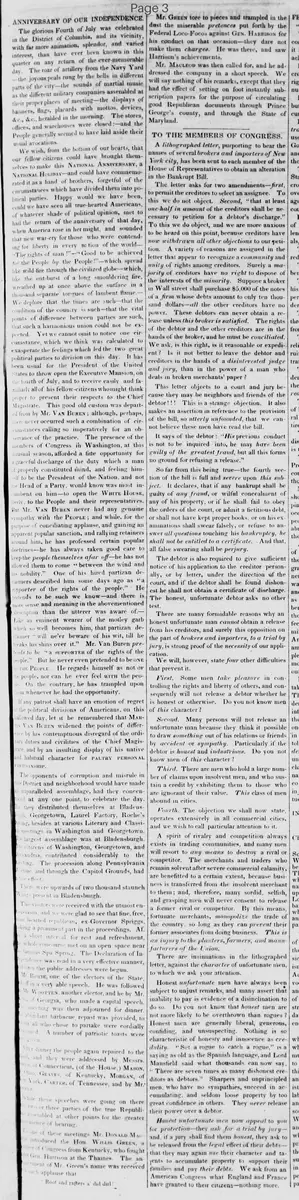
The glorious Fourth of July was celebrated in the District of Columbia, and its vicinity, with far more animation, splendor, and varied interest, than have ever been known in this quarter on any return of the ever-memorable day. The roar of artillery from the Navy Yard—the joyous peals rung by the bells in different parts of the city—the sounds of martial music as the different military companies assembled at their proper places of meeting—the displays of banners, flags, placards with mottos, devices, &c., &c., heralded in the morning. The stores, offices, and warehouses were closed:—and the People generally seemed to have laid aside their usual avocations.
We wish, from the bottom of our hearts, that our fellow citizens could have brought themselves to make this National Anniversary, a National Holiday—and could have commemorated it as a band of brothers, forgetful of the circumstances which have divided them into political parties. Happy would we have been, could we have seen all true-hearted Americans, of whatever shade of political opinion, met to hail the return of the anniversary of that day, when America rose in her might, and sounded that new war-cry for those who were contending for liberty in every nation of the world—“The rights of man!”—“Good to be achieved for the People by the People!”—which spread like wild-fire through the civilized globe—which, like the out-burst of a long smouldering fire, wreathed up at once above the surface in a thousand separate tongues of lambent flame.—
We deplore that the times are such—that the condition of the country is such—that the vital points of difference between parties are such, that such a harmonious union could not be expected. Yet we cannot omit to notice one circumstance, which we think was calculated to exasperate the feelings which led the two great political parties to division on this day. It has been usual for the President of the United States to throw open the Executive Mansion, on the fourth of July, and to receive easily and familiarly all of his fellow-citizens who might think proper to present their respects to the Chief Magistrate. This good old custom was departed from by Mr. Van Buren; although, perhaps, it never occurred such a combination of circumstances calling so imperatively for an observance of the practice. The presence of the members of Congress in Washington, at this unusual season, afforded a fine opportunity for a grateful discharge of the duty which a man of properly constituted mind, and feeling himself to be the President of the Nation, and not the Head of a Party, would know was most incumbent on him—to open the White House, truly, to the People and their representatives.
But Mr. Van Buren never had any genuine sympathy with the People; and while, for the purpose of conciliating applause, and gaining an apparent popular sanction, and rallying retainers around him, he has professed certain popular sentiments—he has always taken good care to keep the people themselves at a distance—he has not allowed them to come "between the wind and his nobility." One of his hired partizan defamers described him some days ago as "a supporter of the rights of the people."—He pretends to be such we know—and there is more sense and meaning in the above-mentioned epithet than the utterer was aware of.—Like an eminent wearer of the motley garb which so well becomes him, that partizan defamer "will ne'er beware of his wit, till he waks his shins over it." Mr. Van Buren pretends to be "a sUPPoRTER of the rights of the people." But he never even pretended to be one of The People. He regards himself as not of the people, nor can he ever feel with the people. On the contrary, he has trampled upon them whenever he had the opportunity. If any patriot shall have an emotion of regret at the political divisions of Americans, on this hallowed day, let it be remembered that Mr. Van Buren widened the points of difference by his contemptuous disregard of the ordinary duties and civilities of the Chief Magistrate, and by an insulting display of his native and habitual character for PALTRY PERSONAL ARTISANSHIP.
The opponents of corruption and misrule in this District and neighborhood would have made an unparalleled assemblage, had they concentrated at any one point, to celebrate the day. As it was, they distributed themselves at Bladensburgh, Georgetown, Laurel Factory, Roche's Spring, besides at various Literary and Classical meetings in Washington and Georgetown. The largest assemblage was at Bladensburgh. The citizens of Washington, Georgetown, and Alexandria, contributed considerably to the meeting. The procession along Pennsylvania Avenue and through the Capitol Grounds, had some three thousand. There were upwards of two thousand staunch Whigs present in Bladensburgh. The visitors were received with the utmost enthusiasm and we were glad to see that fine, free, whole-hearted republican, ex-Governor Spriggs, taking a prominent part in the proceedings. After a short time for rest and refreshment, the whole concourse met on an open space near the famous Spa Spring. The Declaration of Independence was read in a very effective manner, and then the public addresses were begun. Mr. Bowie, one of the electors of the State, spoke first in a very able speech. He was followed by Mr. Warren, another elector, and he by Mr. Wilde, of Georgia, who made a capital speech. The meeting was then adjourned for dinner. A sumptuous barbecue repast was provided, to which all who chose to partake were cordially welcomed. A number of patriotic toasts were drunk.
At dinner the people again repaired to the stand, and they were addressed by Messrs. Wise, of Virginia, (of the House,) Mason, of Virginia, Who, Graves, of Kentucky, Morgan, of New York, Carter, of Tennessee, and by Mr. Giddings. While these speeches were going on there were two or three parties of the true Republicans assembled at other points for the greater convenience of hearing. At one of these meetings Mr. Donald McI. introduced the Hon. Willis Green, a member of Congress from Kentucky, who fought under Gen. Harrison at the Thames. The announcement of Mr. Green's name was received with much applause that "Roof and rafters all duldurl!"
Mr. Green tore to pieces and trampled in the dust the miserable pretences put forth by the Federal Loco-Focos against Gen. Harrison for his conduct on that occasion—they dare not make them charges. He was there, and saw Harrison's achievements.
Mr. Macleod was then called for, and he addressed the company in a short speech. We will say nothing of his remarks, except that they had the effect of setting on foot instantly subscription papers for the purpose of circulating good Republican documents through Prince George's county, and through the State of Maryland.
What sub-type of article is it?
What themes does it cover?
What keywords are associated?
What entities or persons were involved?
Where did it happen?
Story Details
Key Persons
Location
District Of Columbia And Vicinity, Including Bladensburgh, Georgetown, Washington
Event Date
Fourth Of July
Story Details
The Fourth of July is celebrated with great enthusiasm in Washington, D.C., area through artillery, bells, music, and military displays. The author laments political divisions preventing unity and criticizes President Van Buren for not opening the White House. Whig opponents hold large gatherings at Bladensburg and other sites with processions, readings of the Declaration, speeches by various politicians supporting Gen. Harrison, barbecue, toasts, and subscriptions for Republican documents.