Thank you for visiting SNEWPapers!
Sign up free
Letter to Editor
February 19, 1844
Alexandria Gazette
Alexandria, Alexandria County, District Of Columbia
What is this article about?
A letter from South Carolina endorses Henry Clay over Martin Van Buren for president, enclosing a preamble from the Richland Clay Club that recounts historical oppositions to Van Buren and praises Clay's patriotism and role in key crises like the Missouri Compromise and Nullification.
Clipping
OCR Quality
95%
Excellent
Full Text
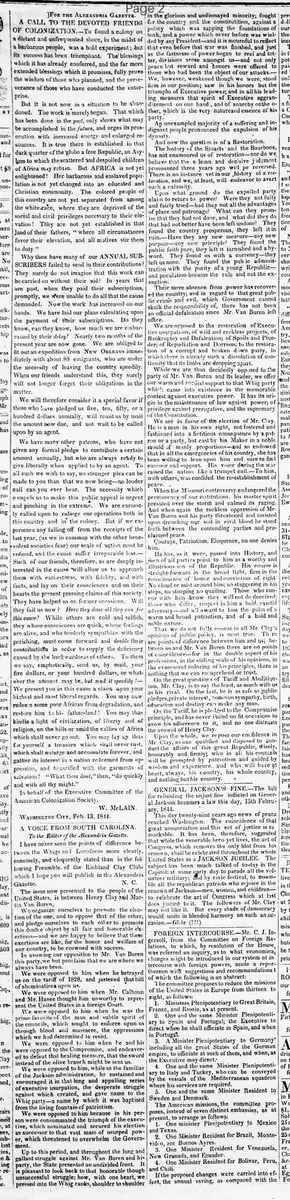
A VOICE FROM SOUTH CAROLINA.
To the Editor of the Alexandria Gazette.
I have never seen the points of difference between the Whigs and Locofocos more clearly, concisely, and eloquently stated than in the following Preamble of the Richland Clay Club—which I hope you will publish in the Alexandria Gazette.
N. C.
The issue now presented to the people of the United States, is between Henry Clay and Martin Van Buren.
We organize ourselves to promote the election of the one, and to oppose that of the other, and pledge ourselves to each other to promote this double object by all fair and honorable exertions—and we are happy to believe that these exertions are like, for the honor and welfare of our country, to be crowned with success.
In avowing our opposition to Mr. Van Buren this party, we but proclaim that we are where we always have been.
We were opposed to him when he betrayed us on the tariff of 1828, and fastened that bill of abominations upon us.
We were opposed to him when Mr. Calhoun and Mr. Hayne thought him unworthy to represent the United States in a foreign Court.
We were opposed to him when he was the prime favorite of the man and subtle spirit of the councils, which sought to enforce upon us through blood and massacre, the oppressions which we had determined to resist.
We were opposed to him when he and his were opposed to the Compromise, and endeavored to defeat that healing measure, that the sword instead of the olive branch might be sent us.
We were opposed to him, while as the familiar of the Jackson administration, he sustained and encouraged it in that long and appalling series of executive usurpation, the desperate struggle against which created, and gave name to the Whig party—a name by which it was baptised from the living fountain of patriotism.
We were opposed to him because in his person were consummated the triumph of the executive, which nominated and secured his election as successor to that vast mass of usurped power, which threatened to overwhelm the Government.
Up to this period, and throughout the long and gallant struggle against Mr. Van Buren and his party, the State presented an undivided front. It is pleasant to look back to that honorable though unsuccessful struggle; how, with one heart, we pressed into the Whig ranks, shoulder to shoulder in the glorious and undismayed minority; fought for the country and the constitution, against a policy which was sapping the foundations of both, and a power which never before was wielded by any President—and it is mournful to reflect that even before that war was finished, and just as the fastnesses of power began to reel and totter, divisions arose amongst us—and not only peace but reward and honors were offered to those who had been the object of our attacks.
We, however, weakened though we were, stood firm in our position; saw in his honors but the triumphs of Executive power; and in all his leading measures that spirit of Executive aggrandizement on one hand, and of anarchy on the other, which is the very nature and essence of his party.
An unexampled majority of a suffering and indignant people pronounced the expulsion of his dynasty.
And now the question is of a Restoration.
The history of the Stuarts and the Bourbons has not enamoured us of restoration—nor do we believe that the solemn and decisive judgment pronounced three years ago will be reversed.
There is no instance yet in our history of a restoration, and we, at least, will endeavor to avert such a calamity.
Upon what ground do the expelled party claim to return to power? Were they not fully and fairly tried—had they not all the advantages of place and patronage? What can they promise that they had not done, and what did they do that had not better have been left undone? They found the country prosperous, they left it in ruin.—Have they any new measure—any new purpose—any new principle? They found the public faith pure, they left it tarnished and a by-word. They found us with a currency—they left us none. They found the public administration with the purity of a young Republic—and peculation became the rule and not the exception.
Their mere absence from power has recovered the country; and in regard to that great public crime and evil, which Government cannot skulk the responsibility of, there has not been an official defalcation since Mr. Van Buren left office.
We are opposed to the restoration of Executive usurpations, of wild and reckless projects, of Bankruptcy and Defalcation; of Spoils and Plunder; of Repudiation and Dorrism; to the restoration of a corrupt and broken down party, in which there is already such a dissolution of continuity that its limbs are dropping apart.
While we are thus decidedly opposed to the party of Mr. Van Buren and its leader, we offer our warm and cordial support to that Whig party which came into existence in the memorable contest against executive power. It has its origin in the maintenance of law against power; of privilege against prerogative, and the supremacy of the Constitution.
We are in favor of the election of Mr. Clay. He is a man in his own right, not fostered and fashioned into a fictitious consequence by a patron or a party, but cast by his Maker in a noble mould of manly proportions—and so endowed that in all the emergencies of his country, she has been willing to lean upon him and sure to find succour and support. His voice during the war raised the nation like a trumpet call.—To him, with others, was confided the re-establishment of peace.
When the Missouri controversy endangered the permanency of our institutions, his master spirit presided over the storm and calmed its raging.
And when again the reckless oppression of Mr. Van Buren and his party threatened and insisted upon drenching our soil in civil blood he stood forth between the contending parties and proclaimed peace.
Courage, Patriotism, Eloquence, no one denies him. He has, as it were, passed into History, and men of all parties point to him as a worthy and illustrious son of the Republic. His course is straight-forward in the broad light, firm in the consciousness of honor and conviction of right. No cloud or mist around him; no staggering in his steps, no stooping no quailing. Those who concur with him know they will not be deceived those who differ, respect in him a bold, candid adversary—and a.' award to him the palm of a warm and broad patriotism, and of a bold and noble nature.
That we do not fully concur in all Mr. Clay's opinions of public policy, is most true. There are points of difference between him and us; between us and Mr. Van Buren there are no points of coincidence—for in the double aspect of his professions, in the sliding scale of his opinions, in the evanescent coloring of his principles, there is nothing that we can comprehend or trust.
On the great questions of Tariff and Abolitionism, Mr. Clay, is to say the least, as much with us as his rival. "On the last, he is as safe as public pledges, private interest, common sympathy, birth, education and destiny can make any man.
On the Tariff, he is pledged to the Compromise principle, and has never failed on fit occasions to avow his adherence to it, and no one distrusts the avowal of Henry Clay.
Upon the whole, we repose our confidence in Mr. Clay, as one qualified and disposed to conduct the affairs of this great Republic, wisely, honorably and firmly; who in all his counsels will be prompted by patriotism and guided by wisdom and experience, and who will have at heart, always, his country, his whole country, and nothing but his country.
To the Editor of the Alexandria Gazette.
I have never seen the points of difference between the Whigs and Locofocos more clearly, concisely, and eloquently stated than in the following Preamble of the Richland Clay Club—which I hope you will publish in the Alexandria Gazette.
N. C.
The issue now presented to the people of the United States, is between Henry Clay and Martin Van Buren.
We organize ourselves to promote the election of the one, and to oppose that of the other, and pledge ourselves to each other to promote this double object by all fair and honorable exertions—and we are happy to believe that these exertions are like, for the honor and welfare of our country, to be crowned with success.
In avowing our opposition to Mr. Van Buren this party, we but proclaim that we are where we always have been.
We were opposed to him when he betrayed us on the tariff of 1828, and fastened that bill of abominations upon us.
We were opposed to him when Mr. Calhoun and Mr. Hayne thought him unworthy to represent the United States in a foreign Court.
We were opposed to him when he was the prime favorite of the man and subtle spirit of the councils, which sought to enforce upon us through blood and massacre, the oppressions which we had determined to resist.
We were opposed to him when he and his were opposed to the Compromise, and endeavored to defeat that healing measure, that the sword instead of the olive branch might be sent us.
We were opposed to him, while as the familiar of the Jackson administration, he sustained and encouraged it in that long and appalling series of executive usurpation, the desperate struggle against which created, and gave name to the Whig party—a name by which it was baptised from the living fountain of patriotism.
We were opposed to him because in his person were consummated the triumph of the executive, which nominated and secured his election as successor to that vast mass of usurped power, which threatened to overwhelm the Government.
Up to this period, and throughout the long and gallant struggle against Mr. Van Buren and his party, the State presented an undivided front. It is pleasant to look back to that honorable though unsuccessful struggle; how, with one heart, we pressed into the Whig ranks, shoulder to shoulder in the glorious and undismayed minority; fought for the country and the constitution, against a policy which was sapping the foundations of both, and a power which never before was wielded by any President—and it is mournful to reflect that even before that war was finished, and just as the fastnesses of power began to reel and totter, divisions arose amongst us—and not only peace but reward and honors were offered to those who had been the object of our attacks.
We, however, weakened though we were, stood firm in our position; saw in his honors but the triumphs of Executive power; and in all his leading measures that spirit of Executive aggrandizement on one hand, and of anarchy on the other, which is the very nature and essence of his party.
An unexampled majority of a suffering and indignant people pronounced the expulsion of his dynasty.
And now the question is of a Restoration.
The history of the Stuarts and the Bourbons has not enamoured us of restoration—nor do we believe that the solemn and decisive judgment pronounced three years ago will be reversed.
There is no instance yet in our history of a restoration, and we, at least, will endeavor to avert such a calamity.
Upon what ground do the expelled party claim to return to power? Were they not fully and fairly tried—had they not all the advantages of place and patronage? What can they promise that they had not done, and what did they do that had not better have been left undone? They found the country prosperous, they left it in ruin.—Have they any new measure—any new purpose—any new principle? They found the public faith pure, they left it tarnished and a by-word. They found us with a currency—they left us none. They found the public administration with the purity of a young Republic—and peculation became the rule and not the exception.
Their mere absence from power has recovered the country; and in regard to that great public crime and evil, which Government cannot skulk the responsibility of, there has not been an official defalcation since Mr. Van Buren left office.
We are opposed to the restoration of Executive usurpations, of wild and reckless projects, of Bankruptcy and Defalcation; of Spoils and Plunder; of Repudiation and Dorrism; to the restoration of a corrupt and broken down party, in which there is already such a dissolution of continuity that its limbs are dropping apart.
While we are thus decidedly opposed to the party of Mr. Van Buren and its leader, we offer our warm and cordial support to that Whig party which came into existence in the memorable contest against executive power. It has its origin in the maintenance of law against power; of privilege against prerogative, and the supremacy of the Constitution.
We are in favor of the election of Mr. Clay. He is a man in his own right, not fostered and fashioned into a fictitious consequence by a patron or a party, but cast by his Maker in a noble mould of manly proportions—and so endowed that in all the emergencies of his country, she has been willing to lean upon him and sure to find succour and support. His voice during the war raised the nation like a trumpet call.—To him, with others, was confided the re-establishment of peace.
When the Missouri controversy endangered the permanency of our institutions, his master spirit presided over the storm and calmed its raging.
And when again the reckless oppression of Mr. Van Buren and his party threatened and insisted upon drenching our soil in civil blood he stood forth between the contending parties and proclaimed peace.
Courage, Patriotism, Eloquence, no one denies him. He has, as it were, passed into History, and men of all parties point to him as a worthy and illustrious son of the Republic. His course is straight-forward in the broad light, firm in the consciousness of honor and conviction of right. No cloud or mist around him; no staggering in his steps, no stooping no quailing. Those who concur with him know they will not be deceived those who differ, respect in him a bold, candid adversary—and a.' award to him the palm of a warm and broad patriotism, and of a bold and noble nature.
That we do not fully concur in all Mr. Clay's opinions of public policy, is most true. There are points of difference between him and us; between us and Mr. Van Buren there are no points of coincidence—for in the double aspect of his professions, in the sliding scale of his opinions, in the evanescent coloring of his principles, there is nothing that we can comprehend or trust.
On the great questions of Tariff and Abolitionism, Mr. Clay, is to say the least, as much with us as his rival. "On the last, he is as safe as public pledges, private interest, common sympathy, birth, education and destiny can make any man.
On the Tariff, he is pledged to the Compromise principle, and has never failed on fit occasions to avow his adherence to it, and no one distrusts the avowal of Henry Clay.
Upon the whole, we repose our confidence in Mr. Clay, as one qualified and disposed to conduct the affairs of this great Republic, wisely, honorably and firmly; who in all his counsels will be prompted by patriotism and guided by wisdom and experience, and who will have at heart, always, his country, his whole country, and nothing but his country.
What sub-type of article is it?
Persuasive
Political
Historical
What themes does it cover?
Politics
Economic Policy
Constitutional Rights
What keywords are associated?
Henry Clay
Martin Van Buren
Whig Party
Locofocos
Tariff 1828
Compromise Act
Executive Usurpation
Presidential Election
What entities or persons were involved?
N. C.
The Editor Of The Alexandria Gazette
Letter to Editor Details
Author
N. C.
Recipient
The Editor Of The Alexandria Gazette
Main Argument
the letter urges support for henry clay's election and opposition to martin van buren's restoration, citing van buren's historical betrayals on tariff, compromise, and executive usurpations, while praising clay's patriotism, eloquence, and role in resolving national crises.
Notable Details
Opposition To Tariff Of 1828
Calhoun And Hayne's Disapproval
Jackson Administration Usurpations
Compromise Act
Missouri Controversy
Nullification Crisis
Richland Clay Club Preamble