Thank you for visiting SNEWPapers!
Sign up free
Story
July 6, 1862
Sunday Dispatch
New York, New York County, New York
What is this article about?
Tonina Marinello, Venetian heroine, disguised as a man to fight bravely with husband in Garibaldi's 1860 Sicilian campaign; later died young in Florence poverty, honored by torchlight funeral procession.
Clipping
OCR Quality
98%
Excellent
Full Text
AN ITALIAN HEROINE.
A correspondent of an English paper writing from Florence, May 30, says:
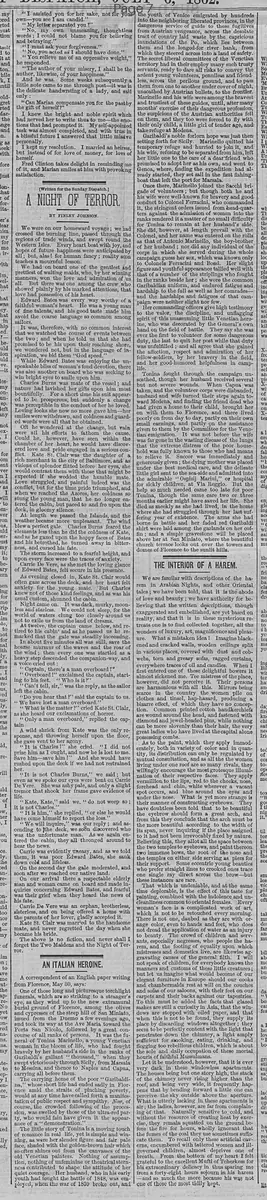
One of those long and picturesque torchlight funerals, which are so striking to a stranger's eye, as they wind up to the new extramural burial ground of Florence, among the olives and cypresses of the steep hill of San Miniato, issued from the Duomo a few evenings ago, and took its way at the Ave Maria toward the Porta San Nicolo, followed by a great concourse of all ranks of persons. It was the funeral of Tonina Marinello, a young Venetian woman in the bloom of life, who had fought bravely by her husband's side in the ranks of Garibaldi's gallant "thousand," when they swept victoriously through Sicily, from Marsala to Messina, and thence to Naples and Capua, carrying all before them.
The carrying home of the poor "Garibaldina," whose short life had ended sadly in Florence amid the straits of pinching poverty, would at any time have called forth a manifestation of public respect and sympathy. Now, of course, the crowded following of the procession, was swelled by those of the ultra-red party, who would fain have given it the appearance of a "demonstration."
The little story of Tonina is a moving touch of romance in real life, yet is simple and winning, as were her slender figure and fair pale face, shaded with the golden-brown hair which so often shines out from the canvasses of the old Venetian painters. Nothing of assumption, nothing of unfeminine or theatrical sternness contributed to shape the attitude of her quiet courage. Her husband, who in his early youth had fought the battle of 1848, was employed, when the war of 1859 broke out, and the youth of Venice emigrated by hundreds into the neighboring liberated provinces, in the dangerous service of guide to these fugitives from Austrian vengeance, across the desolate tract of country laid waste by the capricious inundations of the Po, which lies between them and the longed-for river bank, from which they steered across into a land of safety. The secret liberal committees of the Venetian territory had in their employ many such trusty servants, ready to dare all risks to convey the ardent young volunteers, penniless and friendless, across the perilous ground, and to pass them from one to another under cover of night, unscathed by Austrian bullets, to the frontier. Marinello and his wife were among the bravest and trustiest of these guides, until, after many months' exercise of their dangerous profession, the suspicions of the Austrian authorities fell on them, and they too were forced to fly with their only child, a little girl of tender age, and take refuge at Modena.
Garibaldi's noble forlorn hope was just then setting forth for Sicily. Marinello quitted his temporary refuge and hurried to join it, and his wife, refusing to be separated from him, left her little one to the care of a dear friend who promised to adopt her as his own, and went to Genoa, where, finding the expedition had already started, they set sail in the first fishing boat that left the port for Marsala.
Once there, Marinello joined the Sacchi brigade of volunteers; but though both he and his wife were well-known for bravery and good conduct to Colonel Ferracini, who commanded it, the stringent orders issued from head-quarters against the admission of women into the ranks rendered it a matter of no small difficulty for Tonina to remain at her husband's side. She did, however, at length prevail with the Colonel, and her name was entered on the rolls as that of Antonio Marinello, the boy-brother of her husband; nor did any individual of the corps in which she served during the whole campaign guess her sex, which was known only to Colonels Ferracini and Bossi. Her slight figure and youthful appearance tallied well with that of a number of the striplings who fought in the ranks beside her; she wore the common Garibaldian uniform, and endured fatigue and hardship to the full as well as her comrades--and the hardships and fatigues of that campaign were neither slight nor few.
Her commanding officers give high testimony to the valor, the discipline, and unflagging spirit of this unassuming little Venetian heroine, who was decorated by the General's own hand on the field of battle. They say she was ever the first to volunteer for some dangerous duty, the last to quit her post while that duty was unfulfilled; and all agree that she gained the affection, respect and admiration of her fellow-soldiers, by her bravery in the field, and her good-humored helpfulness in camp life.
Tonina fought through the campaign unscathed, though her husband received several but not severe wounds. When Capua was taken, and the volunteer corps were disbanded, husband and wife turned their steps again toward Modena, and finding the friend dead who had given a home to their child, brought her on with them to Florence, and there lived poorly on from day to day, partly on their own small earnings, and partly on the assistance given to them by the Committee for the Venetian emigration. It was not before the wife was far gone in the wasting disease of the lungs that the extreme distress of the poor household was fully known to those who had means to relieve it. Succor was immediately and generously given; the dying mother was placed under the best medical care, and the delicate little girl sent to the sea-side and admitted into the admirable "Ospizij Marinui," or hospital for sickly children, at Via Reggio. But the help so much needed came too late for poor Tonina, though the same care two or three months earlier might have saved her life. She died as meekly as she had lived, in the home where she had struggled through her last suffering year of existence. The arms she had borne in battle and her faded red Garibaldi shirt were laid among the garlands on her coffin; and a simple gravestone will be placed above her at San Miniato, where the beautiful church terrace looks out over the towers and domes of Florence to the sunlit hills.
A correspondent of an English paper writing from Florence, May 30, says:
One of those long and picturesque torchlight funerals, which are so striking to a stranger's eye, as they wind up to the new extramural burial ground of Florence, among the olives and cypresses of the steep hill of San Miniato, issued from the Duomo a few evenings ago, and took its way at the Ave Maria toward the Porta San Nicolo, followed by a great concourse of all ranks of persons. It was the funeral of Tonina Marinello, a young Venetian woman in the bloom of life, who had fought bravely by her husband's side in the ranks of Garibaldi's gallant "thousand," when they swept victoriously through Sicily, from Marsala to Messina, and thence to Naples and Capua, carrying all before them.
The carrying home of the poor "Garibaldina," whose short life had ended sadly in Florence amid the straits of pinching poverty, would at any time have called forth a manifestation of public respect and sympathy. Now, of course, the crowded following of the procession, was swelled by those of the ultra-red party, who would fain have given it the appearance of a "demonstration."
The little story of Tonina is a moving touch of romance in real life, yet is simple and winning, as were her slender figure and fair pale face, shaded with the golden-brown hair which so often shines out from the canvasses of the old Venetian painters. Nothing of assumption, nothing of unfeminine or theatrical sternness contributed to shape the attitude of her quiet courage. Her husband, who in his early youth had fought the battle of 1848, was employed, when the war of 1859 broke out, and the youth of Venice emigrated by hundreds into the neighboring liberated provinces, in the dangerous service of guide to these fugitives from Austrian vengeance, across the desolate tract of country laid waste by the capricious inundations of the Po, which lies between them and the longed-for river bank, from which they steered across into a land of safety. The secret liberal committees of the Venetian territory had in their employ many such trusty servants, ready to dare all risks to convey the ardent young volunteers, penniless and friendless, across the perilous ground, and to pass them from one to another under cover of night, unscathed by Austrian bullets, to the frontier. Marinello and his wife were among the bravest and trustiest of these guides, until, after many months' exercise of their dangerous profession, the suspicions of the Austrian authorities fell on them, and they too were forced to fly with their only child, a little girl of tender age, and take refuge at Modena.
Garibaldi's noble forlorn hope was just then setting forth for Sicily. Marinello quitted his temporary refuge and hurried to join it, and his wife, refusing to be separated from him, left her little one to the care of a dear friend who promised to adopt her as his own, and went to Genoa, where, finding the expedition had already started, they set sail in the first fishing boat that left the port for Marsala.
Once there, Marinello joined the Sacchi brigade of volunteers; but though both he and his wife were well-known for bravery and good conduct to Colonel Ferracini, who commanded it, the stringent orders issued from head-quarters against the admission of women into the ranks rendered it a matter of no small difficulty for Tonina to remain at her husband's side. She did, however, at length prevail with the Colonel, and her name was entered on the rolls as that of Antonio Marinello, the boy-brother of her husband; nor did any individual of the corps in which she served during the whole campaign guess her sex, which was known only to Colonels Ferracini and Bossi. Her slight figure and youthful appearance tallied well with that of a number of the striplings who fought in the ranks beside her; she wore the common Garibaldian uniform, and endured fatigue and hardship to the full as well as her comrades--and the hardships and fatigues of that campaign were neither slight nor few.
Her commanding officers give high testimony to the valor, the discipline, and unflagging spirit of this unassuming little Venetian heroine, who was decorated by the General's own hand on the field of battle. They say she was ever the first to volunteer for some dangerous duty, the last to quit her post while that duty was unfulfilled; and all agree that she gained the affection, respect and admiration of her fellow-soldiers, by her bravery in the field, and her good-humored helpfulness in camp life.
Tonina fought through the campaign unscathed, though her husband received several but not severe wounds. When Capua was taken, and the volunteer corps were disbanded, husband and wife turned their steps again toward Modena, and finding the friend dead who had given a home to their child, brought her on with them to Florence, and there lived poorly on from day to day, partly on their own small earnings, and partly on the assistance given to them by the Committee for the Venetian emigration. It was not before the wife was far gone in the wasting disease of the lungs that the extreme distress of the poor household was fully known to those who had means to relieve it. Succor was immediately and generously given; the dying mother was placed under the best medical care, and the delicate little girl sent to the sea-side and admitted into the admirable "Ospizij Marinui," or hospital for sickly children, at Via Reggio. But the help so much needed came too late for poor Tonina, though the same care two or three months earlier might have saved her life. She died as meekly as she had lived, in the home where she had struggled through her last suffering year of existence. The arms she had borne in battle and her faded red Garibaldi shirt were laid among the garlands on her coffin; and a simple gravestone will be placed above her at San Miniato, where the beautiful church terrace looks out over the towers and domes of Florence to the sunlit hills.
What sub-type of article is it?
Biography
Heroic Act
Military Action
What themes does it cover?
Bravery Heroism
Tragedy
Misfortune
What keywords are associated?
Italian Heroine
Garibaldi Thousand
Female Soldier
Venetian Guide
Bravery In Battle
Poverty Death
Funeral Procession
What entities or persons were involved?
Tonina Marinello
Marinello
Garibaldi
Colonel Ferracini
Colonel Bossi
Where did it happen?
Florence, Venice, Sicily, Marsala, Messina, Naples, Capua, Modena, Genoa, Venetian Territory, Po River Area
Story Details
Key Persons
Tonina Marinello
Marinello
Garibaldi
Colonel Ferracini
Colonel Bossi
Location
Florence, Venice, Sicily, Marsala, Messina, Naples, Capua, Modena, Genoa, Venetian Territory, Po River Area
Event Date
1848, 1859, 1860; Funeral May 30
Story Details
Tonina Marinello, a young Venetian, guided fugitives from Austrian rule, then disguised as a boy to fight with her husband in Garibaldi's Thousand through Sicily to Capua, earning praise for bravery; later lived in poverty in Florence and died of lung disease.