Thank you for visiting SNEWPapers!
Sign up free
Literary
October 11, 1849
Glasgow Weekly Times
Glasgow, Howard County, Missouri
What is this article about?
A sentimental short story of Walter Marshall, a young New Englander who travels to India for merchant work, returns home after six years, unknowingly reunites with his cousin Mary Fuller on a stagecoach, shares a mistaken first kiss, and they soon marry happily.
Clipping
OCR Quality
95%
Excellent
Full Text
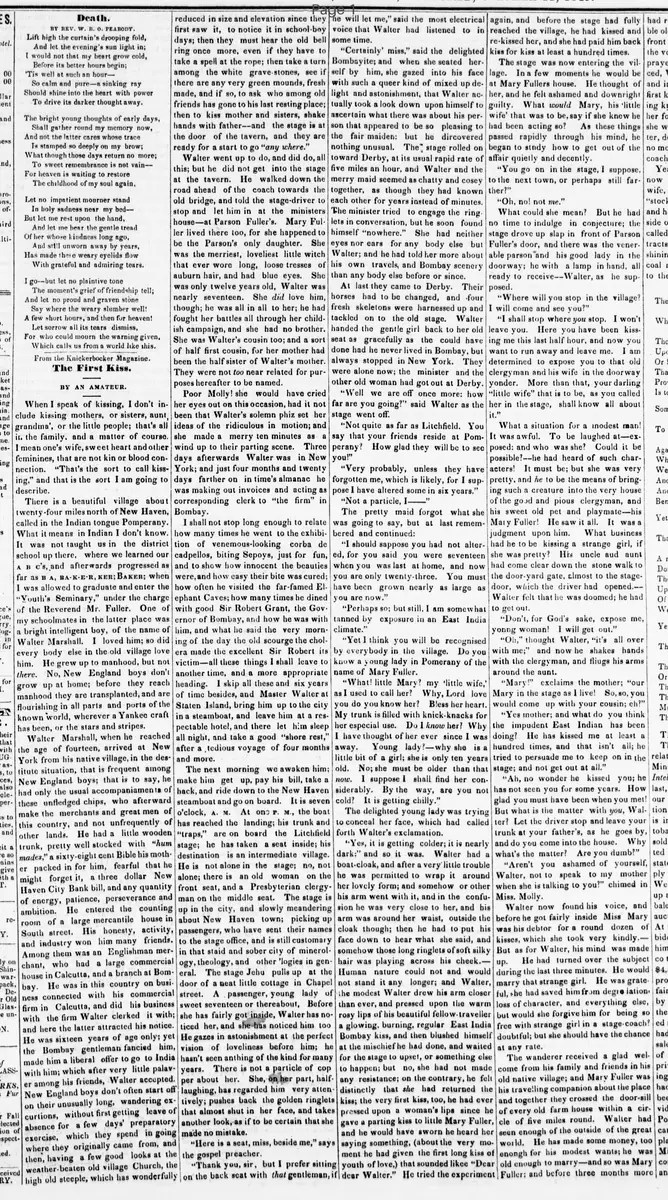
'The First Kiss,
By an Amateur.
When I speak of kissing, I don't include kissing mothers, or sisters, aunts, grandma's, or the little people; that's all in the family, and a matter of course.
I mean one's wife, sweet heart and other feminines, that are not kin or blood connection.
"That's the sort to call kissing," and that is the sort I am going to describe.
There is a beautiful village about twenty-four miles north of New Haven, called in the Indian tongue Pomperany.
What it means in Indian I don't know.
It was not taught us in the district school up there, where we learned our A B C's, and afterwards progressed as far as B A, BA-K-E-R, KER; BAKER; When I was allowed to graduate and enter the "Youth's Seminary," under the charge of the Reverend Mr. Fuller. One of my schoolmates in the latter place was a bright intelligent boy, of the name of Walter Marshall. I loved him; so did every body else in the old village love him. He grew up to manhood, but not there. No, New England boys don't grow up at home; before they reach manhood they are transplanted, and are flourishing in all parts and ports of the known world, wherever a Yankee craft has been, or the stars and stripes.
Walter Marshall, when he reached the age of fourteen, arrived at New York from his native village, in the destitute situation, that is frequent among New England boys; that is to say, he had only the usual accompaniments of these unfledged chips, who afterward make the merchants and great men of this country, and not unfrequently of other lands. He had a little wooden trunk, pretty well stocked with "hummades," a sixty-eight cent Bible his mother packed in for him, fearful that he might forget it, a three dollar New Haven City Bank bill, and any quantity of energy, patience, perseverance and ambition. He entered the counting room of a large mercantile house in South street. His honesty, activity. and industry won him many friends.
Among them was an Englishman merchant, who had a large commercial house in Calcutta, and a branch at Bombay.
He was in this country on business connected with his commercial firm in Calcutta, and did his business with the firm Walter clerked in with; and here the latter attracted his notice.
He was sixteen years of age only; yet the Bombay gentleman fancied him, made him a liberal offer to go to India with him; which after very little palaver among his friends, Walter accepted.
New England boys don't often start off on their unusually long, wandering expeditions, without first getting leave of absence for a few days' preparatory excursions, which they spend in going where they originally came from, and then, having a few good looks at the weather-beaten old village Church, the high old steeple, which has wonderfully reduced in size and elevation since they first saw it, to notice it in school-boy days; then they must hear the old bell ring once more, even if they have to take a spell at the rope; then take a turn among the white grave-stones, see if there are any very green mounds, fresh made, and if so, to ask who among old friends has gone to his last resting place; then to kiss mother and sisters, shake hands with father—and the stage is at the door of the tavern, and they are ready for a start to go "any where.
Walter went up to do, and did do, all this; but he did not get into the stage at the tavern. He walked down the road ahead of the coach towards the old bridge, and told the stage-driver to stop and let him in at the ministers house—at Parson Fuller's. Mary Fuller lived there too, for she happened to be the Parson's only daughter. She was the merriest, loveliest little witch that ever wore long, loose tresses of auburn hair, and had blue eyes. She was only twelve years old, Walter was nearly seventeen. She did love him, though; he was all in all to her; he had fought her battles all through her childish campaign, and she had no brother.
She was Walter's cousin too; and a sort of half first cousin, for her mother had been the half sister of Walter's mother.
They were not too near related for purposes hereafter to be named.
Poor Molly! she would have cried her eyes out on this occasion, had it not been that Walter's solemn phiz set her ideas of the ridiculous in motion; and she made a merry ten minutes as a wind up to their parting scene. Three days afterwards Walter was in New York; and just four months and twenty days farther on in time's almanac he was making out invoices and acting as corresponding clerk to "the firm" in Bombay.
I shall not stop long enough to relate how many times he went to the exhibition of venomous-looking cobra de capellos, biting Sepoys, just for fun, and to show how innocent the beauties were, and how easy their bite was cured: how often he visited the far-famed Elephant Caves; how many times he dined with good Sir Robert Grant, the Governor of Bombay, and how he was with him, and what he said the very morning of the day the old scourge the cholera made the excellent Sir Robert its victim—all these things I shall leave to another time, and a more appropriate heading. I skip all these and six years of time besides, and Master Walter at Staten Island, bring him up to the city in a steamboat, and leave him at a respectable hotel, and there let him sleep all night, and take a good "shore rest," after a tedious voyage of four months and more.
The next morning we awaken him; make him get up, pay his bill, take a hack, and ride down to the New Haven steamboat and go on board. It is seven o'clock, A. M.
At one P. M., the boat has reached the landing; his trunk and "traps," are on board the Litchfield stage; he has taken a seat inside; his destination is an intermediate village.
He is not alone in the stage; no, not alone; there is an old woman on the front seat, and a Presbyterian clergyman on the middle seat. The stage is up in the city, and slowly meandering about New Haven town; picking up passengers, who have sent their names to the stage office, and is still customary in that staid and sober city of mineralogy, theology, and other 'logies in general. The stage Jehu pulls up at the door of a neat little cottage in Chapel street. A passenger, young lady of sweet seventeen or thereabout, Before she has fairly got inside, Walter has noticed her, and she has noticed him too He gazes in astonishment at the perfect vision of loveliness before him; he hasn't seen anything of the kind for many years.
There is not a particle of copper about her. She, on her part, half-laughing, has regarded him very attentively; pushes back the golden ringlets that almost shut in her face, and takes another look, as if to be certain that she made no mistake.
"Here is a seat, miss, beside me," says the gospel preacher.
"Thank you, sir, but I prefer sitting on the back seat with that gentleman, if he will let me," said the most electrical voice that Walter had listened to in some time.
"Certainly miss," said the delighted Bombayite; and when she seated herself by him, she gazed into his face with such a queer kind of mixed up delight and astonishment, that Walter actually took a look down upon himself to ascertain what there was about his person that appeared to be so pleasing to the fair maiden: but he discovered nothing unusual. The stage rolled on toward Derby, at its usual rapid rate of five miles an hour, and Walter and the merry maid seemed as chatty and cosy together, as though they had known each other for years instead of minutes.
The minister tried to engage the ringlets in conversation, but he soon found himself "nowhere."
She had neither eyes nor ears for any body else but Walter; and he had told her more about his own travels, and Bombay scenery than any body else before or since.
At last they came to Derby. Their horses had to be changed, and four fresh skeletons were harnessed up and tackled on to the old stage.
Walter handed the gentle girl back to her old seat as gracefully as he could have done had he never lived in Bombay, but always stopped in New York. They were alone now; the minister and the other old woman had got out at Derby.
"Well we are off once more: how far are you going?" said Walter as the stage went off.
"Not quite as far as Litchfield. You say that your friends reside at Pomperany?
How glad they will be to see you!"
"Very probably, unless they have forgotten me, which is likely, for I suppose I have altered some in six years."
"Not a particle, I The pretty maid forgot what she was going to say, but at last remembered and continued:
"I should suppose you had not altered, for you said you were seventeen when you was last at home, and now you are only twenty-three.
You must have been grown nearly as large as you are now."
"Perhaps so; but still, I am somewhat tanned by exposure in an East India climate."
"Yet I think you will be recognised by everybody in the village.
Do you know a young lady in Pomerany of the name of Mary Fuller.
"What! little Mary? my 'little wife,' as I used to call her?
Why, Lord love you do you know her? Bless her heart.
My trunk is filled with knick-knacks for her especial use.
Do I know her? Why I have thought of her ever since I was away.
Young lady?—why she is a little bit of a girl; she is only ten years old. No; she must be older than that now.
I suppose I shall find her considerably.
By the way, are you not cold? It is getting chilly."
The delighted young lady was trying to conceal her face, which had called forth Walter's exclamation.
"Yes, it is getting colder; it is nearly dark:" and so it was.
Walter had a boat-cloak, and after a very little trouble he was permitted to wrap it around her lovely form; and somehow or other his arm went with it, and in the confusion he was very close to her, and his arm was around her waist, outside the cloak though; then he had to put his face down to hear what she said, and somehow those long ringlets of soft silky hair was playing across his cheek.—
Human nature could not and would not stand it any longer; and Walter, the modest Walter drew his arm closer than ever, and pressed upon the warm rosy lips of his beautiful fellow-traveller a glowing, burning, regular East India Bombay kiss, and then blushed himself at the mischief he had done, and waited for the stage to upset, or something else to happen; but no, she had not made any resistance; on the contrary, he felt distinctly that she had returned the kiss; the very first kiss, too, he had ever pressed upon a woman's lips since he gave a parting kiss to little Mary Fuller, and he would have sworn he heard her saying something, (about the very moment he had given the first long kiss of youth of love,) that sounded like "Dear dear Walter." He tried the experiment The stage was now entering the village. In a few moments he would be at Mary Fullers house. He thought of her, and he felt ashamed and downright guilty.
What would Mary, his 'little wife' that was to be, say if she knew he had been acting so?
As these things passed rapidly through his mind, he began to study how to get out of the affair quietly and decently.
"You go on in the stage, I suppose, to the next town, or perhaps still farther?"
"Oh, no! not me."
What could she mean? But he had no time to indulge in conjecture; the stage drove up slap in front of Parson Fuller's door, and there was the venerable parson and his good lady in the doorway; he with a lamp in hand, all ready to receive—Walter, as he supposed.
"Where will you stop in the village?
I will come and see you?"
"I shall stop where you stop. I won't leave you. Here you have been kissing me this last half hour, and now you want to run away and leave me. I am determined to expose you to that old clergyman and his wife in the doorway yonder. More than that, your darling "little wife" that is to be, as you called her in the stage, shall know all about it."
What a situation for a modest man!
It was awful. To be laughed at—exposed: and who was she? Could it be possible?—he had heard of such characters! It must be; but she was very pretty. and he to be the means of bringing such a creature into the very house of the good and pious clergyman, and his sweet old pet and playmate—his Mary Fuller! He saw it all. It was a judgment upon him.
What business had he to be kissing a strange girl, if she was pretty? His uncle and aunt had come clear down the stone walk to the door-yard gate, almost to the stage-door, which the driver had opened.—
Walter felt that he was doomed; he had to get out.
"Don't, for God's sake, expose me, young woman! I will get out."
"Oh," thought Walter, "it's all over with me;" and now he shakes hands with the clergyman, and flings his arms around the aunt.
"Mary!" exclaims the mother; "our Mary in the stage as I live! So, so, you would come up with your cousin; eh?"
"Yes mother; and what do you think the impudent East Indian has been doing? He has kissed me at least a hundred times, and that isn't all; he tried to persuade me to keep on in the stage; and not get out at all."
"Ah, no wonder he kissed you; he has not seen you for some years. How glad you must have been when you met!
But what is the matter with you, Walter? Let the driver stop and leave your trunk at your father's, as he goes by, and do you come into the house. Why what's the matter? Are you dumb?"
"Aren't you ashamed of yourself, Walter, not to speak to my mother when she is talking to you?" chimed in Miss. Molly.
Walter now found his voice, and before he got fairly inside Miss Mary was his debtor for a round dozen of kisses, which she took very kindly.—
But as for Walter, his mind was made up.
He had turned over the subject during the last three minutes. He would marry that strange girl. He was grateful, she had saved him from degradation, loss of character, and everything else, but would she forgive him for being so free with strange girl in a stage-coach?
doubtful; but she should have the chance at any rate.
The wanderer received a glad welcome from his family and friends in his old native village; and Mary Fuller was his travelling companion about the place and together they crossed the door-sill of every old farm house within a circle of five miles round. Walter had seen enough of the outside of the great world. He has made some money, too enough for his modest wants; he was old enough to marry—and so was Mary Fuller; and before three months more had rolled over their heads, the venerable old father made them one in the front parlor of the old globe.
When the vows had been spoken, the last prayer made, and the blessing pronounced, Walter clasped Mary to his breast and imprinted on her sweet lips another first kiss; but now it was the first, thrilling kiss of married love; and as he had her for a moment in his ardent embrace she whispered gently in his ear—"Walter, dear, it is understood in the vow. no more kissing strange girls in a stage-coach."
Years have flown by since then, and now Walter Marshall and his gentle wife, and the little people they call their "stock in trade." are living pleasantly and happily somewhere on the other side of the Alleghanies, near a place called Pittsburgh, where he owns large tracts of mines not humbug washy shining gold, but real, hard, substantial coal mines, productive to himself and to the country he lives in.
By an Amateur.
When I speak of kissing, I don't include kissing mothers, or sisters, aunts, grandma's, or the little people; that's all in the family, and a matter of course.
I mean one's wife, sweet heart and other feminines, that are not kin or blood connection.
"That's the sort to call kissing," and that is the sort I am going to describe.
There is a beautiful village about twenty-four miles north of New Haven, called in the Indian tongue Pomperany.
What it means in Indian I don't know.
It was not taught us in the district school up there, where we learned our A B C's, and afterwards progressed as far as B A, BA-K-E-R, KER; BAKER; When I was allowed to graduate and enter the "Youth's Seminary," under the charge of the Reverend Mr. Fuller. One of my schoolmates in the latter place was a bright intelligent boy, of the name of Walter Marshall. I loved him; so did every body else in the old village love him. He grew up to manhood, but not there. No, New England boys don't grow up at home; before they reach manhood they are transplanted, and are flourishing in all parts and ports of the known world, wherever a Yankee craft has been, or the stars and stripes.
Walter Marshall, when he reached the age of fourteen, arrived at New York from his native village, in the destitute situation, that is frequent among New England boys; that is to say, he had only the usual accompaniments of these unfledged chips, who afterward make the merchants and great men of this country, and not unfrequently of other lands. He had a little wooden trunk, pretty well stocked with "hummades," a sixty-eight cent Bible his mother packed in for him, fearful that he might forget it, a three dollar New Haven City Bank bill, and any quantity of energy, patience, perseverance and ambition. He entered the counting room of a large mercantile house in South street. His honesty, activity. and industry won him many friends.
Among them was an Englishman merchant, who had a large commercial house in Calcutta, and a branch at Bombay.
He was in this country on business connected with his commercial firm in Calcutta, and did his business with the firm Walter clerked in with; and here the latter attracted his notice.
He was sixteen years of age only; yet the Bombay gentleman fancied him, made him a liberal offer to go to India with him; which after very little palaver among his friends, Walter accepted.
New England boys don't often start off on their unusually long, wandering expeditions, without first getting leave of absence for a few days' preparatory excursions, which they spend in going where they originally came from, and then, having a few good looks at the weather-beaten old village Church, the high old steeple, which has wonderfully reduced in size and elevation since they first saw it, to notice it in school-boy days; then they must hear the old bell ring once more, even if they have to take a spell at the rope; then take a turn among the white grave-stones, see if there are any very green mounds, fresh made, and if so, to ask who among old friends has gone to his last resting place; then to kiss mother and sisters, shake hands with father—and the stage is at the door of the tavern, and they are ready for a start to go "any where.
Walter went up to do, and did do, all this; but he did not get into the stage at the tavern. He walked down the road ahead of the coach towards the old bridge, and told the stage-driver to stop and let him in at the ministers house—at Parson Fuller's. Mary Fuller lived there too, for she happened to be the Parson's only daughter. She was the merriest, loveliest little witch that ever wore long, loose tresses of auburn hair, and had blue eyes. She was only twelve years old, Walter was nearly seventeen. She did love him, though; he was all in all to her; he had fought her battles all through her childish campaign, and she had no brother.
She was Walter's cousin too; and a sort of half first cousin, for her mother had been the half sister of Walter's mother.
They were not too near related for purposes hereafter to be named.
Poor Molly! she would have cried her eyes out on this occasion, had it not been that Walter's solemn phiz set her ideas of the ridiculous in motion; and she made a merry ten minutes as a wind up to their parting scene. Three days afterwards Walter was in New York; and just four months and twenty days farther on in time's almanac he was making out invoices and acting as corresponding clerk to "the firm" in Bombay.
I shall not stop long enough to relate how many times he went to the exhibition of venomous-looking cobra de capellos, biting Sepoys, just for fun, and to show how innocent the beauties were, and how easy their bite was cured: how often he visited the far-famed Elephant Caves; how many times he dined with good Sir Robert Grant, the Governor of Bombay, and how he was with him, and what he said the very morning of the day the old scourge the cholera made the excellent Sir Robert its victim—all these things I shall leave to another time, and a more appropriate heading. I skip all these and six years of time besides, and Master Walter at Staten Island, bring him up to the city in a steamboat, and leave him at a respectable hotel, and there let him sleep all night, and take a good "shore rest," after a tedious voyage of four months and more.
The next morning we awaken him; make him get up, pay his bill, take a hack, and ride down to the New Haven steamboat and go on board. It is seven o'clock, A. M.
At one P. M., the boat has reached the landing; his trunk and "traps," are on board the Litchfield stage; he has taken a seat inside; his destination is an intermediate village.
He is not alone in the stage; no, not alone; there is an old woman on the front seat, and a Presbyterian clergyman on the middle seat. The stage is up in the city, and slowly meandering about New Haven town; picking up passengers, who have sent their names to the stage office, and is still customary in that staid and sober city of mineralogy, theology, and other 'logies in general. The stage Jehu pulls up at the door of a neat little cottage in Chapel street. A passenger, young lady of sweet seventeen or thereabout, Before she has fairly got inside, Walter has noticed her, and she has noticed him too He gazes in astonishment at the perfect vision of loveliness before him; he hasn't seen anything of the kind for many years.
There is not a particle of copper about her. She, on her part, half-laughing, has regarded him very attentively; pushes back the golden ringlets that almost shut in her face, and takes another look, as if to be certain that she made no mistake.
"Here is a seat, miss, beside me," says the gospel preacher.
"Thank you, sir, but I prefer sitting on the back seat with that gentleman, if he will let me," said the most electrical voice that Walter had listened to in some time.
"Certainly miss," said the delighted Bombayite; and when she seated herself by him, she gazed into his face with such a queer kind of mixed up delight and astonishment, that Walter actually took a look down upon himself to ascertain what there was about his person that appeared to be so pleasing to the fair maiden: but he discovered nothing unusual. The stage rolled on toward Derby, at its usual rapid rate of five miles an hour, and Walter and the merry maid seemed as chatty and cosy together, as though they had known each other for years instead of minutes.
The minister tried to engage the ringlets in conversation, but he soon found himself "nowhere."
She had neither eyes nor ears for any body else but Walter; and he had told her more about his own travels, and Bombay scenery than any body else before or since.
At last they came to Derby. Their horses had to be changed, and four fresh skeletons were harnessed up and tackled on to the old stage.
Walter handed the gentle girl back to her old seat as gracefully as he could have done had he never lived in Bombay, but always stopped in New York. They were alone now; the minister and the other old woman had got out at Derby.
"Well we are off once more: how far are you going?" said Walter as the stage went off.
"Not quite as far as Litchfield. You say that your friends reside at Pomperany?
How glad they will be to see you!"
"Very probably, unless they have forgotten me, which is likely, for I suppose I have altered some in six years."
"Not a particle, I The pretty maid forgot what she was going to say, but at last remembered and continued:
"I should suppose you had not altered, for you said you were seventeen when you was last at home, and now you are only twenty-three.
You must have been grown nearly as large as you are now."
"Perhaps so; but still, I am somewhat tanned by exposure in an East India climate."
"Yet I think you will be recognised by everybody in the village.
Do you know a young lady in Pomerany of the name of Mary Fuller.
"What! little Mary? my 'little wife,' as I used to call her?
Why, Lord love you do you know her? Bless her heart.
My trunk is filled with knick-knacks for her especial use.
Do I know her? Why I have thought of her ever since I was away.
Young lady?—why she is a little bit of a girl; she is only ten years old. No; she must be older than that now.
I suppose I shall find her considerably.
By the way, are you not cold? It is getting chilly."
The delighted young lady was trying to conceal her face, which had called forth Walter's exclamation.
"Yes, it is getting colder; it is nearly dark:" and so it was.
Walter had a boat-cloak, and after a very little trouble he was permitted to wrap it around her lovely form; and somehow or other his arm went with it, and in the confusion he was very close to her, and his arm was around her waist, outside the cloak though; then he had to put his face down to hear what she said, and somehow those long ringlets of soft silky hair was playing across his cheek.—
Human nature could not and would not stand it any longer; and Walter, the modest Walter drew his arm closer than ever, and pressed upon the warm rosy lips of his beautiful fellow-traveller a glowing, burning, regular East India Bombay kiss, and then blushed himself at the mischief he had done, and waited for the stage to upset, or something else to happen; but no, she had not made any resistance; on the contrary, he felt distinctly that she had returned the kiss; the very first kiss, too, he had ever pressed upon a woman's lips since he gave a parting kiss to little Mary Fuller, and he would have sworn he heard her saying something, (about the very moment he had given the first long kiss of youth of love,) that sounded like "Dear dear Walter." He tried the experiment The stage was now entering the village. In a few moments he would be at Mary Fullers house. He thought of her, and he felt ashamed and downright guilty.
What would Mary, his 'little wife' that was to be, say if she knew he had been acting so?
As these things passed rapidly through his mind, he began to study how to get out of the affair quietly and decently.
"You go on in the stage, I suppose, to the next town, or perhaps still farther?"
"Oh, no! not me."
What could she mean? But he had no time to indulge in conjecture; the stage drove up slap in front of Parson Fuller's door, and there was the venerable parson and his good lady in the doorway; he with a lamp in hand, all ready to receive—Walter, as he supposed.
"Where will you stop in the village?
I will come and see you?"
"I shall stop where you stop. I won't leave you. Here you have been kissing me this last half hour, and now you want to run away and leave me. I am determined to expose you to that old clergyman and his wife in the doorway yonder. More than that, your darling "little wife" that is to be, as you called her in the stage, shall know all about it."
What a situation for a modest man!
It was awful. To be laughed at—exposed: and who was she? Could it be possible?—he had heard of such characters! It must be; but she was very pretty. and he to be the means of bringing such a creature into the very house of the good and pious clergyman, and his sweet old pet and playmate—his Mary Fuller! He saw it all. It was a judgment upon him.
What business had he to be kissing a strange girl, if she was pretty? His uncle and aunt had come clear down the stone walk to the door-yard gate, almost to the stage-door, which the driver had opened.—
Walter felt that he was doomed; he had to get out.
"Don't, for God's sake, expose me, young woman! I will get out."
"Oh," thought Walter, "it's all over with me;" and now he shakes hands with the clergyman, and flings his arms around the aunt.
"Mary!" exclaims the mother; "our Mary in the stage as I live! So, so, you would come up with your cousin; eh?"
"Yes mother; and what do you think the impudent East Indian has been doing? He has kissed me at least a hundred times, and that isn't all; he tried to persuade me to keep on in the stage; and not get out at all."
"Ah, no wonder he kissed you; he has not seen you for some years. How glad you must have been when you met!
But what is the matter with you, Walter? Let the driver stop and leave your trunk at your father's, as he goes by, and do you come into the house. Why what's the matter? Are you dumb?"
"Aren't you ashamed of yourself, Walter, not to speak to my mother when she is talking to you?" chimed in Miss. Molly.
Walter now found his voice, and before he got fairly inside Miss Mary was his debtor for a round dozen of kisses, which she took very kindly.—
But as for Walter, his mind was made up.
He had turned over the subject during the last three minutes. He would marry that strange girl. He was grateful, she had saved him from degradation, loss of character, and everything else, but would she forgive him for being so free with strange girl in a stage-coach?
doubtful; but she should have the chance at any rate.
The wanderer received a glad welcome from his family and friends in his old native village; and Mary Fuller was his travelling companion about the place and together they crossed the door-sill of every old farm house within a circle of five miles round. Walter had seen enough of the outside of the great world. He has made some money, too enough for his modest wants; he was old enough to marry—and so was Mary Fuller; and before three months more had rolled over their heads, the venerable old father made them one in the front parlor of the old globe.
When the vows had been spoken, the last prayer made, and the blessing pronounced, Walter clasped Mary to his breast and imprinted on her sweet lips another first kiss; but now it was the first, thrilling kiss of married love; and as he had her for a moment in his ardent embrace she whispered gently in his ear—"Walter, dear, it is understood in the vow. no more kissing strange girls in a stage-coach."
Years have flown by since then, and now Walter Marshall and his gentle wife, and the little people they call their "stock in trade." are living pleasantly and happily somewhere on the other side of the Alleghanies, near a place called Pittsburgh, where he owns large tracts of mines not humbug washy shining gold, but real, hard, substantial coal mines, productive to himself and to the country he lives in.
What sub-type of article is it?
Prose Fiction
What themes does it cover?
Love Romance
Commerce Trade
Patriotism
What keywords are associated?
First Kiss
Reunion
New England
Bombay Merchant
Stagecoach Romance
Cousin Marriage
Yankee Ambition
What entities or persons were involved?
By An Amateur.
Literary Details
Title
The First Kiss
Author
By An Amateur.
Key Lines
"Walter, Dear, It Is Understood In The Vow. No More Kissing Strange Girls In A Stage Coach."
And Pressed Upon The Warm Rosy Lips Of His Beautiful Fellow Traveller A Glowing, Burning, Regular East India Bombay Kiss
He Would Marry That Strange Girl. He Was Grateful, She Had Saved Him From Degradation, Loss Of Character, And Everything Else