Thank you for visiting SNEWPapers!
Sign up free
Editorial
March 15, 1884
Southern Standard
Mcminnville, Warren County, Tennessee
What is this article about?
A Western farmer responds to an Alabama critic, arguing that protective tariffs have driven prosperity for farmers over 20 years through mutual trade with manufacturers. He urges the South to embrace manufacturing and infrastructure to avoid self-destruction from low tariffs.
Clipping
OCR Quality
98%
Excellent
Full Text
WESTERN FARMERS TO THE SOUTH.
Cor. American.
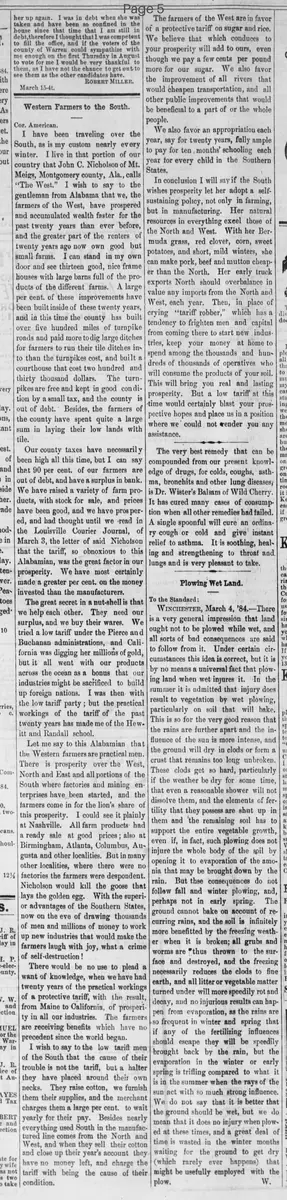
I have been traveling over the South, as is my custom nearly every winter. I live in that portion of our country that John C. Nicholson of Mt. Meigs, Montgomery county, Ala., calls "The West." I wish to say to the gentleman from Alabama that we, the farmers of the West, have prospered and accumulated wealth faster for the past twenty years than ever before, and the greater part of the renters of twenty years ago now own good but small farms. I can stand in my own door and see thirteen good, nice frame houses with large barns full of the products of the different farms. A large per cent. of these improvements have been built inside of these twenty years, and in this time the county has built over five hundred miles of turnpike roads and paid more to dig large ditches for farmers to run their tile ditches into than the turnpikes cost, and built a courthouse that cost two hundred and thirty thousand dollars. The turnpikes are free and kept in good condition by a small tax, and the county is out of debt. Besides, the farmers of the county have spent quite a large sum in laying their low lands with tile.
Our county taxes have necessarily been high all this time, but I can say that 90 per cent. of our farmers are out of debt, and have a surplus in bank. We have raised a variety of farm products, with stock for sale, and prices have been good, and we have prospered, and had thought until we read in the Louisville Courier Journal, of March 3, the letter of said Nicholson that the tariff, so obnoxious to this Alabamian, was the great factor in our prosperity. We have most certainly made a greater per cent. on the money invested than the manufacturers.
The great secret in a nut-shell is that we help each other. They need our surplus, and we buy their wares. We tried a low tariff under the Pierce and Buchanan administrations, and California was digging her millions of gold, but it all went with our products across the ocean as a bonus that our industries might be sacrificed to build up foreign nations. I was then with the low tariff party; but the practical workings of the tariff of the past twenty years has made me of the Newitt and Randall school.
Let me say to this Alabamian that the Western farmers are practical men. There is prosperity over the West, North and East and all portions of the South where factories and mining enterprises have been started, and the farmers come in for the lion's share of this prosperity. I could see it plainly at Nashville. All farm products had a ready sale at good prices; also at Birmingham, Atlanta, Columbus, Augusta and other localities. But in many other localities, where there were no factories the farmers were despondent. Nicholson would kill the goose that lays the golden egg. With the superior advantages of the Southern States, now on the eve of drawing thousands of men and millions of money to work up new industries that would make the farmers laugh with joy, what a crime of self-destruction! There would be no use to plead a want of knowledge, when we have had twenty years of the practical workings of a protective tariff, with the result, from Maine to California, of prosperity in all our industries. The farmers are receiving benefits which have no precedent since the world began.
I wish to say to the low tariff men of the South that the cause of their trouble is not the tariff, but a halter they have placed around their own necks. They raise cotton, we furnish them their supplies, and the merchant charges them a large per cent. to wait yearly for their pay. Besides nearly everything used South in the manufactured line comes from the North and West, and when they sell their cotton and close up their year's account they have no money left, and charge the tariff with being the cause of their condition.
The farmers of the West are in favor of a protective tariff on sugar and rice. We believe that which conduces to your prosperity will add to ours, even though we pay a few cents per pound more for our sugar. We also favor the improvement of all rivers that would cheapen transportation, and all other public improvements that would be beneficial to a part of or the whole people.
We also favor an appropriation each year, say for twenty years, fully ample to pay for ten months' schooling each year for every child in the Southern States.
In conclusion I will say if the South wishes prosperity let her adopt a self-sustaining policy, not only in farming, but in manufacturing. Her natural resources in everything excel those of the North and West. With her Bermuda grass, red clover, corn, sweet potatoes, and short, mild winters, she can make pork, beef and mutton cheaper than the North. Her early truck exports North should overbalance in value any imports from the North and West, each year. Then, in place of crying "tariff robber," which has a tendency to frighten men and capital from coming there to start new industries, keep your money at home to spend among the thousands and hundreds of thousands of operatives who will consume the products of your soil. This will bring you real and lasting prosperity. But a low tariff at this time would certainly blast your prospective hopes and place us in a position where we could not render you any assistance.
Cor. American.
I have been traveling over the South, as is my custom nearly every winter. I live in that portion of our country that John C. Nicholson of Mt. Meigs, Montgomery county, Ala., calls "The West." I wish to say to the gentleman from Alabama that we, the farmers of the West, have prospered and accumulated wealth faster for the past twenty years than ever before, and the greater part of the renters of twenty years ago now own good but small farms. I can stand in my own door and see thirteen good, nice frame houses with large barns full of the products of the different farms. A large per cent. of these improvements have been built inside of these twenty years, and in this time the county has built over five hundred miles of turnpike roads and paid more to dig large ditches for farmers to run their tile ditches into than the turnpikes cost, and built a courthouse that cost two hundred and thirty thousand dollars. The turnpikes are free and kept in good condition by a small tax, and the county is out of debt. Besides, the farmers of the county have spent quite a large sum in laying their low lands with tile.
Our county taxes have necessarily been high all this time, but I can say that 90 per cent. of our farmers are out of debt, and have a surplus in bank. We have raised a variety of farm products, with stock for sale, and prices have been good, and we have prospered, and had thought until we read in the Louisville Courier Journal, of March 3, the letter of said Nicholson that the tariff, so obnoxious to this Alabamian, was the great factor in our prosperity. We have most certainly made a greater per cent. on the money invested than the manufacturers.
The great secret in a nut-shell is that we help each other. They need our surplus, and we buy their wares. We tried a low tariff under the Pierce and Buchanan administrations, and California was digging her millions of gold, but it all went with our products across the ocean as a bonus that our industries might be sacrificed to build up foreign nations. I was then with the low tariff party; but the practical workings of the tariff of the past twenty years has made me of the Newitt and Randall school.
Let me say to this Alabamian that the Western farmers are practical men. There is prosperity over the West, North and East and all portions of the South where factories and mining enterprises have been started, and the farmers come in for the lion's share of this prosperity. I could see it plainly at Nashville. All farm products had a ready sale at good prices; also at Birmingham, Atlanta, Columbus, Augusta and other localities. But in many other localities, where there were no factories the farmers were despondent. Nicholson would kill the goose that lays the golden egg. With the superior advantages of the Southern States, now on the eve of drawing thousands of men and millions of money to work up new industries that would make the farmers laugh with joy, what a crime of self-destruction! There would be no use to plead a want of knowledge, when we have had twenty years of the practical workings of a protective tariff, with the result, from Maine to California, of prosperity in all our industries. The farmers are receiving benefits which have no precedent since the world began.
I wish to say to the low tariff men of the South that the cause of their trouble is not the tariff, but a halter they have placed around their own necks. They raise cotton, we furnish them their supplies, and the merchant charges them a large per cent. to wait yearly for their pay. Besides nearly everything used South in the manufactured line comes from the North and West, and when they sell their cotton and close up their year's account they have no money left, and charge the tariff with being the cause of their condition.
The farmers of the West are in favor of a protective tariff on sugar and rice. We believe that which conduces to your prosperity will add to ours, even though we pay a few cents per pound more for our sugar. We also favor the improvement of all rivers that would cheapen transportation, and all other public improvements that would be beneficial to a part of or the whole people.
We also favor an appropriation each year, say for twenty years, fully ample to pay for ten months' schooling each year for every child in the Southern States.
In conclusion I will say if the South wishes prosperity let her adopt a self-sustaining policy, not only in farming, but in manufacturing. Her natural resources in everything excel those of the North and West. With her Bermuda grass, red clover, corn, sweet potatoes, and short, mild winters, she can make pork, beef and mutton cheaper than the North. Her early truck exports North should overbalance in value any imports from the North and West, each year. Then, in place of crying "tariff robber," which has a tendency to frighten men and capital from coming there to start new industries, keep your money at home to spend among the thousands and hundreds of thousands of operatives who will consume the products of your soil. This will bring you real and lasting prosperity. But a low tariff at this time would certainly blast your prospective hopes and place us in a position where we could not render you any assistance.
What sub-type of article is it?
Economic Policy
Agriculture
Trade Or Commerce
What keywords are associated?
Protective Tariff
Farmers Prosperity
Southern Economy
Regional Trade
Manufacturing Development
Low Tariff Criticism
Public Improvements
Education Funding
What entities or persons were involved?
John C. Nicholson
Mt. Meigs
Montgomery County, Ala.
Louisville Courier Journal
Pierce Administration
Buchanan Administration
Newitt And Randall
Editorial Details
Primary Topic
Defense Of Protective Tariff For Regional Prosperity
Stance / Tone
Pro Protective Tariff, Critical Of Low Tariff Policies
Key Figures
John C. Nicholson
Mt. Meigs
Montgomery County, Ala.
Louisville Courier Journal
Pierce Administration
Buchanan Administration
Newitt And Randall
Key Arguments
Western Farmers Have Prospered Under Protective Tariff For 20 Years
Mutual Benefit Between Farmers And Manufacturers Through Trade
Low Tariff Under Pierce And Buchanan Led To Loss Of Wealth To Foreign Nations
Prosperity In Areas With Factories And Mining
Southern Farmers' Issues Stem From Credit System And Reliance On Northern Goods, Not Tariff
Support Protective Tariff On Sugar And Rice
Favor River Improvements And Public Education Funding In South
South Should Develop Manufacturing To Achieve Self Sustaining Prosperity