Thank you for visiting SNEWPapers!
Sign up free
New York Daily Tribune
New York, New York County, New York
What is this article about?
In a June 14, 1861, letter from Boston to the New York Tribune, the correspondent laments economic hardships amid Civil War tensions, noting subdued Anniversary Week events, unsold goods, lack of new books, and critiques England's sympathy for the South, urging a return to farming and principled resolve.
Clipping
OCR Quality
Full Text
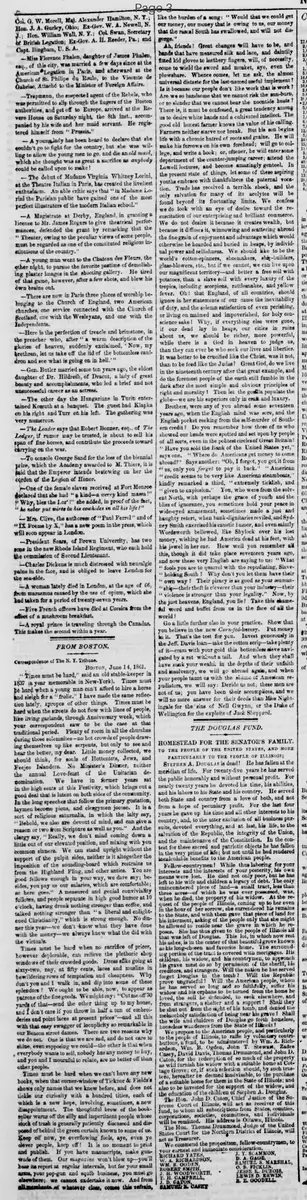
Correspondence of The N. Y. Tribune.
Boston, June 14, 1861.
"Times must be hard," said an old stable-keeper in 1837 (a year memorable in New-York). Times must be hard when a young man can't afford to hire a horse and sleigh for a "frolic." I have made the same reflection lately, apropos of other things. Times must be hard when the streets do not flow with lines of people, like living garlands, through Anniversary week, which your correspondent saw to be the case at that traditional period. Plenty of room in all the churches during those solemnities—no hot crowds of people drawing themselves up like serpents, but only to see and hear the better, my dear. Little money collected, we should think, for souls of Hottentots, Jews, and Feejee Islanders. No Minister's Dinner, neither the annual Love-feast of the Unitarian denomination.
We have in former years sat in the high seats at this Festivity, which brings out a good deal that is latent on both sides of the community. In the long speeches that follow the primary gustation, laymen become pious, and clergymen jocose. It is a sort of religious saturnalia, in which the laity say, "Behold, we also are devout of mind, and can give a reason or two from Scripture as well as you." And the clergy say, "Really, we don't mind coming down a little out of our elevated position, and mixing with you common sinners. We can stand upright without the support of the pulpit sides, neither is it altogether the imposition of the sounding-board which restrains us from the Highland Fling, and other antics. You are good fellows enough in your way, we dare say; besides, you pay us our salaries, which are comfortable; so here goes." A measured and genial conviviality follows, and people separate in high good humor at 10 o'clock, having drunk nothing stronger than coffee, and talked nothing stronger than "a liberal and enlightened Christianity," which is strong enough. No dinner this year—we don't know what they have done with the money—we always knew what they did with the victuals.
Times must be hard when no sacrifice of prices, however deplorable, can relieve the plethoric shop windows of their crowded goods. Dress silks going at sixty-two, nay, at fifty cents, laces and muslins in bewildering rows of temptation and cheapness. Why don't you and I walk in, and dip into some of these splendors? We ought to be able, now, to appear as patrons of the fine goods. We might say: "Cut me off 30 yards of that—send the other thing up to my house, and I don't care if you throw in half a ton of embroideries and point laces at present prices"—and all this with that easy swagger of locupacity so remarkable in our Beacon street dames. There are two reasons why we do not. One is that we are sad, and do not care to shine, even supposing we could—the other is that when everybody wants to sell, nobody has any money to buy, and you and I, mournful to relate, are no better off than other people.
Times must be hard when we can't have any new books, when that corner-window of Ticknor & Fields's shows only names that we knew before, and does not tickle our curiosity with a hundred titles, each of which is a new hope, involving, sometimes, a new disappointment. The thoughtful brow of the book-seller warns off the silly and impertinent people whose stock of trash is generally patiently discussed and disposed of behind the green curtain known to some of us. Keep off now, ye overflowing fools, aye, even ye clever people, keep off! It is no moment to print and publish. If you have manuscripts, make gun-wads of them. Our magazine won't blow up—you'll hear its report at regular intervals, but for your small arms, your pop-gun and squib business, you must go elsewhere; we cannot undertake it now. And from Ilushonte like the burden of a song: "Would that we could get our money, our money that is owing to us, our money that the rascal South has swallowed, and will not disgorge."
Ah, friends! Great changes will have to be, and hands that have measured silk and lace, and daintily fitted kid gloves to leathery fingers, will, of necessity, come to wield the sword and musket, aye, even the plowshare. Whence comes, let me ask, the almost universal distaste for the last-named useful implement! Is it because our people don't like work that is work! Are we so handsome that we cannot risk the sun-burn, or so slender that we cannot bear the noontide heats! There is, it must be confessed, a great tendency among us to desire white hands and a cultivated intellect. The good old honest farmer knows the value of his calling. Farmers neither starve nor break. But his son begins life with a chronic hatred of roots and grains. He will make his furrows on his own forehead; will go to college, and write a book; or, oftener, he will enter some department of the counter-jumping career; attend the Lowell lectures, and become amazingly genteel. In the present state of things, let some of these aspiring youths embrace with thankfulness the paternal vocation. Trade has received a terrible shock, and the only salvation for many of its acolytes will be found beyond its fluctuating limits. We confess we do look with an eye of desire toward the resuscitation of our enterprising and brilliant commerce. We do not desire it because it creates wealth, but because it diffuses it, winnowing and scattering abroad the fine grain of enjoyment and advantage which would otherwise be hoarded and buried in heaps, by individual power and selfishness. We should like to be the world's cotton-spinners, shoemakers, ship-builders, glass-blowers, etc., but if we cannot, we can live upon our magnificent territory—and better a free soil with potatoes, than a slave soil with every luxury of the tropics, including scorpions, rattlesnakes, and yellow fever. Oh! that England, of all countries, should ignore in her statements of our cause the inevitability of duty, and the solemn satisfaction of even perishing, or living on maimed and impoverished, for holy conscience sake! Why, if everything else were gone, if our dead lay in heaps, our cities in ruins about us, we should be richer, more powerful, while there is a God in heaven to judge us, than they can ever be who seek our lives and liberties. It was better to be crucified like the Christ, was it not, than to be fed like the Judas? Great God, do we live in the nineteenth century after that great example, and do the foremost people of the earth still fumble in the dark after the most simple and obvious principles of right and morality? Then let the gorla populate the globe—we are his superiors only in craft and luxury.
Brothers, were any of you abroad some seventeen years ago, when the English mind was sore, and the English pocket reeking from the self-murder of Southern credit? Do you remember how those of us who showed our heads were spotted and set upon by people of all sorts, even in the politest circles of Great Britain? "Have you sold the Bank of the United States yet," says one. "Where do Americans get money to come abroad?" Says another: "Oh, I forgot, you got it from us, only you forget to pay it back." "American credit seems to be very like American steamboats," kindly remarked a third, "extremely ticklish, and given to explosion." You, who were from the solvent North, with perhaps the grace of youth and the bliss of ignorance, you sometimes held your peace in wide-eyed amazement, sometimes made a just and haughty retort, when bank-dignitaries reviled, and Sydney Smith exercised his caustic humor, and even saintly Wordsworth bellowed, like Shylock over his lost money, wishing he had America dead at his feet, with his jewel in her ear. How well you remember all this, though it did take place seventeen years ago, and now these very English are saying to us: "What fools you are to quarrel with the repudiating, Slave-holding South? Why don't you let them have their own way? Their piracy is as good as your seamanship—their theft is cleverer than your industry—their violence is stronger than your legality." Now, by the just heavens, England, you lie! Take this shameful word and buffet from us in the face of all the world!
Go a little further also in your practice. Show that you believe in the new Corn-fed-heresy. Put money in it. That's the test for you. Invest generously in the Jeff. Davis loan—take the cotton scrip—take plenty of it—cram with your gold this bottomless sieve navigated by a rat without a tail. And when they shall have sunk your wealth in the depths of their unfaith and insolvency, we will go abroad again, and when your people taunt us with the shame of American repudiators, we will say: Deride us not; these men are not of us; you have been their accomplices, and we will no more answer for their deeds than Miss Nightingale for the sins of Nell Gwynn, or the Duke of Wellington for the exploits of Jack Sheppard.
What sub-type of article is it?
What keywords are associated?
Where did it happen?
Domestic News Details
Primary Location
Boston
Event Date
June 14, 1861
Event Details
A correspondent reports on economic difficulties in Boston, including subdued religious and social events during Anniversary week, unsold merchandise despite low prices, lack of new book publications, and broader impacts from the Civil War, such as disrupted trade with the South and calls for returning to agriculture; also criticizes England's support for the Confederacy and recalls past British attitudes toward American finances.