Thank you for visiting SNEWPapers!
Sign up free
Wheeling Times And Advertiser
Wheeling, Ohio County, West Virginia
What is this article about?
A Virginia letter urges the state legislature to establish and fund a uniform system of free common schools across the commonwealth, opposing voluntary or county-based approaches. It critiques the Richmond school convention's county plan and contrasts republicanism's support for education with democracy's hostility to knowledge that limits power. Dated Dec. 16, 1842; signed A.B.
Clipping
OCR Quality
Full Text
Va., Dec. 16, 1842.
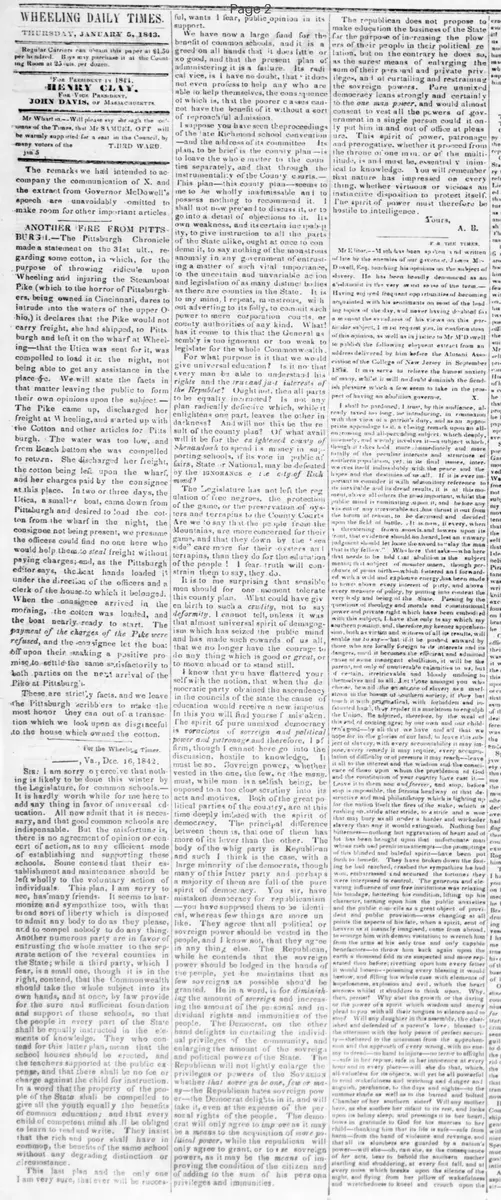
Sir: I am sorry to receive that nothing is likely to be done this winter by the Legislature, for common schools.-- It is hardly worth while for me here to add any thing in favor of universal education. All now admit that it is necessary, and that good common schools are indispensable. But the misfortune is, there is no agreement of opinion or concert of action, as to any efficient mode of establishing and supporting these schools. Some contend that their establishment and maintenance should be left wholly to the voluntary action of individuals. This plan, I am sorry to see, has many friends. It seems to harmonize and sympathize too, with that broad sort of liberty which is disposed to admit anybody to do as they please, and to compel nobody to do any thing. Another numerous party are in favor of entrusting the whole matter to the separate action of the several counties in the State; while a third party, which I fear, is a small one, though it is in the right, contend, that the Commonwealth should take the whole subject into its own hands, and at once, by law provide for the sure and sufficient foundation and support of those schools, so that the people in every part of the State shall be equally instructed in the elements of knowledge. They who contend for this latter plan, mean that the school houses should be erected, and the teachers supported at the public expense, and that there shall be no fee or charge against the child for instruction. In a word that the property of the people of the State shall be compelled to give all the youth equally the benefits of common education; and that every child of competent mind shall be obliged to learn to read and write. They insist that the rich and poor shall have in common, the benefits of the same school without any degrading distinction or circumstance. This last plan and the only one I am very sure, that ever will be successful, wants, I fear, public opinion in its support. We have now a large fund for the benefit of common schools, and it is agreed on all hands that it does little or no good, and that the present plan of administering it is a failure. Its radical vice, is I have no doubt, that it does not even profess to help any who are able to help themselves, the consequence of which is, that the poorer classes cannot have the benefit of it without a sort of reproachful admission. I suppose you have seen the proceedings of the late Richmond school convention --and the address of its committee Its plan, to be brief is the county plan--is to leave the whole matter to the counties separately, and that through the instrumentality of the County courts.-- This plan--this county plan--seems to me to be wholly inadmissible and to possess nothing to recommend it. I shall not now pretend to discuss it, or to go into a detail of objections to it. Its own weakness, and its certain incapacity, to give instruction to all the parts of the State alike, ought at once to condemn it, to say nothing of the monstrous anomaly in any government of entrusting a matter of such vital importance, to the uncertain and variable action and legislation of as many distinct bodies as there are counties in the State. It is to my mind, I repeat, monstrous, without adverting to its folly, to commit such power to mere corporation courts, or county authorities of any kind. What! has it come to this that the General Assembly is too ignorant or too weak to legislate for the whole Commonwealth. For what purpose is it that we would give universal education? Is it not that every man be able to understand his rights and the true and just interests of the Republic? Ought not, then all parts to be equally instructed? Is not any plan radically defective which, while it enlightens one part, leaves the other in darkness? And will not this be the result of the county plan? of what avail will it be for the enlightened county of Shenandoah to spend its money in supporting schools, if its vote in public affairs, State or National, may be defeated by the IGNORANCE of the city of Richmond? The Legislature has not left the regulation of free negroes, the protection of the game, or the preservation of oysters and terrapins to the County Courts Are we to say that the people from the Mountains, are more concerned for their game, and that they down by the 'tide side' care more for their oysters and terrapins, than they do for the education of the people! I fear, truth will constrain them to say, they do. It is to me surprising that sensible men should for one moment tolerate this county plan, What could have given birth to such a crudity, not to say deformity. I cannot tell, unless it was that almost universal spirit of demagogism which has seized the public mind and has made such cowards of us all, that we no longer have the courage to do any thing which is good or great, or to move ahead or to stand still. I know that you have flattered yourself with the notion, that when the democratic party obtained the ascendency in the councils of the state the cause of education would receive a new impetus In this you will find yourself mistaken. The spirit of pure unmixed democracy is ravenous of sovereign and political power and patronage and therefore, I affirm, though I cannot here go into the discussion. hostile to knowledge. It must be so. Sovereign power, whether vested in the one, the few, or the many. must, while man is a selfish being, be opposed to a too close scrutiny into its acts and motives. Both of the great political parties of the country, are at this time deeply imbued with the spirit of democracy. The principal difference between them is, that one of them has more of its leaven than the other. The body of the whig party is Republican and such I think is the case, with a large minority of the democrats, though many of this latter party and perhaps a majority of them are full of the pure spirit of democracy. You sir, have mistaken democracy for republicanism --you have supposed them to be identical, whereas few things are more unlike. They agree that all political or sovereign power should be vested in the people, and I know not, that they agree in any thing else. The Republican, while he contends that the sovereign power should be lodged in the hands of the people. yet he maintains that as few sovereigns as possible should be granted. He in a word, is for diminishing the amount of sovereign and increasing the amount of the personal and individual rights and immunities of the people. The Democrat, on the other hand delights in curtailing the individual privileges of the community, and enlarging the amount of the sovereign and political powers of the State. The Republican will not lightly enlarge the privileges or powers of the Sovereign whether that sovereign be one, few or many--the Republican hates sovereign power--the Democrat delights in it, and will take it, even at the expense of the personal rights of the people. The democrat will only agree to improve as it may be a means to the acquisition of more political power, while the republican will only agree to grant, or to use sovereign powers, as it may be the means of improving the condition of the citizen and of adding to the sum of his personal privileges and immunities. The republican does not propose to make education the business of the State for the purpose of increasing the power of their people in their political relation, but on the contrary he does so, as the surest means of enlarging the sum of their personal and private privileges, and of curtailing and restraining the sovereign powers. Pure unmixed democracy leans strongly and certainly to the one man power, and would almost consent to vest all the powers of government in a single person could it only put him in and out of office at pleasure. This spirit of power, patronage and prerogative. whether it proceed from the throne of one man. or of the multitude, is and must be, essentially inimical to knowledge. You will remember that nature has impressed on every thing, whether virtuous or vicious an instinctive disposition to protect itself. The spirit of power must therefore be hostile to intelligence.
Yours,
A. B.
What sub-type of article is it?
What themes does it cover?
What keywords are associated?
What entities or persons were involved?
Letter to Editor Details
Author
A. B.
Recipient
Sir
Main Argument
the commonwealth should establish and fund a uniform system of free common schools statewide to ensure equal education for all children, rejecting voluntary or county-based plans as inadequate and unequal. this aligns with republican principles that enhance individual rights through knowledge, while pure democracy opposes education to preserve sovereign power.
Notable Details