Thank you for visiting SNEWPapers!
Sign up free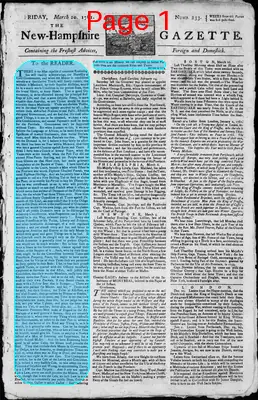
Editorial
March 20, 1761
The New Hampshire Gazette
Portsmouth, Rockingham County, New Hampshire
What is this article about?
An anonymous editorial under 'Publicus' defends the necessity of taxes to support civil government, criticizing widespread complaints against taxation as selfish resistance to civic duty, despite the benefits of protection and order society provides.
Clipping
OCR Quality
98%
Excellent
Full Text
To the READER.
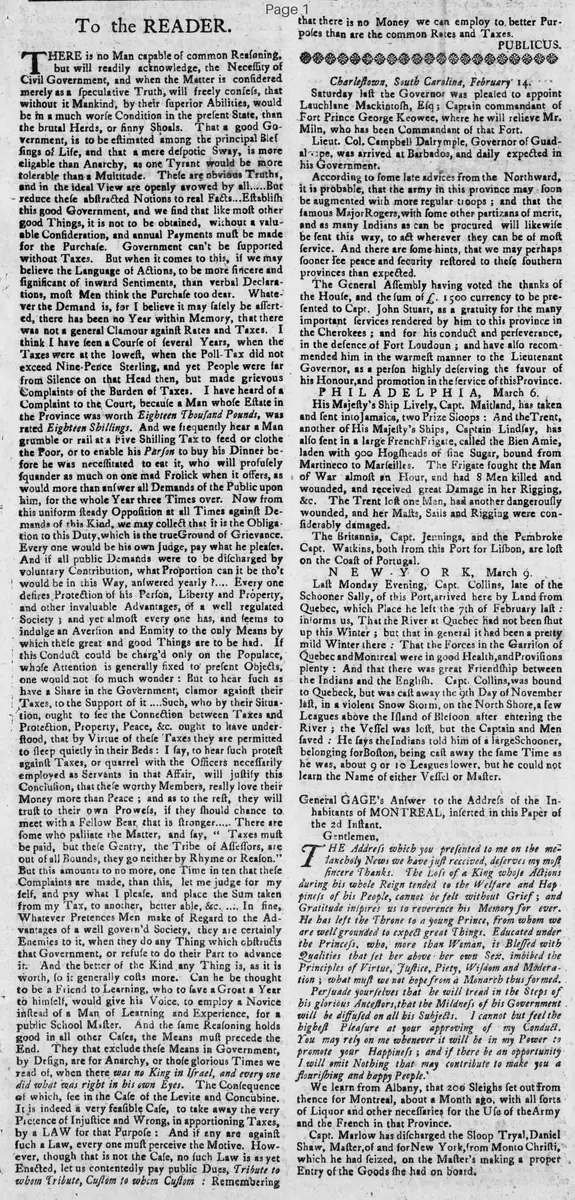
There is no Man capable of common Reasoning, but will readily acknowledge, the Necessity of Civil Government, and when the Matter is considered merely as a speculative Truth, will freely confess, that without it Mankind, by their superior Abilities, would be in a much worse Condition in the present State, than the brutal Herds, or finny Shoals. That a good Government, is to be estimated among the principal Blessings of Life, and that a mere despotic Sway, is more eligible than Anarchy, as one Tyrant would be more tolerable than a Multitude. These are obvious Truths, and in the ideal View are openly avowed by all.....But reduce these abstracted Notions to real Facts...Establish this good Government, and we find that like most other good Things, it is not to be obtained, without a valuable Consideration, and annual Payments must be made for the Purchase. Government can't be supported without Taxes. But when it comes to this, if we may believe the Language of Actions, to be more sincere and significant of inward Sentiments, than verbal Declarations, most Men think the Purchase too dear. Whatever the Demand is, for I believe it may safely be asserted, there has been no Year within Memory, that there was not a general Clamour against Rates and Taxes. I think I have seen a Course of several Years, when the Taxes were at the lowest, when the Poll-Tax did not exceed Nine Pence Sterling, and yet People were far from Silence on that Head then, but made grievous Complaints of the Burden of Taxes. I have heard of a Complaint to the Court, because a Man whose Estate in the Province was worth Eighteen Thousand Pounds, was rated Eighteen Shillings. And we frequently hear a Man grumble or rail at a Five Shilling Tax to feed or clothe the Poor, or to enable his Parson to buy his Dinner before he was necessitated to eat it, who will profusely quander as much on one mad Frolic when it offers, as would more than answer all Demands of the Public upon him, for the whole Year three Times over. Now from this uniform steady Opposition at all Times against Demands of this Kind, we may collect that it is the Obligation to this Duty, which is the true Ground of Grievance. Every one would be his own Judge, pay what he pleases. And if all public Demands were to be discharged by voluntary Contribution, what Proportion can it be thought would be in this Way, answered yearly?.... Every one desires Protection of his Person, Liberty and Property, and other invaluable Advantages, of a well regulated Society; and yet almost every one has, and seems to indulge an Aversion and Enmity to the only Means by which these great and good Things are to be had. If this Conduct could be charged only on the Populace, whose Attention is generally fixed to present Objects, one would not so much wonder: But to hear such as have a Share in the Government, clamor against their Taxes, to the Support of it ....Such, who by their Situation, ought to see the Connection between Taxes and Protection, Property, Peace, &c. ought to have understood, that by Virtue of these Taxes they are permitted to sleep quietly in their Beds: I say, to hear such protest against Taxes, or quarrel with the Officers necessarily employed as Servants in that Affair, will justify this Conclusion, that these worthy Members, really love their Money more than Peace; and as to the rest, they will trust to their own Prowess, if they should chance to meet with a Fellow Bear, that is stronger..... There are some who palliate the Matter, and say, "Taxes must be paid, but these Gentry, the Tribe of Assessors, are out of all Bounds, they go neither by Rhyme or Reason." But this amounts to no more, one Time in ten that these Complaints are made, than this, let me judge for myself, and pay what I please, and place the Sum taken from my Tax, to another, better able, &c. i.e. In fine. Whatever Pretences Men make of Regard to the Advantages of a well govern'd Society, they are certainly Enemies to it, when they do any Thing which obstructs that Government, or refuse to do their Part to advance it: And the better of the Kind any Thing is, as it is worth, so it generally costs more. Can he be thought to be a Friend to Learning, who to save a Groat a Year to himself, would give his Voice, to employ a Novice instead of a Man of Learning and Experience, for a public School Master. And the same Reasoning holds good in all other Cases, the Means must precede the End. They that exclude these Means in Government, by Design, are for Anarchy, or those glorious Times we read of, when there was no King in Israel, and every one did what was right in his own Eyes. The Consequence of which, see in the Case of the Levite and Concubine. It is indeed a very feasible Case, to take away the very Pretence of Injustice and Wrong, in apportioning Taxes, by a LAW for that Purpose: And if any are against Such a Law, every one must perceive the Motive. However, though that is not the Case, no such Law is as yet Enacted, let us contentedly pay public Dues, Tribute to whom Tribute, Custom to whom Custom: Remembering that there is no Money we can employ to better Purposes than are the common Rates and Taxes.
PUBLICUS.
There is no Man capable of common Reasoning, but will readily acknowledge, the Necessity of Civil Government, and when the Matter is considered merely as a speculative Truth, will freely confess, that without it Mankind, by their superior Abilities, would be in a much worse Condition in the present State, than the brutal Herds, or finny Shoals. That a good Government, is to be estimated among the principal Blessings of Life, and that a mere despotic Sway, is more eligible than Anarchy, as one Tyrant would be more tolerable than a Multitude. These are obvious Truths, and in the ideal View are openly avowed by all.....But reduce these abstracted Notions to real Facts...Establish this good Government, and we find that like most other good Things, it is not to be obtained, without a valuable Consideration, and annual Payments must be made for the Purchase. Government can't be supported without Taxes. But when it comes to this, if we may believe the Language of Actions, to be more sincere and significant of inward Sentiments, than verbal Declarations, most Men think the Purchase too dear. Whatever the Demand is, for I believe it may safely be asserted, there has been no Year within Memory, that there was not a general Clamour against Rates and Taxes. I think I have seen a Course of several Years, when the Taxes were at the lowest, when the Poll-Tax did not exceed Nine Pence Sterling, and yet People were far from Silence on that Head then, but made grievous Complaints of the Burden of Taxes. I have heard of a Complaint to the Court, because a Man whose Estate in the Province was worth Eighteen Thousand Pounds, was rated Eighteen Shillings. And we frequently hear a Man grumble or rail at a Five Shilling Tax to feed or clothe the Poor, or to enable his Parson to buy his Dinner before he was necessitated to eat it, who will profusely quander as much on one mad Frolic when it offers, as would more than answer all Demands of the Public upon him, for the whole Year three Times over. Now from this uniform steady Opposition at all Times against Demands of this Kind, we may collect that it is the Obligation to this Duty, which is the true Ground of Grievance. Every one would be his own Judge, pay what he pleases. And if all public Demands were to be discharged by voluntary Contribution, what Proportion can it be thought would be in this Way, answered yearly?.... Every one desires Protection of his Person, Liberty and Property, and other invaluable Advantages, of a well regulated Society; and yet almost every one has, and seems to indulge an Aversion and Enmity to the only Means by which these great and good Things are to be had. If this Conduct could be charged only on the Populace, whose Attention is generally fixed to present Objects, one would not so much wonder: But to hear such as have a Share in the Government, clamor against their Taxes, to the Support of it ....Such, who by their Situation, ought to see the Connection between Taxes and Protection, Property, Peace, &c. ought to have understood, that by Virtue of these Taxes they are permitted to sleep quietly in their Beds: I say, to hear such protest against Taxes, or quarrel with the Officers necessarily employed as Servants in that Affair, will justify this Conclusion, that these worthy Members, really love their Money more than Peace; and as to the rest, they will trust to their own Prowess, if they should chance to meet with a Fellow Bear, that is stronger..... There are some who palliate the Matter, and say, "Taxes must be paid, but these Gentry, the Tribe of Assessors, are out of all Bounds, they go neither by Rhyme or Reason." But this amounts to no more, one Time in ten that these Complaints are made, than this, let me judge for myself, and pay what I please, and place the Sum taken from my Tax, to another, better able, &c. i.e. In fine. Whatever Pretences Men make of Regard to the Advantages of a well govern'd Society, they are certainly Enemies to it, when they do any Thing which obstructs that Government, or refuse to do their Part to advance it: And the better of the Kind any Thing is, as it is worth, so it generally costs more. Can he be thought to be a Friend to Learning, who to save a Groat a Year to himself, would give his Voice, to employ a Novice instead of a Man of Learning and Experience, for a public School Master. And the same Reasoning holds good in all other Cases, the Means must precede the End. They that exclude these Means in Government, by Design, are for Anarchy, or those glorious Times we read of, when there was no King in Israel, and every one did what was right in his own Eyes. The Consequence of which, see in the Case of the Levite and Concubine. It is indeed a very feasible Case, to take away the very Pretence of Injustice and Wrong, in apportioning Taxes, by a LAW for that Purpose: And if any are against Such a Law, every one must perceive the Motive. However, though that is not the Case, no such Law is as yet Enacted, let us contentedly pay public Dues, Tribute to whom Tribute, Custom to whom Custom: Remembering that there is no Money we can employ to better Purposes than are the common Rates and Taxes.
PUBLICUS.
What sub-type of article is it?
Taxation
Constitutional
Moral Or Religious
What keywords are associated?
Taxation
Civil Government
Tax Complaints
Civic Duty
Anarchy
Public Dues
Assessors
What entities or persons were involved?
Publicus
Editorial Details
Primary Topic
Necessity Of Taxes For Civil Government
Stance / Tone
Supportive Of Taxation As Civic Duty, Critical Of Tax Complaints
Key Figures
Publicus
Key Arguments
Civil Government Is Essential To Prevent Anarchy And Worse Than Brute Conditions.
Good Government Requires Taxes, Yet People Universally Complain About Them Regardless Of Amount.
Complaints Reveal Aversion To Obligation Rather Than The Burden Itself.
Even Government Officials Who Benefit From Taxes Protest Against Them, Preferring Money Over Peace.
Opposition To Taxes Equates To Enmity Toward Society's Advantages Like Protection And Property.
True Friends Of Government And Learning Accept Necessary Costs.
Resistance To Fair Tax Laws Shows Selfish Motives.
Citizens Should Pay Dues Contentedly As The Best Use Of Money.