Thank you for visiting SNEWPapers!
Sign up free
Editorial
January 17, 1953
Jackson Advocate
Jackson, Hinds County, Mississippi
What is this article about?
Editorial criticizes Senator Taft's refusal to end Senate filibusters blocking civil rights, linking it to the historical Un-written Compromise that traded Negro rights for northern industrial dominance, causing southern stagnation until Democratic reforms.
Clipping
OCR Quality
98%
Excellent
Full Text
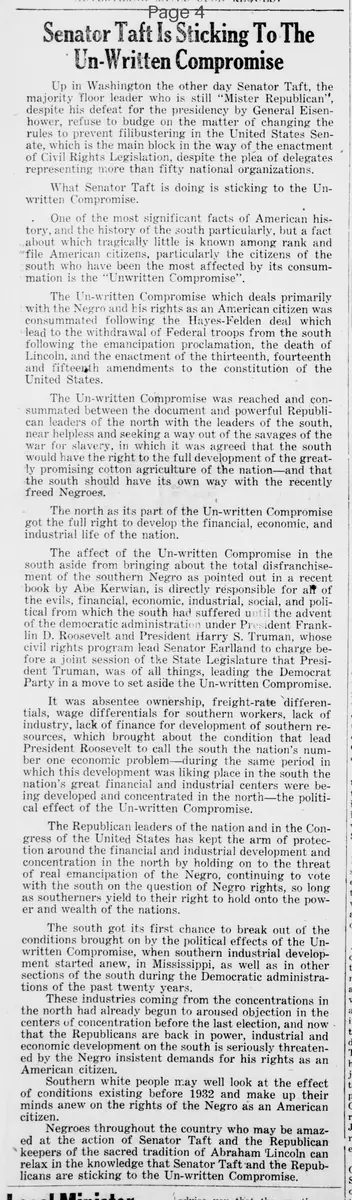
Senator Taft Is Sticking To The Un-Written Compromise
Up in Washington the other day Senator Taft, the majority floor leader who is still "Mister Republican", despite his defeat for the presidency by General Eisenhower, refused to budge on the matter of changing the rules to prevent filibustering in the United States Senate, which is the main block in the way of the enactment of Civil Rights Legislation, despite the plea of delegates representing more than fifty national organizations.
What Senator Taft is doing is sticking to the Un-written Compromise.
One of the most significant facts of American history, and the history of the south particularly, but a fact about which tragically little is known among rank and file American citizens, particularly the citizens of the south who have been the most affected by its consummation is the "Unwritten Compromise".
The Un-written Compromise which deals primarily with the Negro and his rights as an American citizen was consummated following the Hayes-Tilden deal which lead to the withdrawal of Federal troops from the south following the emancipation proclamation, the death of Lincoln, and the enactment of the thirteenth, fourteenth and fifteenth amendments to the constitution of the United States.
The Un-written Compromise was reached and consummated between the democratic and powerful Republican leaders of the north with the leaders of the south, near helpless and seeking a way out of the savages of the war for slavery, in which it was agreed that the south would have the right to the full development of the greatly promising cotton agriculture of the nation—and that the south should have its own way with the recently freed Negroes.
The north as its part of the Un-written Compromise got the full right to develop the financial, economic, and industrial life of the nation.
The affect of the Un-written Compromise in the south aside from bringing about the total disfranchisement of the southern Negro as pointed out in a recent book by V. O. Key, is directly responsible for all of the evils, financial, economic, industrial, social, and political from which the south had suffered until the advent of the democratic administration under President Franklin D. Roosevelt and President Harry S. Truman, whose civil rights program lead Senator Eastland to charge before a joint session of the State Legislature that President Truman, was of all things, leading the Democrat Party in a move to set aside the Un-written Compromise.
It was absentee ownership, freight-rate differentials, wage differentials for southern workers, lack of industry, lack of finance for development of southern resources, which brought about the condition that lead President Roosevelt to call the south the nation's number one economic problem—during the same period in which this development was taking place in the south the nation's great financial and industrial centers were being developed and concentrated in the north—the political effect of the Un-written Compromise.
The Republican leaders of the nation and in the Congress of the United States has kept the arm of protection around the financial and industrial development and concentration in the north by holding on to the threat of real emancipation of the Negro, continuing to vote with the south on the question of Negro rights, so long as southerners yield to their right to hold onto the power and wealth of the nations.
The south got its first chance to break out of the conditions brought on by the political effects of the Un-written Compromise, when southern industrial development started anew, in Mississippi, as well as in other sections of the south during the Democratic administrations of the past twenty years.
These industries coming from the concentrations in the north had already begun to aroused objection in the centers of concentration before the last election, and now that the Republicans are back in power, industrial and economic development on the south is seriously threatened by the Negro insistent demands for his rights as an American citizen.
Southern white people may well look at the effect of conditions existing before 1932 and make up their minds anew on the rights of the Negro as an American citizen.
Negroes throughout the country who may be amazed at the action of Senator Taft and the Republican keepers of the sacred tradition of Abraham Lincoln can relax in the knowledge that Senator Taft and the Republicans are sticking to the Un-written Compromise.
Up in Washington the other day Senator Taft, the majority floor leader who is still "Mister Republican", despite his defeat for the presidency by General Eisenhower, refused to budge on the matter of changing the rules to prevent filibustering in the United States Senate, which is the main block in the way of the enactment of Civil Rights Legislation, despite the plea of delegates representing more than fifty national organizations.
What Senator Taft is doing is sticking to the Un-written Compromise.
One of the most significant facts of American history, and the history of the south particularly, but a fact about which tragically little is known among rank and file American citizens, particularly the citizens of the south who have been the most affected by its consummation is the "Unwritten Compromise".
The Un-written Compromise which deals primarily with the Negro and his rights as an American citizen was consummated following the Hayes-Tilden deal which lead to the withdrawal of Federal troops from the south following the emancipation proclamation, the death of Lincoln, and the enactment of the thirteenth, fourteenth and fifteenth amendments to the constitution of the United States.
The Un-written Compromise was reached and consummated between the democratic and powerful Republican leaders of the north with the leaders of the south, near helpless and seeking a way out of the savages of the war for slavery, in which it was agreed that the south would have the right to the full development of the greatly promising cotton agriculture of the nation—and that the south should have its own way with the recently freed Negroes.
The north as its part of the Un-written Compromise got the full right to develop the financial, economic, and industrial life of the nation.
The affect of the Un-written Compromise in the south aside from bringing about the total disfranchisement of the southern Negro as pointed out in a recent book by V. O. Key, is directly responsible for all of the evils, financial, economic, industrial, social, and political from which the south had suffered until the advent of the democratic administration under President Franklin D. Roosevelt and President Harry S. Truman, whose civil rights program lead Senator Eastland to charge before a joint session of the State Legislature that President Truman, was of all things, leading the Democrat Party in a move to set aside the Un-written Compromise.
It was absentee ownership, freight-rate differentials, wage differentials for southern workers, lack of industry, lack of finance for development of southern resources, which brought about the condition that lead President Roosevelt to call the south the nation's number one economic problem—during the same period in which this development was taking place in the south the nation's great financial and industrial centers were being developed and concentrated in the north—the political effect of the Un-written Compromise.
The Republican leaders of the nation and in the Congress of the United States has kept the arm of protection around the financial and industrial development and concentration in the north by holding on to the threat of real emancipation of the Negro, continuing to vote with the south on the question of Negro rights, so long as southerners yield to their right to hold onto the power and wealth of the nations.
The south got its first chance to break out of the conditions brought on by the political effects of the Un-written Compromise, when southern industrial development started anew, in Mississippi, as well as in other sections of the south during the Democratic administrations of the past twenty years.
These industries coming from the concentrations in the north had already begun to aroused objection in the centers of concentration before the last election, and now that the Republicans are back in power, industrial and economic development on the south is seriously threatened by the Negro insistent demands for his rights as an American citizen.
Southern white people may well look at the effect of conditions existing before 1932 and make up their minds anew on the rights of the Negro as an American citizen.
Negroes throughout the country who may be amazed at the action of Senator Taft and the Republican keepers of the sacred tradition of Abraham Lincoln can relax in the knowledge that Senator Taft and the Republicans are sticking to the Un-written Compromise.
What sub-type of article is it?
Constitutional
Partisan Politics
Slavery Abolition
What keywords are associated?
Un Written Compromise
Senator Taft
Civil Rights Legislation
Filibustering
Negro Rights
Southern Economy
Republican Policy
Hayes Tilden Deal
Emancipation Aftermath
Racial Disfranchisement
What entities or persons were involved?
Senator Taft
General Eisenhower
Hayes Tilden
Abraham Lincoln
Franklin D. Roosevelt
Harry S. Truman
Senator Eastland
V. O. Key
Republicans
Democrats
Southern Leaders
Negroes
Editorial Details
Primary Topic
Senator Taft Upholding The Un Written Compromise Against Civil Rights Legislation
Stance / Tone
Critical Of Republican Adherence To Historical Compromise Denying Negro Rights
Key Figures
Senator Taft
General Eisenhower
Hayes Tilden
Abraham Lincoln
Franklin D. Roosevelt
Harry S. Truman
Senator Eastland
V. O. Key
Republicans
Democrats
Southern Leaders
Negroes
Key Arguments
Senator Taft Refuses To Change Senate Rules To Prevent Filibustering Blocking Civil Rights Legislation
The Un Written Compromise Allowed South Control Over Freed Negroes In Exchange For North's Industrial Development
This Compromise Led To Negro Disfranchisement And Southern Economic Woes
Republican Leaders Protect Northern Interests By Blocking Negro Rights Advancements
Democratic Administrations Under Roosevelt And Truman Began Breaking The Compromise Through Civil Rights And Southern Development
Southern Industrial Growth Is Threatened By Republican Return And Negro Rights Demands