Thank you for visiting SNEWPapers!
Sign up free
Story
August 2, 1872
Vermont Phœnix
Brattleboro, Bellows Falls, Ludlow, Windham County, Windsor County, Vermont
What is this article about?
Man-hating spinster Miss Eunice Higgins finds a runaway boy, Johnny Dale, under her bed after a tea party. She cares for him to spite his widower father but softens when the father arrives, leading to romance and marriage despite her friends' disapproval.
Clipping
OCR Quality
98%
Excellent
Full Text
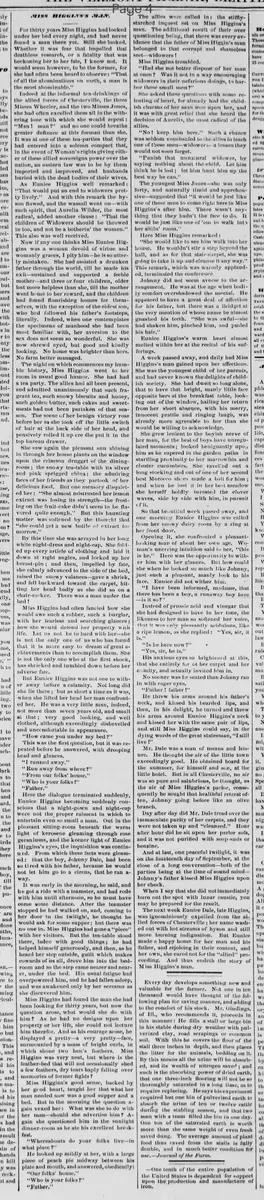
For thirty years Miss Higgins had looked under her bed every night, and had never found a man there yet. Still she looked. Whether it was fear that impelled that deathless research, or a fatality that was beckoning her to her fate, I know not. It would seem however, to be the former, for she had often been heard to observe: "That of all the abominations, on earth, a man is the most abominable."
Indeed at the informal tea-drinkings of the allied forces of Chesterville, the three Misses Wheeler, and the two Misses Jones, she had often excelled them all in the withering tone with which she would repeat: "Man! man!" and no one could breathe greater defiance at this foeman than she.
It was at one of these tea-parties that they had entered into a solemn compact that in the event of Woman's rights giving either of these allied sovereigns power over the nation, an eastern law was to be by them imported and improved, and husbands buried with the dead bodies of their wives. As Eunice Higgins well remarked "That would put an end to widowers pretty lively." And with this remark the hyson flowed, and the wassail went on-with such spirit, that Aurelia Wilder, the most radical, added another clause: "That the children of Widowers should be throwed in too, and not be a botherin' the women." This also was well received.
Now if any one thinks Miss Eunice Higgins was a woman devoid of virtue and womanly graces, I pity him—he is so utterly mistaken. She had assisted a drunken father through the world, till he made his exit—sustained and supported a feeble mother—and three or four children, older but more helpless than she, till the mother went home to her reward, and the children had found flourishing homes for themselves, with the exception of the eldest son, who had followed his father's footsteps, literally. Indeed, when one contemplates the specimens of manhood she had been most familiar with, her aversion to the sex does not seem so wonderful. She was now shrewd eyed, but good and kindly looking. No home was brighter than hers. No farm better managed.
The night on which commences my humble history, Miss Higgins went to her room in usual good humor. She had had a tea party. The allies had all been present, and admitted unanimously that such fragrant tea, such snowy biscuits and honey, such golden butter, such cakes and sweetmeats had not been partaken of that season. The scene of her benign victory rose before her as she took off the little switch of hair at the back side of her head, and pensively rolled it up ere she put it in the top bureau drawer. She saw again the pleasant sun shining in through her house plants on the window upon the crimson drugget of the dining-room; the snowy tea-table with its silver and pink sprigged china; the admiring faces of her friends as they partook of her delicious food. But one memory disquieted her: "She almost mistrusted her lemon extract was losing its strength—the frosting on the fruit-cake didn't seem to be flavored quite enough." But this haunting matter was softened by the thought that "she could get a new bottle of extract tomorrow."
By this time she was arrayed in her long white night-dress and night-cap. She folded up every article of clothing and laid it down at right angles, and locked up her breast-pin: and then, impelled by fate, she calmly advanced to the side of the bed, raised the snowy valances—gave a shriek, and fell backward toward the carpet, hitting her head badly as she did so on a chair-rocker. There was a man under the bed!
Miss Higgins had often fancied how she would awe such a robber, such a burglar, with her fearless and searching glances; how she would defend her property with life. Let us not be too hard with her—she is not the only one of us who has found that it is more easy to dream of great achievements than to accomplish them. She is not the only one who at the first shock, has shrieked and tumbled down before her adverse fate.
But Eunice Higgins was not one to wither away before a calamity. Not long did she lie there; but as short a time as it was, when she lifted her head her man confronted her. He was a very little man, indeed, not more than seven years old, and small at that; very good looking, and well clothed, although exceedingly dishevelled and uncomfortable in appearance.
"How came you under my bed?"
This was the first question, but it was repeated before he answered, with drooping head and glances.
"I runned away."
"Run away from where?"
"From our folks' house."
"Who is your folks?"
"Father."
Here the dialogue terminated suddenly, Eunice Higgins becoming suddenly conscious that a night-gown and night-cap were not the proper raiment in which to entertain even so small a man. Out in the pleasant sitting-room beneath the warm light of kerosene gleaming through rose geraniums, and the keener light of Eunice Higgins's eyes, the inquisition was continued. From which these facts were gleaned: that the boy, Johnny Dale, had been so tired with his father, because he would not let him go to a circus, that he ran away. It was early in the morning, he said, and he got a ride with a teamster, and had rode with him until afternoon, so he must have come some distance. After the teamster stopped he had walked on, and, coming to her door in the twilight, he thought he would ask for some supper; but there was no one in. Miss Higgins had gone a "piece" with her visitors. But the tea-table stood there, laden with good things; he had helped himself generously, and then, as he heard her step outside, guilt which makes cowards of us all, drove him into the bed-room and as the step came nearer and nearer, under the bed. His usual fatigue had overpowered him, and he had fallen asleep and was awakened only by her screams as she discovered him.
Miss Higgins had found the man she had been looking for thirty years, but now the question arose, what would she do with him? As he had no designs upon her property or her life, she could not lecture him therefor. And as his courage arose, he displayed a pretty—a very pretty—face surmounted by a mass of bright curls, in which shone two hen's feathers. Miss Higgins was very neat, but where is the feather-bed that will not occasionally shed a few feathers, dry tears haply falling over memories of former fights?
Miss Higgins's good sense, backed by her good heart, taught her that what her man needed now was a good supper and a bed. But in the morning the question again vexed her: What was she to do with her man—should she advertise him? Again she questioned him in the sunlight dinner-room as he ate his excellent breakfast.
"Whereabouts do your folks live—in what place?"
He looked up mildly at her, with a large piece of peach pie midway between his plate and mouth, and answered, obediently
"Our folks' house.'"
"Who is your folks?"
"Father"
The allies were called in: the stately, starched inquest sat on Miss Higgins's man. The additional result of their over questioning being, that there was every evidence that the father of Miss Higgins's man belonged to that corrupt and shameless sect—widowers!
Miss Higgins trembled.
"Had she not better dispose of her man at once? Was it not in a way encouraging widowers in their nefarious doings, to harbor these small men?"
She asked these questions with some relenting of heart, for already had the childish charms of her man won upon her, and it was with great relief that she heard the decision of Aurelia, the most radical of the allies.
"No! keep him here." Such a chance was seldom vouchsafed to the allies to teach one of these men—widowers—a lesson they would not soon forget.
"Punish that unnatural widower, by saying nothing about the child. Let him think he is lost; let him hunt him up the best way he can."
The youngest Miss Jones—she was only forty, and naturally timid and apprehensive—suggested that "it would be just like one of these men to come right here to Miss Higgins's after him. There wasn't anything that they hadn't the face to do. It would be just like one of 'em to walk into her sittin' room.'"
Here Miss Higgins remarked:
"She would like to see him walk into her house. He wouldn't stir a step beyond the hall, and as for that stair-carpet, she was going to take it up and cleanse it any way."
This remark, which was warmly applauded, terminated the conference.
Johnny did not seem averse to the arrangement. He was at the age when bodily comfort overshadowed the mental. He appeared to have a great deal of affection for his father, but there was a Bridget at the very mention of whose name he almost gnashed his teeth. "She was awful—she had shaken him, pinched him, and pulled his hair."
Eunice Higgins's warm heart almost melted within her at the recital of his sufferings.
A week passed away, and daily had Miss Higgins's man gained upon her affections. She was the youngest child of her parents, and had never known the delights of childish society. She had dwelt so long alone that to have that bright, manly little face opposite hers at the breakfast table, looking out of the window, hailing her return from her short absence, with his merry, innocent prattle and ringing laugh, was already more agreeable to her than she would be willing to acknowledge. She grew lenient to the boyish nerve of her man, for the best of boys have unregulated moments: looked benignantly upon him as he capered in the garden paths in startling proximity to her marrowfats and cluster cucumbers. She raveled out a long stocking and out of one of her second best Morocco shoes made a ball for him: and when he lost it in her best meadow she herself boldly bisected the clover waves, side by side with him, in pursuit of it.
So that beautiful week passed away, and one morning Eunice Higgins was called from her snowy dairy room by a ring at her front door. Opening it, she confronted a pleasant looking man of about her own age. Woman's unerring intuition said to her, "this is he." Here was the opportunity to wither him with her glances. But how could she when he looked so much like Johnny, just such a pleasant, manly look to his face. Eunice did not wither him.
"I have been informed, madame, that there has been a boy, a runaway boy here—is it so?"
Instead of prussic acid and vinegar that she had designed to have in her tone, the likeness to her man so softened her voice that it was only pleasantly acidulous, like a ripe lemon, as she replied: "Yes, sir, it is."
"Is he here now?"
"Yes, sir, he is."
His anxious eyes so brightened at this that she entirely forgot her carpet and her enmity, and actually invited him in.
No sooner was he seated than Johnny ran in with eager eyes.
"Father! father!"
He threw his arms around his father's neck, and kissed his bearded lips, and then, in his delight, he turned and threw his arms around Eunice Higgins's neck and kissed her with the same pair of lips and still Miss Higgins could say, in the dying words of the great statesman, "I still live!"
Mr. Dale was a man of means and leisure. He thought the air of the little town exceedingly good. He obtained board for the summer, for himself and son, at the little hotel. But in all Chesterville, no air was so pure and salubrious, he thought, as the air of Miss Higgins's parlor, consequently he sought that healthful retreat often, Johnny going before like an olive branch.
Day after day did Mr. Dale tread over the immaculate purity of her carpets, and they were not taken up and "cleansed." Hour after hour did he sit upon her parlor sofa and it was not purified with soap-suds or benzine.
And at last, one peaceful twilight, it was on the fourteenth day of September, at the close of a long conversation—both of the parties being at the time of sound mind—Johnny's father kissed Miss Higgins upon her cheek.
When I say that she did not immediately burn out the spot with lunar caustic, you may be prepared for the result.
The next week Eunice Dale, late Higgins, was ignominiously expelled from the allied forces of Chesterville; her name washed out with hot streams of hyson and still more burning indignation. But Eunice made a happy home for her man and his father, and rejoicing in their content, and her own, she cared not for the "allied" proceeding. And thus endeth the story of Miss Higgins's man.
Indeed at the informal tea-drinkings of the allied forces of Chesterville, the three Misses Wheeler, and the two Misses Jones, she had often excelled them all in the withering tone with which she would repeat: "Man! man!" and no one could breathe greater defiance at this foeman than she.
It was at one of these tea-parties that they had entered into a solemn compact that in the event of Woman's rights giving either of these allied sovereigns power over the nation, an eastern law was to be by them imported and improved, and husbands buried with the dead bodies of their wives. As Eunice Higgins well remarked "That would put an end to widowers pretty lively." And with this remark the hyson flowed, and the wassail went on-with such spirit, that Aurelia Wilder, the most radical, added another clause: "That the children of Widowers should be throwed in too, and not be a botherin' the women." This also was well received.
Now if any one thinks Miss Eunice Higgins was a woman devoid of virtue and womanly graces, I pity him—he is so utterly mistaken. She had assisted a drunken father through the world, till he made his exit—sustained and supported a feeble mother—and three or four children, older but more helpless than she, till the mother went home to her reward, and the children had found flourishing homes for themselves, with the exception of the eldest son, who had followed his father's footsteps, literally. Indeed, when one contemplates the specimens of manhood she had been most familiar with, her aversion to the sex does not seem so wonderful. She was now shrewd eyed, but good and kindly looking. No home was brighter than hers. No farm better managed.
The night on which commences my humble history, Miss Higgins went to her room in usual good humor. She had had a tea party. The allies had all been present, and admitted unanimously that such fragrant tea, such snowy biscuits and honey, such golden butter, such cakes and sweetmeats had not been partaken of that season. The scene of her benign victory rose before her as she took off the little switch of hair at the back side of her head, and pensively rolled it up ere she put it in the top bureau drawer. She saw again the pleasant sun shining in through her house plants on the window upon the crimson drugget of the dining-room; the snowy tea-table with its silver and pink sprigged china; the admiring faces of her friends as they partook of her delicious food. But one memory disquieted her: "She almost mistrusted her lemon extract was losing its strength—the frosting on the fruit-cake didn't seem to be flavored quite enough." But this haunting matter was softened by the thought that "she could get a new bottle of extract tomorrow."
By this time she was arrayed in her long white night-dress and night-cap. She folded up every article of clothing and laid it down at right angles, and locked up her breast-pin: and then, impelled by fate, she calmly advanced to the side of the bed, raised the snowy valances—gave a shriek, and fell backward toward the carpet, hitting her head badly as she did so on a chair-rocker. There was a man under the bed!
Miss Higgins had often fancied how she would awe such a robber, such a burglar, with her fearless and searching glances; how she would defend her property with life. Let us not be too hard with her—she is not the only one of us who has found that it is more easy to dream of great achievements than to accomplish them. She is not the only one who at the first shock, has shrieked and tumbled down before her adverse fate.
But Eunice Higgins was not one to wither away before a calamity. Not long did she lie there; but as short a time as it was, when she lifted her head her man confronted her. He was a very little man, indeed, not more than seven years old, and small at that; very good looking, and well clothed, although exceedingly dishevelled and uncomfortable in appearance.
"How came you under my bed?"
This was the first question, but it was repeated before he answered, with drooping head and glances.
"I runned away."
"Run away from where?"
"From our folks' house."
"Who is your folks?"
"Father."
Here the dialogue terminated suddenly, Eunice Higgins becoming suddenly conscious that a night-gown and night-cap were not the proper raiment in which to entertain even so small a man. Out in the pleasant sitting-room beneath the warm light of kerosene gleaming through rose geraniums, and the keener light of Eunice Higgins's eyes, the inquisition was continued. From which these facts were gleaned: that the boy, Johnny Dale, had been so tired with his father, because he would not let him go to a circus, that he ran away. It was early in the morning, he said, and he got a ride with a teamster, and had rode with him until afternoon, so he must have come some distance. After the teamster stopped he had walked on, and, coming to her door in the twilight, he thought he would ask for some supper; but there was no one in. Miss Higgins had gone a "piece" with her visitors. But the tea-table stood there, laden with good things; he had helped himself generously, and then, as he heard her step outside, guilt which makes cowards of us all, drove him into the bed-room and as the step came nearer and nearer, under the bed. His usual fatigue had overpowered him, and he had fallen asleep and was awakened only by her screams as she discovered him.
Miss Higgins had found the man she had been looking for thirty years, but now the question arose, what would she do with him? As he had no designs upon her property or her life, she could not lecture him therefor. And as his courage arose, he displayed a pretty—a very pretty—face surmounted by a mass of bright curls, in which shone two hen's feathers. Miss Higgins was very neat, but where is the feather-bed that will not occasionally shed a few feathers, dry tears haply falling over memories of former fights?
Miss Higgins's good sense, backed by her good heart, taught her that what her man needed now was a good supper and a bed. But in the morning the question again vexed her: What was she to do with her man—should she advertise him? Again she questioned him in the sunlight dinner-room as he ate his excellent breakfast.
"Whereabouts do your folks live—in what place?"
He looked up mildly at her, with a large piece of peach pie midway between his plate and mouth, and answered, obediently
"Our folks' house.'"
"Who is your folks?"
"Father"
The allies were called in: the stately, starched inquest sat on Miss Higgins's man. The additional result of their over questioning being, that there was every evidence that the father of Miss Higgins's man belonged to that corrupt and shameless sect—widowers!
Miss Higgins trembled.
"Had she not better dispose of her man at once? Was it not in a way encouraging widowers in their nefarious doings, to harbor these small men?"
She asked these questions with some relenting of heart, for already had the childish charms of her man won upon her, and it was with great relief that she heard the decision of Aurelia, the most radical of the allies.
"No! keep him here." Such a chance was seldom vouchsafed to the allies to teach one of these men—widowers—a lesson they would not soon forget.
"Punish that unnatural widower, by saying nothing about the child. Let him think he is lost; let him hunt him up the best way he can."
The youngest Miss Jones—she was only forty, and naturally timid and apprehensive—suggested that "it would be just like one of these men to come right here to Miss Higgins's after him. There wasn't anything that they hadn't the face to do. It would be just like one of 'em to walk into her sittin' room.'"
Here Miss Higgins remarked:
"She would like to see him walk into her house. He wouldn't stir a step beyond the hall, and as for that stair-carpet, she was going to take it up and cleanse it any way."
This remark, which was warmly applauded, terminated the conference.
Johnny did not seem averse to the arrangement. He was at the age when bodily comfort overshadowed the mental. He appeared to have a great deal of affection for his father, but there was a Bridget at the very mention of whose name he almost gnashed his teeth. "She was awful—she had shaken him, pinched him, and pulled his hair."
Eunice Higgins's warm heart almost melted within her at the recital of his sufferings.
A week passed away, and daily had Miss Higgins's man gained upon her affections. She was the youngest child of her parents, and had never known the delights of childish society. She had dwelt so long alone that to have that bright, manly little face opposite hers at the breakfast table, looking out of the window, hailing her return from her short absence, with his merry, innocent prattle and ringing laugh, was already more agreeable to her than she would be willing to acknowledge. She grew lenient to the boyish nerve of her man, for the best of boys have unregulated moments: looked benignantly upon him as he capered in the garden paths in startling proximity to her marrowfats and cluster cucumbers. She raveled out a long stocking and out of one of her second best Morocco shoes made a ball for him: and when he lost it in her best meadow she herself boldly bisected the clover waves, side by side with him, in pursuit of it.
So that beautiful week passed away, and one morning Eunice Higgins was called from her snowy dairy room by a ring at her front door. Opening it, she confronted a pleasant looking man of about her own age. Woman's unerring intuition said to her, "this is he." Here was the opportunity to wither him with her glances. But how could she when he looked so much like Johnny, just such a pleasant, manly look to his face. Eunice did not wither him.
"I have been informed, madame, that there has been a boy, a runaway boy here—is it so?"
Instead of prussic acid and vinegar that she had designed to have in her tone, the likeness to her man so softened her voice that it was only pleasantly acidulous, like a ripe lemon, as she replied: "Yes, sir, it is."
"Is he here now?"
"Yes, sir, he is."
His anxious eyes so brightened at this that she entirely forgot her carpet and her enmity, and actually invited him in.
No sooner was he seated than Johnny ran in with eager eyes.
"Father! father!"
He threw his arms around his father's neck, and kissed his bearded lips, and then, in his delight, he turned and threw his arms around Eunice Higgins's neck and kissed her with the same pair of lips and still Miss Higgins could say, in the dying words of the great statesman, "I still live!"
Mr. Dale was a man of means and leisure. He thought the air of the little town exceedingly good. He obtained board for the summer, for himself and son, at the little hotel. But in all Chesterville, no air was so pure and salubrious, he thought, as the air of Miss Higgins's parlor, consequently he sought that healthful retreat often, Johnny going before like an olive branch.
Day after day did Mr. Dale tread over the immaculate purity of her carpets, and they were not taken up and "cleansed." Hour after hour did he sit upon her parlor sofa and it was not purified with soap-suds or benzine.
And at last, one peaceful twilight, it was on the fourteenth day of September, at the close of a long conversation—both of the parties being at the time of sound mind—Johnny's father kissed Miss Higgins upon her cheek.
When I say that she did not immediately burn out the spot with lunar caustic, you may be prepared for the result.
The next week Eunice Dale, late Higgins, was ignominiously expelled from the allied forces of Chesterville; her name washed out with hot streams of hyson and still more burning indignation. But Eunice made a happy home for her man and his father, and rejoicing in their content, and her own, she cared not for the "allied" proceeding. And thus endeth the story of Miss Higgins's man.
What sub-type of article is it?
Romance
Family Drama
Personal Triumph
What themes does it cover?
Love
Family
Triumph
What keywords are associated?
Runaway Boy
Spinster Romance
Widower Father
Women's Alliance
Unexpected Marriage
Tea Party
Chesterville
What entities or persons were involved?
Eunice Higgins
Johnny Dale
Mr. Dale
Aurelia Wilder
Misses Wheeler
Misses Jones
Where did it happen?
Chesterville
Story Details
Key Persons
Eunice Higgins
Johnny Dale
Mr. Dale
Aurelia Wilder
Misses Wheeler
Misses Jones
Location
Chesterville
Event Date
Fourteenth Day Of September
Story Details
Man-hating spinster Eunice Higgins discovers runaway boy Johnny Dale under her bed, cares for him to punish his widower father, but falls in love with the father upon his arrival and marries him.