Thank you for visiting SNEWPapers!
Sign up free
Martinsburg Gazette And Public Advertiser
Martinsburg, Berkeley County, West Virginia
What is this article about?
Newspaper commentary defends Daniel Webster's Senate speech on federal vs. state powers against misrepresentations in the Richmond Enquirer, praises Mr. Rowan's response, criticizes Jacksonian tactics, and notes related political items including Randolph's disclaimer, Clay's declination, and a Massachusetts resolution honoring Webster.
Clipping
OCR Quality
Full Text
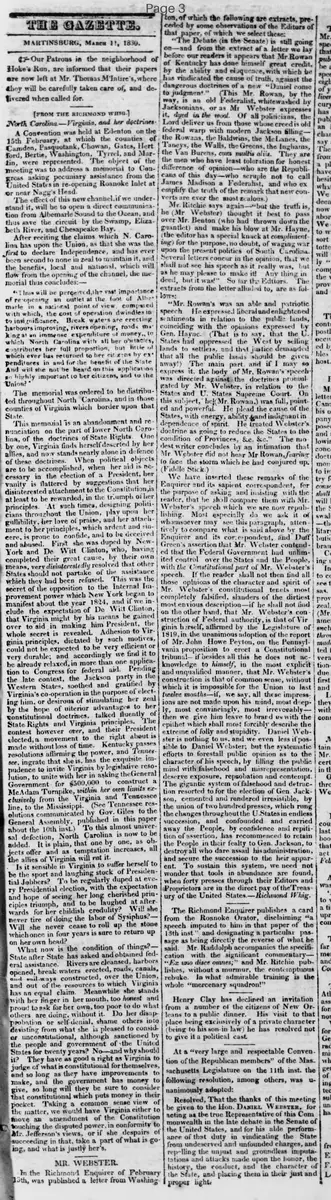
In the Richmond Enquirer of February 13th, was published a letter from Washington, of which the following are extracts, preceded by some observations of the Editors of that paper, of which we select these:
"The Debate (in the Senate) is still going on-and from the extract of a letter we lay before our readers it appears that Mr. Rowan of Kentucky has done himself great credit, by the ability and eloquence, with which he has vindicated the cause of truth, against the dangerous doctrines of a new "Daniel come to judgment."
(This Mr. Rowan, by the way, is an old Federalist, whitewashed by Jacksonians, or as Mr. Webster expresses it, dyed in the wool. Of all politicians, the Lord deliver us from those whose creed is old federal warp with modern Jackson filling- the Rowans, the Baldwins, the McLanes, the Taneys, the Walls, the Greens, the Inghams, the Van Burens, cum multis aliis. They are the men who have least toleration for honest difference of opinion-who are the Republicans of this day-who scruple not to call James Madison a Federalist, and who exemplify the truth of the remark that new converts are ever the most zealous.)
Mr. Ritchie says again--"but the truth is, he (Mr. Webster) thought it best to pass over Mr. Benton (who had thrown down the gauntlet) and make his blow at Mr. Hayne, (the editor has a special knack at complimenting) for the purpose, no doubt, of waging war upon the present politics of South Carolina."
Several letters concur in the opinion, that we shall not see his speech as it really was, but as he may please to make it! Anything indeed, but it was!" So far the Editors. The extracts from the letter alluded to, are as follows:
"Mr. Rowan's was an able and patriotic speech. He expressed liberal and enlightened sentiments in relation to the public lands, coinciding with the opinions expressed by Gen. Hayne. (That is to say, that the U. States had oppressed the West by selling lands to settlers, and that justice demanded that all the public lands should be given away! The main part, and if I may so express it, the body of Mr. Rowan's speech was directed against the doctrines promulgated by Mr. Webster, in relation to the States and U. States Supreme Court. On this subject, he (Mr. Rowan) was full, pointed and powerful. He plead the cause of the States, with energy, ability and indignant independence of spirit. He treated Webster's doctrine as going to reduce the States to the condition of Provinces, &c. &c." The modest writer concludes by an intimation that Mr. Webster did not hear Mr. Rowan, fearing to face the storm which he had conjured up. (Fiddle Stick.)
We have inserted these remarks of the Enquirer and its sapient correspondent, for the purpose of asking and insisting with the reader, that he shall compare them with Mr. Webster's speech which we are now republishing. Most especially do we ask it of whomsoever may see this paragraph, attentively to compare what is said above by the Enquirer and its correspondent, and Duff Green's assertion that Mr. Webster contended that the Federal Government had unlimited control over the States and the People, with the Constitutional part of Mr. Webster's speech. If the reader shall not then find all those opinions of the character and spirit of Mr. Webster's constitutional tenets most completely falsified, slanders of the dirtiest most envious description-if he shall not find on the other hand, that Mr. Webster's construction of Federal authority, is that of Virginia herself, affirmed by the Legislature of 1819, in the unanimous adoption of the report of Mr. John Howe Peyton, on the Pennsylvania proposition to erect a Constitutional tribunal- if besides all this he does not acknowledge to himself, in the most explicit and unqualified manner, that Mr. Webster's construction is that of common sense, without which it is impossible for the Union to last twelve months-if, we say, all these impressions are not made upon his mind, most deeply, most convincingly, most irrevocably-- then we give him leave to brand us with the epithet which shall most forcibly describe the extreme of folly and stupidity. Daniel Webster is nothing to us, and we even less if possible to Daniel Webster; but the systematic efforts to forestall public opinion as to the character of his speech, by filling the public mind with falsehood and misrepresentation, deserve exposure, reprobation and contempt.
The gigantic system of falsehood and detraction resorted to for the election of Gen. Jackson, cemented and rendered irresistible, by the union of two hundred presses, which rung the changes throughout the U. States in endless succession, and confounded and carried away the People, by confidence and repetition of assertion, has recommenced to retain the People in their fealty to Gen. Jackson, to destroy all who dare assail his administration, and secure the succession to the heir apparent. To sustain this system, we need not wonder that tools in abundance are found, when forty presses through their Editors and Proprietors are in the direct pay of the Treasury of the United States.-Richmond Whig.
The Richmond Enquirer publishes a card from the Roanoke Orator, disclaiming "a speech imputed to him in that paper of the 13th inst." and designating a particular passage as being directly the reverse of what he said. Mr. Randolph accompanies the specification with the significant commentary- "Ex uno disce omnes;" and Mr. Ritchie publishes, without a murmur, the contemptuous rebuke. In what admirable training is the whole "mercenary squadron!"
Henry Clay has declined an invitation from a number of the citizens of New Orleans to a public dinner. His visit to that place being exclusively of a private character (being to his son-in law) he has resolved not to give it a political cast.
At a "very large and respectable Convention of the Republican members" of the Massachusetts Legislature on the 11th inst. the following resolution, among others, was unanimously adopted:
Resolved, That the thanks of this meeting be given to the Hon. Daniel Webster, for acting as the true Representative of this Commonwealth in the late debate in the Senate of the United States, and for his able performance of that duty in vindicating the State from undeserved and unfounded charges, and repelling the unjust and groundless imputations and attacks made upon the honor, the history, the conduct, and the character of the State, and placing them in their just and proper light.
What sub-type of article is it?
What themes does it cover?
What keywords are associated?
What entities or persons were involved?
Where did it happen?
Story Details
Key Persons
Location
Washington
Event Date
February 13th
Story Details
Commentary defends Webster's Senate speech on federal authority against Enquirer's misrepresentations, praises Rowan's response, criticizes Jacksonian slanders, notes Randolph's disclaimer of misquoted speech, Clay's declination of political dinner, and Massachusetts resolution honoring Webster.