Thank you for visiting SNEWPapers!
Sign up free
Winchester Gazette
Winchester, Virginia
What is this article about?
Editorial from Connecticut Mirror criticizes Congress for reinstating trade restrictions like Non-Intercourse, blaming Jefferson and Madison for economic harm to farmers, merchants, and laborers in New England. Highlights benefits of open trade with Britain and includes anecdote of De Witt Clinton opposing the Embargo due to French influence proofs.
Clipping
OCR Quality
Full Text
FROM THE CONNECTICUT MIRROR.
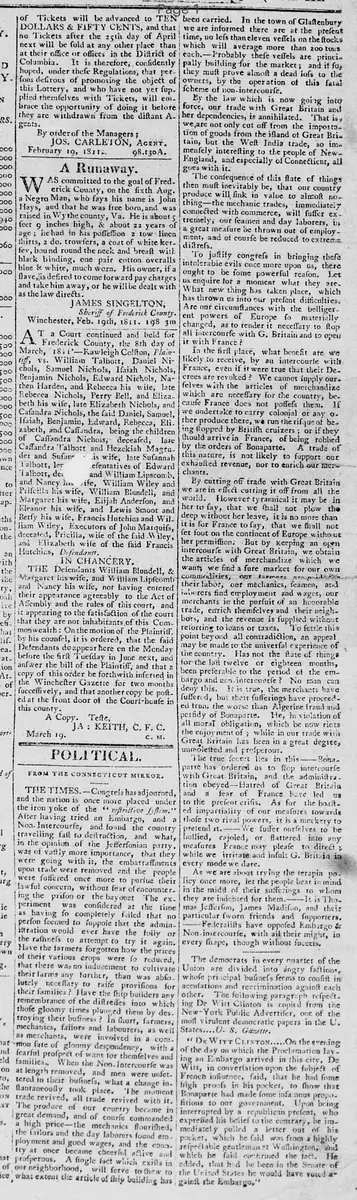
THE TIMES.--Congress has adjourned, and the nation is once more placed under the iron yoke of the "restrictive System." After having tried an Embargo, and a Non-Intercourse, and found the country travelling fast to destruction, and what, in the opinion of the Jeffersonian party, was of vastly more importance, that they were going with it, the embarrassments upon trade were removed and the people were suffered once more to pursue their lawful concern, without fear of encountering the prison or the bayonet. The experiment was considered at the time as having so completely failed that no person seemed to suppose that the administration would ever have the folly or the rashness to attempt to try it again. Have the farmers forgotten how the prices of their various crops were so reduced, that there was no inducement to cultivate their farms any further, than was absolutely necessary to raise provisions for their families? Have the ship builders any remembrance of the distress into which those gloomy times plunged them by destroying their business? In short, farmers, mechanics, sailors and labourers, as well as merchants, were involved in a common fate of gloomy despondency, with a fearful prospect of want for themselves and families-- When the Non-Intercourse was at length removed, and men were unfettered in their business, what a change instantaneously took place. The moment trade revived, all trade revived with it. The produce of our country became in great demand, and of course commanded a high price--the mechanics flourished, the sailors and the day laborers found employment and good wages, and the country at once became cheerful active and prosperous. A single fact which exists in our neighborhood, will serve to show to what extent the article of ship building has been carried. In the town of Glastenbury we are informed there are at the present time, no less than eleven vessels on the stocks which will average more than 200 tons each.--Probably these vessels are principally building for the market; and if so they must prove almost a dead loss to the owners, by the operation of this fatal scheme of non-intercourse. By the law which is now going into force, our trade with Great Britain and her dependencies, is annihilated. That is, we are not only cut off from the importation of goods from the island of Great Britain, but the West India trade, so immensely interesting to the people of New-England, and especially of Connecticut, all goes with it: The consequence of this state of things then must inevitably be, that our country produce will sink in value to almost nothing--the mechanic trades, immediately connected with commerce, will suffer extremely; our seamen and day laborers, in a great measure be thrown out of employment, and of course be reduced to extreme distress. To justify congress in bringing these intolerable evils once more upon us, there ought to be some powerful reason. Let us enquire for a moment what they are. What new thing has taken place, which has thrown us into our present difficulties. Are our circumstances with the belligerent powers of Europe so materially changed, as to render it necessary to stop all intercourse with G. Britain and to open it with France? In the first place. what benefit are we likely to receive, by an intercourse with France, even if it were true that their Decrees are revoked? We cannot supply ourselves with the articles of merchandize which are necessary for the country, because France does not possess them. If we undertake to carry colonial or any other produce there, we run the risque of being stopped by British cruizers ; or if they should arrive in France, of being robbed by the orders of Bonaparte. A trade of this nature, is not likely to support our exhausted revenue, nor to enrich our merchants. By cutting off trade with Great Britain we are in effect cutting it off from all the world. However tyrannical it may be in her to say, that we shall not plow the deep without her leave, it is no more than it is for France to say, that we shall not set foot on the continent of Europe without her permission: But by keeping an open intercourse with Great Britain, we obtain the articles of merchandize which we want, we find a sure market for our own commodities our farmers properly paid for their labor, our mechanics, seamen, and laborers find employment and wages, our merchants in the pursuit of an honorable trade, enrich themselves and their neighbors; and the revenue is supplied without resorting to loans or taxes. To settle this point beyond all contradiction, an appeal may be made to the universal experience of the country. Has not the state of things for the last twelve or eighteen months, been preferable to the period of the embargo and non-intercourse? No man can deny this. It is true, the merchants have suffered, but their sufferings have proceeded from: the worse than Algerine fraud and perfidy of Bonaparte. He, in violation of all moral obligation, which be now riots the enjoyment of ; while in our trade with Great Britain has been in a great degree, unmolested and prosperous. The true secret lies in this--Bonaparte has ordered us to stop intercourse with Great-Britain, and the administration obeyed--Hatred of Great Britain and a fear of France have led us to the present crisis. As for the boasted impartiality of our measures towards those two rival powers, it is a mockery to pretend it.--We suffer ourselves to be bullied, cajoled, or flattered into any measures France may please to direct ; while we irritate and insult G. Britain in every mode we dare. As we are about trying the torpedo policy once more, let the people bear in mind in the midst of their sufferings to whom they are indebted for them.---It is Thomas Jefferson, James Madison, and their particular sworn friends and supporters. Federalists have opposed Embargo & Non-intercourse, with all their might, in every shape, though without success. The democrats in every quarter of the Union are divided into angry factions, whose principal business seems to consist in accusations and recrimination against each other. The following paragraph respecting De Witt Clinton is copied from the New-York Public Advertiser, one of the most virulent democratic papers in the U. States....U. S. Gazette. " De Witt Clinton.....On the evening of the day on which the Proclamation laying an Embargo arrived in this city, De Witt, in conversation upon the subject of French influence, said, that he had some high proofs in his pocket, to show that Bonaparte had made some infamous propositions to our government. Upon being interrupted by a republican present, who expressed his belief to the contrary, he immediately pulled a letter out of his pocket, which he said was from a highly respectable gentleman at Washington, and which he said confirmed the fact. He added, that had he been in the Senate of the United States he would have voted against the Embargo."
What sub-type of article is it?
What themes does it cover?
What keywords are associated?
What entities or persons were involved?
Where did it happen?
Story Details
Key Persons
Location
Connecticut, New England, Glastenbury, New York
Event Date
Last Twelve Or Eighteen Months
Story Details
Criticism of reinstating Non-Intercourse Act, predicting economic distress for farmers, mechanics, sailors, and merchants; contrasts prosperity from open trade with Britain against harms from restrictions favoring France; anecdote of De Witt Clinton revealing proofs of French influence and stating opposition to Embargo.