Thank you for visiting SNEWPapers!
Sign up free
The Union Daily Times
Union, Union County, South Carolina
What is this article about?
At a boll weevil conference at Clemson College on July 24, 1922, experts reported increasing weevil infestation in South Carolina's cotton fields, urging farmers to intensify poisoning, cultivation, and square picking amid favorable weather for pests and showery conditions hindering control.
Clipping
OCR Quality
Full Text
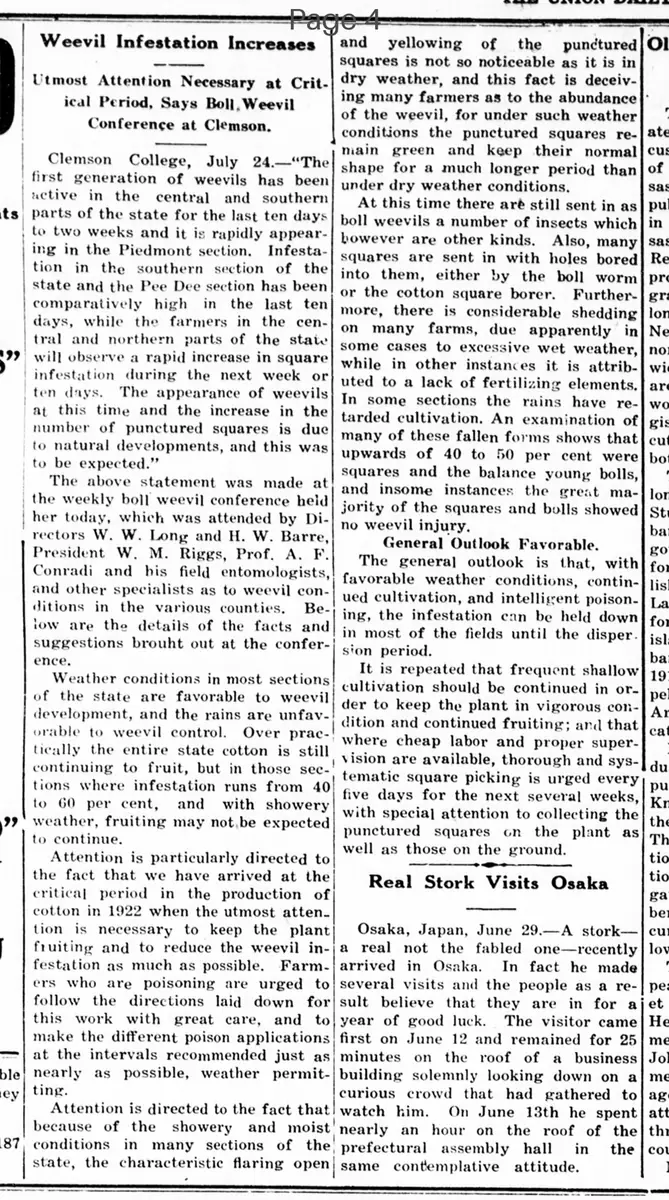
Immediate Attention Necessary at Critical Period, Says Boll Weevil Conference at Clemson.
Clemson College, July 24.—"The first generation of weevils has been active in the central and southern parts of the state for the last ten days to two weeks and it is rapidly appearing in the Piedmont section. Infestation in the southern section of the state and the Pee Dee section has been comparatively high in the last ten days, while the farmers in the central and northern parts of the state will observe a rapid increase in square infestation during the next week or ten days. The appearance of weevils at this time and the increase in the number of punctured squares is due to natural developments, and this was to be expected."
The above statement was made at the weekly boll weevil conference held here today, which was attended by Directors W. W. Long and H. W. Barre, President W. M. Riggs, Prof. A. F. Conradi and his field entomologists, and other specialists as to weevil conditions in the various counties. Below are the details of the facts and suggestions brought out at the conference.
Weather conditions in most sections of the state are favorable to weevil development, and the rains are unfavorable to weevil control. Over practically the entire state cotton is still continuing to fruit, but in those sections where infestation runs from 40 to 60 per cent, and with showery weather, fruiting may not be expected to continue.
Attention is particularly directed to the fact that we have arrived at the critical period in the production of cotton in 1922 when the utmost attention is necessary to keep the plant fruiting and to reduce the weevil infestation as much as possible. Farmers who are poisoning are urged to follow the directions laid down for this work with great care, and to make the different poison applications at the intervals recommended just as nearly as possible, weather permitting.
Attention is directed to the fact that because of the showery and moist conditions in many sections of the state, the characteristic flaring open and yellowing of the punctured squares is not so noticeable as it is in dry weather, and this fact is deceiving many farmers as to the abundance of the weevil. For under such weather conditions the punctured squares remain green and keep their normal shape for a much longer period than under dry weather conditions.
At this time there are still sent in as boll weevils a number of insects which however are other kinds. Also, many squares are sent in with holes bored into them, either by the boll worm or the cotton square borer. Furthermore, there is considerable shedding on many farms, due apparently in some cases to excessive wet weather, while in other instances it is attributed to a lack of fertilizing elements.
In some sections the rains have retarded cultivation. An examination of many of these fallen forms shows that upwards of 40 to 50 per cent were squares and the balance young bolls, and in some instances the great majority of the squares and bolls showed no weevil injury.
General Outlook Favorable.
The general outlook is that, with favorable weather conditions, continued cultivation, and intelligent poisoning, the infestation can be held down in most of the fields until the dispersion period.
It is repeated that frequent shallow cultivation should be continued in order to keep the plant in vigorous condition and continued fruiting; and that where cheap labor and proper supervision are available, thorough and systematic square picking is urged every five days for the next several weeks, with special attention to collecting the punctured squares on the plant as well as those on the ground.
What sub-type of article is it?
What keywords are associated?
What entities or persons were involved?
Where did it happen?
Domestic News Details
Primary Location
Clemson College, South Carolina
Event Date
July 24
Key Persons
Outcome
infestation increasing to 40-60% in some sections; general outlook favorable with continued cultivation, poisoning, and square picking to hold down infestation until dispersion period.
Event Details
Weekly boll weevil conference at Clemson College reported active first generation weevils in central and southern South Carolina, rapid spread to Piedmont; weather favorable to weevils, unfavorable to control; critical period for cotton production in 1922 requiring utmost attention to poisoning, cultivation, and square picking; misidentification of pests and shedding due to weather or fertilizer noted.