Thank you for visiting SNEWPapers!
Sign up free
Berkeley And Jefferson Intelligencer
Martinsburg, Berkeley County, Virginia
What is this article about?
Exchange of letters between General Moreau and Lieutenant General Duroc in Paris on September 8, where Moreau declines a command in the French expedition against England, criticizing its risks, and Duroc relays the First Consul's response requesting a private meeting on the 25th.
Clipping
OCR Quality
Full Text
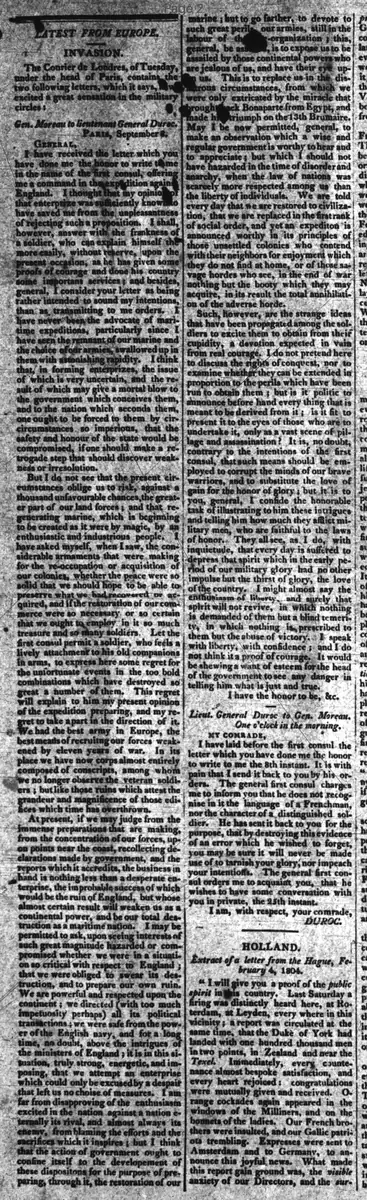
INVASION.
The Courier de Londres of Tuesday, under the head of Paris, contains the two following letters, which it says excited a great sensation in the military circles:
Gen. Moreau to Lieutenant General Duroc.
PARIS, September 8.
GENERAL,
I have received the letter which you have done me the honor to write to me in the name of the first consul, offering me a command in the expedition against England. I thought that my opinion of that enterprize was sufficiently known to have saved me from the unpleasantness of rejecting such a proposition. I shall, however, answer with the frankness of a soldier, who can explain himself the more easily without reserve upon the present occasion; as he has given some proofs of courage and done his country some important services; and besides, general, I consider your letter as being rather intended to sound my intentions, than as transmitting to me orders. I have never been the advocate of maritime expeditions, particularly since I have seen the remnant of our marine and the choice of our armies swallowed up in them with astonishing rapidity. I think that in forming enterprizes, the issue of which is very uncertain, and the result of which may give a mortal blow to the government which conceives them, and to the nation which seconds them, one ought to be forced to them by circumstances so imperious, that the safety and honour of the state would be compromised, if one should make a retrograde step that should discover weakness or irresolution. But I do not see that the present circumstances oblige us to risk against a thousand unfavourable chances the greater part of our land forces; and that regenerating marine, which is beginning to be created as it were by magic by an enthusiastic and industrious people. I have asked myself, when I saw the considerable armaments that were making for the re-occupation or acquisition of our colonies; whether the peace were so solid that we should hope to be able to preserve what we had recovered or acquired, and if the restoration of our commerce were so necessary, or so certain, that we ought to employ in it so much treasure and so many soldiers. Let the first consul permit a soldier, who feels a lively attachment to his old companions in arms, to express here some regret for the unfortunate events in the too bold combinations which have destroyed so great a number of them. This regret will explain to him my present opinion of the expedition preparing, and my regret to take a part in the direction of it. We had the best army in Europe, the best means of recruiting our forces weakened by eleven years of war. In its place we have now corps almost entirely composed of conscripts, among whom we no longer observe the veteran soldiers: but like those ruins which attest the grandeur and magnificence of those edifices which time has overthrown. At present, if we may judge from the immense preparations that are making, from the concentration of our forces, upon points near the coast, recollecting declarations made by government, and the reports which it accredits, the business in hand is nothing less than a desperate enterprize, the improbable success of which would be the ruin of England, but whose almost certain result will weaken us as a continental power and be our total destruction as a maritime nation. I may be permitted to ask, upon seeing interests of such great magnitude hazarded or compromised, whether we were in a situation so critical with respect to England, that we were obliged to swear its destruction, and to prepare our own ruin. We are powerful and respected upon the continent; we directed (with too much impetuosity perhaps) all its political transactions; we were safe from the power of the English navy, and for a long time, no doubt, above the intrigues of the ministers of England: it is in this situation, truly strong, energetic, and imposing, that we attempt an enterprise which could only be excused by a despair that left us no choice of measures. I am far from disapproving of the enthusiasm excited in the nation against a nation eternally its rival, and almost always its enemy; from blaming the efforts and the sacrifices which it inspires. But I think that the action of government ought to confine itself to the development of these dispositions for the purpose of preparing, through it, the restoration of our marine; but to go farther, to devote to such great peril our armies, still in the labour of their reorganization; this, general, is to expose us to be assailed by those continental powers who are jealous of us, and have their eye upon us. This is to replace us in the disastrous circumstances, from which we were only extricated by the miracle that brought back Bonaparte from Egypt, and made him triumph on the 13th Brumaire. May I now be permitted, general, to make an observation which a wise and regular government is worthy to hear and to appreciate; but which I should not have hazarded in the time of disorder and anarchy, when the law of nations was scarcely more respected among us than the liberty of individuals. We are told every day that we are restored to civilization, that we are replaced in the first rank of social order; and yet an expedition is announced worthy in its principles of those unsettled colonies who contend with their neighbours for enjoyments which they do not find at home, or of those savage hordes who see in the end of war nothing but the booty which they may acquire, in its result the total annihilation of the adverse horde. Such, however, are the strange ideas that have been propagated among the soldiers to excite them to obtain from their cupidity, a devotion expected in vain from real courage. I do not pretend here to discuss the rights of conquest, nor to examine whether they can be extended in proportion to the perils which have been run to obtain them; but is it politic to announce beforehand every thing that is meant to be derived from it; is it fit to present it to the eyes of those who are to undertake it, only as a vast scene of pillage and assassination? It is, no doubt, contrary to the intentions of the first consul that such means should be employed to corrupt the minds of our brave warriors, and to substitute the love of gain for the honour of glory; but it is to you, general, I confide the honorable task of illustrating to him these intrigues, and telling him how much they afflict military men who are faithful to the laws of honor. They all see, as I do with inquietude, that every day is suffered to depress that spirit which in the early period of our military glory had no other impulse but the thirst of glory, the love of the country. I might almost say the enthusiasm of liberty; and surely that spirit will not revive, in which nothing is demanded of them but a blind temerity, in which nothing is prescribed to them but the abuse of victory. I speak with liberty, with confidence; and I do not think it a proof of courage. It would be shewing a want of esteem for the head of the government to see any danger in telling him what is just and true.
I have the honor to be, &c.
Lieut. General Duroc to Gen. Moreau.
One o'clock in the morning.
MY COMRADE,
I have laid before the first consul the letter which you have done me the honor to write to me the 8th instant. It is with pain that I send it back to you by his orders. The general first consul charges me to inform you that he does not recognise in it the language of a Frenchman, nor the character of a distinguished soldier. He has sent it back to you for the purpose, that by destroying this evidence of an error which he wishes to forget, you may be sure it will never be made use of to tarnish your glory nor impeach your intentions. The general first consul orders me to acquaint you, that he wishes to have some conversation with you in private, the 25th instant.
I am, with respect, your comrade.
DUROC.
What sub-type of article is it?
What keywords are associated?
What entities or persons were involved?
Where did it happen?
Foreign News Details
Primary Location
Paris
Event Date
September 8
Key Persons
Outcome
moreau declines command in the expedition against england; first consul returns the letter with instructions to destroy it and requests private conversation on the 25th instant.
Event Details
General Moreau writes to Lieutenant General Duroc declining a command offered by the First Consul in the expedition against England, expressing concerns over its risks to French forces and marine, criticizing the motivations presented to soldiers, and regretting past losses. Duroc responds that the First Consul does not recognize the letter's language as that of a Frenchman or distinguished soldier, returns it to be destroyed, and invites Moreau for a private conversation on the 25th instant.