Thank you for visiting SNEWPapers!
Sign up free
The Portland Gazette
Portland, Cumberland County, Maine
What is this article about?
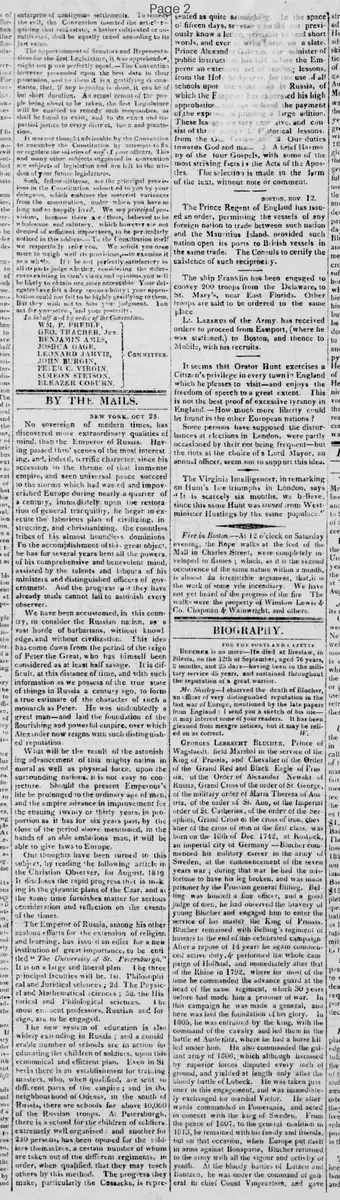
Report on Emperor Alexander I of Russia's efforts to civilize, educate, and Christianize his empire, including a new University of St. Petersburg, widespread school systems for soldiers and tribes, and scripture-based reading lessons approved by the emperor.
Clipping
OCR Quality
Full Text
NEW YORK, OCT 25.
No sovereign of modern times, has
discovered more extraordinary qualities of
mind, than the Emperor of Russia. Having passed through scenes of the most interesting,
and, indeed, terrific character, since his
accession to the throne of that immense
empire, and seen universal peace succeed
to the storms which had wasted and impoverished Europe during nearly a quarter of
a century, immediately upon the restoration of general tranquility, he began to execute the laborious plan of civilizing, instructing, and christianizing, the countless
tribes of his almost boundless dominions.
To the accomplishment of this great object,
he has for several years bent all the powers,
of his comprehensive and benevolent mind,
assisted by the talents and labours of his
ministers and distinguished officers of government. And the progress in it they have
already made cannot fail to astonish every
observer.
We have been accustomed, in this country, to consider the Russian nation, as a
vast horde of barbarians, without knowledge, and without civilization. This idea
has come down from the period of the reign
of Peter the Great, who has himself been
considered as at least half savage. It is difficult, at this distance of time, and with such
information as we possess of the true state
of things in Russia a century ago, to form
a true estimate of the character of such a
monarch as Peter. He was undoubtedly a
great man—and laid the foundation of the
flourishing and powerful empire, over which
Alexander now reigns with such distinguished reputation.
What will be the result of the astonishing advancement of this mighty nation in
moral as well as physical force, upon the
surrounding nations, it is not easy to conjecture. Should the present Emperor's
life be prolonged to the ordinary age of men,
and the empire advance in improvement for
the ensuing twenty or thirty years, in proportion as it has for six years past, by the
close of the period above mentioned, in the
hands of an able ambitious man, it will be
able to give laws to Europe.
Our thoughts have been turned to this
subject, by reading the following article in
the Christian Observer, for August, 1819.
It discloses the rapid progress that is making in the gigantic plans of the Czar, and at
the same time furnishes matter for serious
consideration and reflection on the events
of the times.
The Emperor of Russia, among his other
zealous efforts for the extension of religion
and learning, has issued an edict for a new
institution of great importance, to be entitled "The University of St. Petersburgh."
It is on a large and liberal plan. The three
principal faculties will be, 1st. Philosophical and Juridical sciences; 2d. The Physical and Mathematical sciences; 3d. the Historical and Philological sciences. The
most eminent professors, Russian and foreign, are to be engaged.
The new system of education is also
widely extending in Russia; and a considerable number of schools are in action for
educating the children of soldiers, upon this
economical and efficient plan. Even in Siberia there is an establishment for training
masters, who, when qualified, are sent to
different parts of the empire; and in the
neighbourhood of Odessa, in the south of
Russia, there are schools for above 10,000
of the Russian troops. At Petersburgh,
there is a school for the children of soldiers,
extremely well organised: and another for
250 persons, has been opened for the soldiers themselves, a certain number of whom
are taken out of the different regiments, in
order, when qualified, that they may teach
others by this method. The progress they
make, particularly the Cossacks, is represented as quite astonishing. In the space
of fifteen days, several who did not previously know a letter, were able to read short
words, and even write them on a slate.
Prince Alexander Galitzin, minister of
public instruction, has laid before the Emperor an extensive set of reading lessons,
from the Holy Scriptures for the use of all
schools upon the plan in Russia, of
which the Emperor has expressed his high
approbation, and has ordered the payment
of the expense of printing a large edition.
These lessons are very extensive, and consist of three parts: 1. Historical lessons,
from the Old Testament; 2. Our duties
towards God and man; 3. A brief Harmony of the four Gospels, with some of the
most striking facts in the Acts of the Apostles. The selection is made in the form
of the text, without note or comment.
What sub-type of article is it?
What keywords are associated?
What entities or persons were involved?
Where did it happen?
Foreign News Details
Primary Location
Russia
Event Date
August 1819
Key Persons
Outcome
rapid progress in education and christianization, including establishment of new university, schools for soldiers and children, and scripture-based lessons; astonishing learning advances among cossacks and others.
Event Details
Emperor Alexander I pursues plans to civilize, instruct, and Christianize Russia's tribes through government efforts. From Christian Observer August 1819: Edict for University of St. Petersburgh with faculties in philosophical/juridical, physical/mathematical, and historical/philological sciences. Expanding education system includes schools for soldiers' children in Siberia, Odessa (for 10,000 troops), and Petersburg; training for masters and soldiers as teachers. Prince Galitzin presents approved scripture reading lessons in three parts: Old Testament history, duties to God and man, and Gospels/Acts harmony.