Thank you for visiting SNEWPapers!
Sign up free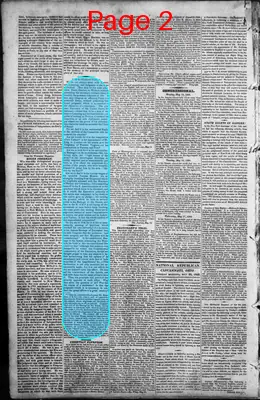
Editorial
May 30, 1826
The National Republican And Ohio Political Register
Cincinnati, Hamilton County, Ohio
What is this article about?
An editorial from the Richmond Enquirer critiques the U.S. President's lack of statesman-like judgment, focusing on his cabinet choices, appointments, oratorical message style, and inconsistent handling of the Panama Mission, including constitutional oversteps in executive authority.
Clipping
OCR Quality
95%
Excellent
Full Text
From the Richmond Enquirer.
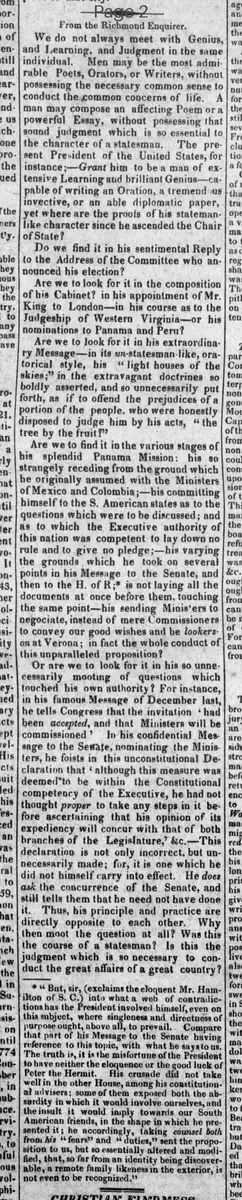
We do not always meet with Genius and Learning, and Judgment in the same individual. Men may be the most admirable Poets, Orators, or Writers, without possessing the necessary common sense to conduct the common concerns of life. A man may compose an affecting Poem or a powerful Essay, without possessing that sound judgment which is so essential to the character of a statesman. The present President of the United States, for instance;—Grant him to be a man of extensive Learning and brilliant Genius—capable of writing an Oration, a tremendous invective, or an able diplomatic paper, yet where are the proofs of his statesman-like character since he ascended the Chair of State?
Do we find it in his sentimental Reply to the Address of the Committee who announced his election? Are we to look for it in the composition of his Cabinet? in his appointment of Mr. King to London—in his course as to the Judgeship of Western Virginia—or his nominations to Panama and Peru? Are we to look for it in his extraordinary Message—in its un-statesman-like, oratorical style, his "light houses of the skies;" in the extravagant doctrines so boldly asserted, and so unnecessarily put forth, as if to offend the prejudices of a portion of the people, who were honestly disposed to judge him by his acts, "the tree by the fruit?"
Are we to find it in the various stages of his splendid Panama Mission: his so strangely receding from the ground which he originally assumed with the Ministers of Mexico and Colombia;—his committing himself to the S. American states as to the questions which were to be discussed; and as to which the Executive authority of this nation was competent to lay down no rule and to give no pledge; his varying the grounds which he took on several points in his Message to the Senate, and then to the H. of R.;* is not laying all the documents at once before them, touching the same point—his sending Ministers to negociate, instead of mere Commissioners to convey our good wishes and be lookers on at Verona: in fact the whole conduct of this unparalleled proposition?
Or are we to look for it in his so unnecessarily mooting of questions which touched his own authority? For instance, in his famous Message of December last he tells Congress that the invitation had been accepted, and that Ministers will be commissioned. In his confidential Message to the Senate, nominating the Ministers, he foists in this unconstitutional Declaration that 'although this measure was deemed to be within the Constitutional competency of the Executive, he had not thought proper to take any steps in it before ascertaining that his opinion of its expediency will concur with that of both branches of the Legislature,' &c.—This declaration is not only incorrect, but unnecessarily made; for, it is one which he did not himself carry into effect. He does ask the concurrence of the Senate, and still tells them that he need not have done it. Thus, his principle and practice are directly opposite to each other. Why then moot the question at all? Was this the course of a statesman? Is this the judgment which is so necessary to conduct the great affairs of a great country?
* " But, sir, (exclaims the eloquent Mr. Hamilton of S. C.) into what a web of contradictions has the President involved himself, even on this subject, where singleness and directness of purpose ought, above all, to prevail. Compare that part of his Message to the Senate having reference to this topic, with what he says to us. The truth is, it is the misfortune of the President to have neither the eloquence or the good luck of Peter the Hermit. His crusade did not take well in the other House, among his constitutional advisers: some of them exposed both the absurdity in which it would involve ourselves, and the insult it would imply towards our South American friends, in the shape in which he presented it; he accordingly, taking counsel both from his "ears" and " duties," sent the proposition to us, but so essentially altered and modified, that, so far from an identity being discoverable, a remote family likeness in the exterior, is not even to be recognized."
We do not always meet with Genius and Learning, and Judgment in the same individual. Men may be the most admirable Poets, Orators, or Writers, without possessing the necessary common sense to conduct the common concerns of life. A man may compose an affecting Poem or a powerful Essay, without possessing that sound judgment which is so essential to the character of a statesman. The present President of the United States, for instance;—Grant him to be a man of extensive Learning and brilliant Genius—capable of writing an Oration, a tremendous invective, or an able diplomatic paper, yet where are the proofs of his statesman-like character since he ascended the Chair of State?
Do we find it in his sentimental Reply to the Address of the Committee who announced his election? Are we to look for it in the composition of his Cabinet? in his appointment of Mr. King to London—in his course as to the Judgeship of Western Virginia—or his nominations to Panama and Peru? Are we to look for it in his extraordinary Message—in its un-statesman-like, oratorical style, his "light houses of the skies;" in the extravagant doctrines so boldly asserted, and so unnecessarily put forth, as if to offend the prejudices of a portion of the people, who were honestly disposed to judge him by his acts, "the tree by the fruit?"
Are we to find it in the various stages of his splendid Panama Mission: his so strangely receding from the ground which he originally assumed with the Ministers of Mexico and Colombia;—his committing himself to the S. American states as to the questions which were to be discussed; and as to which the Executive authority of this nation was competent to lay down no rule and to give no pledge; his varying the grounds which he took on several points in his Message to the Senate, and then to the H. of R.;* is not laying all the documents at once before them, touching the same point—his sending Ministers to negociate, instead of mere Commissioners to convey our good wishes and be lookers on at Verona: in fact the whole conduct of this unparalleled proposition?
Or are we to look for it in his so unnecessarily mooting of questions which touched his own authority? For instance, in his famous Message of December last he tells Congress that the invitation had been accepted, and that Ministers will be commissioned. In his confidential Message to the Senate, nominating the Ministers, he foists in this unconstitutional Declaration that 'although this measure was deemed to be within the Constitutional competency of the Executive, he had not thought proper to take any steps in it before ascertaining that his opinion of its expediency will concur with that of both branches of the Legislature,' &c.—This declaration is not only incorrect, but unnecessarily made; for, it is one which he did not himself carry into effect. He does ask the concurrence of the Senate, and still tells them that he need not have done it. Thus, his principle and practice are directly opposite to each other. Why then moot the question at all? Was this the course of a statesman? Is this the judgment which is so necessary to conduct the great affairs of a great country?
* " But, sir, (exclaims the eloquent Mr. Hamilton of S. C.) into what a web of contradictions has the President involved himself, even on this subject, where singleness and directness of purpose ought, above all, to prevail. Compare that part of his Message to the Senate having reference to this topic, with what he says to us. The truth is, it is the misfortune of the President to have neither the eloquence or the good luck of Peter the Hermit. His crusade did not take well in the other House, among his constitutional advisers: some of them exposed both the absurdity in which it would involve ourselves, and the insult it would imply towards our South American friends, in the shape in which he presented it; he accordingly, taking counsel both from his "ears" and " duties," sent the proposition to us, but so essentially altered and modified, that, so far from an identity being discoverable, a remote family likeness in the exterior, is not even to be recognized."
What sub-type of article is it?
Foreign Affairs
Constitutional
What keywords are associated?
Panama Mission
Presidential Judgment
Foreign Policy
Executive Authority
Statesmanship
Cabinet Appointments
Congressional Messages
South American Diplomacy
What entities or persons were involved?
President Of The United States
Mr. King
Ministers Of Mexico And Colombia
S. American States
Mr. Hamilton Of S. C.
Congress
Senate
House Of Representatives
Editorial Details
Primary Topic
Critique Of The President's Statesmanship In Handling The Panama Mission And Executive Authority
Stance / Tone
Strongly Critical Of Presidential Judgment And Conduct
Key Figures
President Of The United States
Mr. King
Ministers Of Mexico And Colombia
S. American States
Mr. Hamilton Of S. C.
Congress
Senate
House Of Representatives
Key Arguments
Men Can Possess Genius And Learning Without Sound Judgment For Statesmanship
No Proofs Of Statesmanship In President's Reply To Election Announcement
Questionable Cabinet Composition And Appointments Like Mr. King To London And Judgeship In Western Virginia
Nominations To Panama And Peru Lack Statesman Like Quality
Extraordinary Message Features Un Statesman Like Oratorical Style And Extravagant Doctrines
In Panama Mission, Receded From Original Positions With Mexico And Colombia Ministers
Committed To S. American States On Discussion Questions Without Executive Rule Or Pledge
Varied Grounds In Messages To Senate And House Of Representatives
Failed To Lay All Documents Before Congress At Once
Sent Ministers To Negotiate Instead Of Commissioners To Observe At Verona
Unnecessarily Mooted Questions Touching His Own Authority
In Message To Congress, Declared Invitation Accepted And Ministers To Be Commissioned
In Confidential Message To Senate, Included Unconstitutional Declaration Seeking Legislative Concurrence Despite Executive Competency
Principle And Practice Contradict Each Other In Seeking Senate Concurrence While Claiming It Unnecessary