Thank you for visiting SNEWPapers!
Sign up free
Literary
May 24, 1825
The National Republican And Ohio Political Register
Cincinnati, Hamilton County, Ohio
What is this article about?
Historical narrative of Sir Niel Campbell, the Black Knight of Lochow, resisting English forces in the Scottish Highlands. He allies with Wallace to defeat traitor Macfadzean at the Pass of Brandir, securing oaths of fidelity from Highland chiefs at Ardchattan Priory.
Clipping
OCR Quality
95%
Excellent
Full Text
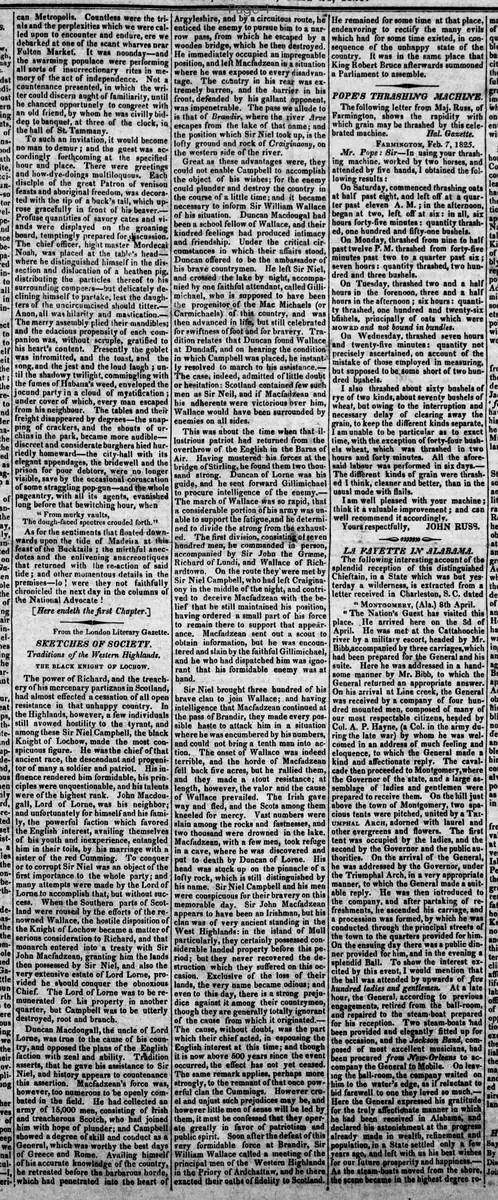
From the London Literary Gazette.
SKETCHES OF SOCIETY.
Traditions of the Western Highlands.
THE BLACK KNIGHT OF LOCHOW.
The power of Richard, and the treachery of his mercenary partizans in Scotland, had almost effected a cessation of all open resistance in that unhappy country. In the Highlands, however, a few individuals still avowed hostility to the tyrant, and among these Sir Niel Campbell, the black Knight of Lochow, made the most conspicuous figure. He was the chief of that ancient race, the descendant and progenitor of many a soldier and patriot. His influence rendered him formidable, his principles were unquestionable, and his talents were of the highest rank. John Macdougall, Lord of Lorne, was his neighbor: and unfortunately for himself and his family, the powerful faction which favored the English interest, availing themselves of his youth and inexperience, entangled him in their toils, by his marriage with a sister of the red Comyn. To conquer or to corrupt Sir Niel was an object of the first importance to the whole party; and many attempts were made by the Lord of Lorne to accomplish that; but without success. When the Southern parts of Scotland were roused by the efforts of the renowned Wallace, the hostile disposition of the Knight of Lochow became a matter of serious consideration to Richard, and that monarch entered into a treaty with Sir John Macfadzean, granting him the lands then possessed by Sir Niel, and also the very extensive estate of Lord Lorne, provided he should conquer the obnoxious Chief. The Lord of Lorne was to be remunerated for his property in another quarter, but Campbell was to be utterly destroyed, root and branch.
Duncan Macdougall, the uncle of Lord Lorne, was true to the cause of his country, and opposed the plans of the English faction with zeal and ability. Tradition asserts, that he gave his assistance to Sir Niel, and history appears to countenance this assertion. Macfadzean's force was, however, too numerous to be openly combated in the field. He had collected an army of 15,000 men, consisting of Irish and treacherous Scotch, who had joined him with hope of plunder; and Campbell showed a degree of skill and conduct as a General, which was worthy the best days of Greece and Rome. Availing himself of his accurate knowledge of the country, he retreated before the barbarous horde, which had penetrated into the heart of Argyleshire, and by a circuitous route, he enticed the enemy to pursue him to a narrow pass, from which he escaped by a wooden bridge, which he then destroyed. He immediately occupied an impregnable position, and left Macfadzean in a situation where he was exposed to every disadvantage. The country in his rear was extremely barren, and the barrier in his front, defended by his gallant opponent, was impenetrable. The pass we allude to is that of Brandir, where the river Awe escapes from the lake of that name; and the position which Sir Niel took up, is the lofty ground and rock of Craiginaony, on the western side of the river.
Great as these advantages were, they could not enable Campbell to accomplish the object of his wishes; for the enemy could plunder and destroy the country in the course of a little time; and it became necessary to inform Sir William Wallace of his situation. Duncan Macdougal had been a school fellow of Wallace, and their kindred feelings had produced intimacy and friendship. Under the critical circumstances in which their affairs stood, Duncan offered to be the ambassador of his brave countrymen. He left Sir Niel, and crossed the lake by night, accompanied by one faithful attendant, called Gillimichael, who is supposed to have been the progenitor of the Mac Michaels (or Carmichaels) of this country, and was then advanced in life, but still celebrated for swiftness of foot and for bravery. Tradition relates that Duncan found Wallace at Dundaff, and on hearing the condition in which Campbell was placed, he instantly resolved to march to his assistance. The case, indeed, admitted of little doubt or hesitation: Scotland contained few such men as Sir Neil, and if Macfadzean and his adherents were victorious over him, Wallace would have been surrounded by enemies on all sides.
This was about the time when that illustrious patriot had returned from the overthrow of the English in the Barns of Ayr. Having mustered his forces at the bridge of Stirling, he found them two thousand strong. Duncan of Lorne was his guide, and he sent forward Gillimichael to procure intelligence of the enemy. The march of Wallace was so rapid, that a considerable portion of his army was unable to support the fatigue, and he determined to divide the strong from the exhausted. The first division, consisting of seven hundred men, he commanded in person, accompanied by Sir John the Graeme, Richard of Lundie, and Wallace of Ricardtown. On the route they were met by Sir Niel Campbell, who had left Craiginaony in the middle of the night, and contrived to deceive Macfadzean with the belief that he still maintained his position, having ordered a small part of his force to remain there to support that appearance. Macfadzean sent out a scout to obtain information, but he was encountered and slain by the faithful Gillimichael, and he who had dispatched him was ignorant that his formidable enemy was at hand.
Sir Niel brought three hundred of his brave clan to join Wallace; and having intelligence that Macfadzean continued at the pass of Brandir, they made every possible haste to attack him in a situation where he was encumbered by his numbers, and could not bring a tenth man into action. The onset of Wallace was indeed terrible, and the horde of Macfadzean fell back five acres, but he rallied them, and they made a stout resistance; at length, however, the valor and the cause of Wallace prevailed. The Irish gave way and fled, and the Scots among them kneeled for mercy. Vast numbers were slain among the rocks and fastnesses, and two thousand were drowned in the lake. Macfadzean, with a few men, took refuge in a cave, where he was discovered and put to death by Duncan of Lorne. His head was stuck up on the pinnacle of a lofty rock, which is still distinguished by his name. Sir Niel Campbell and his men were conspicuous for their bravery on this memorable day. Sir John Macfadzean appears to have been an Irishman, but his clan was of very ancient standing in the West Highlands: in the island of Mull particularly, they certainly possessed considerable landed property before this period; but they never recovered the destruction which they suffered on this occasion. Exclusive of the loss of their lands, the very name became odious; and even to this day, there is a strong prejudice against it among their countrymen, though they are generally totally ignorant of the cause from which it originated. The cause, without doubt, was the part which their chief acted, in espousing the English interest at this time; and though it is now above 500 years since the event occurred, the effect has not yet ceased. The same remark applies, perhaps more strongly, to the remnant of that once powerful clan the Comyns. However cruel and unjust such prejudices may be, and however little men of sense will be led by them, it must be confessed that they operate greatly in favor of patriotism and public spirit. Soon after the defeat of this very formidable force at Brandir, Sir William Wallace called a meeting of the principal men of the Western Highlands in the Priory of Ardchattan, and he there exacted their oaths of fidelity to Scotland.
He remained for some time at that place, endeavoring to rectify the many evils which had for some time existed, in consequence of the unhappy state of the country. It was in the same place that King Robert Bruce afterwards summoned a Parliament to assemble.
SKETCHES OF SOCIETY.
Traditions of the Western Highlands.
THE BLACK KNIGHT OF LOCHOW.
The power of Richard, and the treachery of his mercenary partizans in Scotland, had almost effected a cessation of all open resistance in that unhappy country. In the Highlands, however, a few individuals still avowed hostility to the tyrant, and among these Sir Niel Campbell, the black Knight of Lochow, made the most conspicuous figure. He was the chief of that ancient race, the descendant and progenitor of many a soldier and patriot. His influence rendered him formidable, his principles were unquestionable, and his talents were of the highest rank. John Macdougall, Lord of Lorne, was his neighbor: and unfortunately for himself and his family, the powerful faction which favored the English interest, availing themselves of his youth and inexperience, entangled him in their toils, by his marriage with a sister of the red Comyn. To conquer or to corrupt Sir Niel was an object of the first importance to the whole party; and many attempts were made by the Lord of Lorne to accomplish that; but without success. When the Southern parts of Scotland were roused by the efforts of the renowned Wallace, the hostile disposition of the Knight of Lochow became a matter of serious consideration to Richard, and that monarch entered into a treaty with Sir John Macfadzean, granting him the lands then possessed by Sir Niel, and also the very extensive estate of Lord Lorne, provided he should conquer the obnoxious Chief. The Lord of Lorne was to be remunerated for his property in another quarter, but Campbell was to be utterly destroyed, root and branch.
Duncan Macdougall, the uncle of Lord Lorne, was true to the cause of his country, and opposed the plans of the English faction with zeal and ability. Tradition asserts, that he gave his assistance to Sir Niel, and history appears to countenance this assertion. Macfadzean's force was, however, too numerous to be openly combated in the field. He had collected an army of 15,000 men, consisting of Irish and treacherous Scotch, who had joined him with hope of plunder; and Campbell showed a degree of skill and conduct as a General, which was worthy the best days of Greece and Rome. Availing himself of his accurate knowledge of the country, he retreated before the barbarous horde, which had penetrated into the heart of Argyleshire, and by a circuitous route, he enticed the enemy to pursue him to a narrow pass, from which he escaped by a wooden bridge, which he then destroyed. He immediately occupied an impregnable position, and left Macfadzean in a situation where he was exposed to every disadvantage. The country in his rear was extremely barren, and the barrier in his front, defended by his gallant opponent, was impenetrable. The pass we allude to is that of Brandir, where the river Awe escapes from the lake of that name; and the position which Sir Niel took up, is the lofty ground and rock of Craiginaony, on the western side of the river.
Great as these advantages were, they could not enable Campbell to accomplish the object of his wishes; for the enemy could plunder and destroy the country in the course of a little time; and it became necessary to inform Sir William Wallace of his situation. Duncan Macdougal had been a school fellow of Wallace, and their kindred feelings had produced intimacy and friendship. Under the critical circumstances in which their affairs stood, Duncan offered to be the ambassador of his brave countrymen. He left Sir Niel, and crossed the lake by night, accompanied by one faithful attendant, called Gillimichael, who is supposed to have been the progenitor of the Mac Michaels (or Carmichaels) of this country, and was then advanced in life, but still celebrated for swiftness of foot and for bravery. Tradition relates that Duncan found Wallace at Dundaff, and on hearing the condition in which Campbell was placed, he instantly resolved to march to his assistance. The case, indeed, admitted of little doubt or hesitation: Scotland contained few such men as Sir Neil, and if Macfadzean and his adherents were victorious over him, Wallace would have been surrounded by enemies on all sides.
This was about the time when that illustrious patriot had returned from the overthrow of the English in the Barns of Ayr. Having mustered his forces at the bridge of Stirling, he found them two thousand strong. Duncan of Lorne was his guide, and he sent forward Gillimichael to procure intelligence of the enemy. The march of Wallace was so rapid, that a considerable portion of his army was unable to support the fatigue, and he determined to divide the strong from the exhausted. The first division, consisting of seven hundred men, he commanded in person, accompanied by Sir John the Graeme, Richard of Lundie, and Wallace of Ricardtown. On the route they were met by Sir Niel Campbell, who had left Craiginaony in the middle of the night, and contrived to deceive Macfadzean with the belief that he still maintained his position, having ordered a small part of his force to remain there to support that appearance. Macfadzean sent out a scout to obtain information, but he was encountered and slain by the faithful Gillimichael, and he who had dispatched him was ignorant that his formidable enemy was at hand.
Sir Niel brought three hundred of his brave clan to join Wallace; and having intelligence that Macfadzean continued at the pass of Brandir, they made every possible haste to attack him in a situation where he was encumbered by his numbers, and could not bring a tenth man into action. The onset of Wallace was indeed terrible, and the horde of Macfadzean fell back five acres, but he rallied them, and they made a stout resistance; at length, however, the valor and the cause of Wallace prevailed. The Irish gave way and fled, and the Scots among them kneeled for mercy. Vast numbers were slain among the rocks and fastnesses, and two thousand were drowned in the lake. Macfadzean, with a few men, took refuge in a cave, where he was discovered and put to death by Duncan of Lorne. His head was stuck up on the pinnacle of a lofty rock, which is still distinguished by his name. Sir Niel Campbell and his men were conspicuous for their bravery on this memorable day. Sir John Macfadzean appears to have been an Irishman, but his clan was of very ancient standing in the West Highlands: in the island of Mull particularly, they certainly possessed considerable landed property before this period; but they never recovered the destruction which they suffered on this occasion. Exclusive of the loss of their lands, the very name became odious; and even to this day, there is a strong prejudice against it among their countrymen, though they are generally totally ignorant of the cause from which it originated. The cause, without doubt, was the part which their chief acted, in espousing the English interest at this time; and though it is now above 500 years since the event occurred, the effect has not yet ceased. The same remark applies, perhaps more strongly, to the remnant of that once powerful clan the Comyns. However cruel and unjust such prejudices may be, and however little men of sense will be led by them, it must be confessed that they operate greatly in favor of patriotism and public spirit. Soon after the defeat of this very formidable force at Brandir, Sir William Wallace called a meeting of the principal men of the Western Highlands in the Priory of Ardchattan, and he there exacted their oaths of fidelity to Scotland.
He remained for some time at that place, endeavoring to rectify the many evils which had for some time existed, in consequence of the unhappy state of the country. It was in the same place that King Robert Bruce afterwards summoned a Parliament to assemble.
What sub-type of article is it?
Prose Fiction
What themes does it cover?
Liberty Freedom
Political
War Peace
What keywords are associated?
Black Knight Lochow
Sir Niel Campbell
William Wallace
Battle Brandir
Scottish Highlands
English Treachery
Highland Resistance
What entities or persons were involved?
From The London Literary Gazette
Literary Details
Title
The Black Knight Of Lochow
Author
From The London Literary Gazette
Subject
Traditions Of The Western Highlands