Thank you for visiting SNEWPapers!
Sign up free
Editorial
March 14, 1828
Delaware Patriot & American Watchman
Wilmington, New Castle County, Delaware
What is this article about?
This editorial lambasts Henry Clay for political inconsistency, highlighting his shift from opposing secretary succession to endorsing it after aligning with John Quincy Adams in the 1824 presidential election, betraying his constituents and principles for personal ambition.
Clipping
OCR Quality
95%
Excellent
Full Text
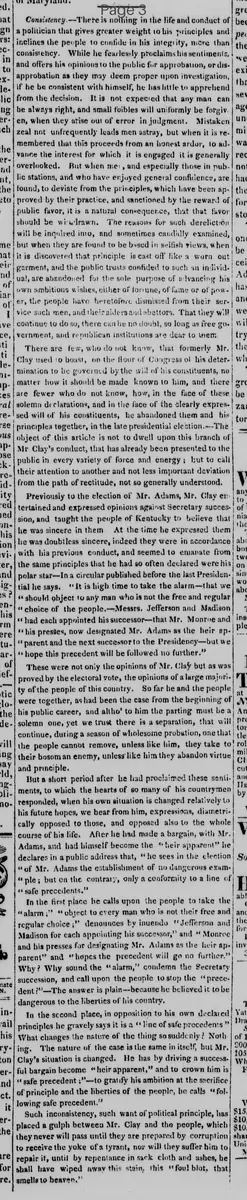
Consistency,-There is nothing in the life and conduct of a politician that gives greater weight to his principles and inclines the people to confide in his integrity, more than consistency. While he fearlessly proclaims his sentiments, and offers his opinions to the public for approbation, or disapprobation as they may deem proper upon investigation, if he be consistent with himself, he has little to apprehend from the decision. It is not expected that any man can be always right, and small foibles will uniformly be forgiven, when they arise out of error in judgment. Mistaken zeal not unfrequently leads men astray, but when it is remembered that this proceeds from an honest ardor, to advance the interest for which it is engaged it is generally overlooked. But when men, and especially those in public stations, and who have enjoyed general confidence, are found, to deviate from the principles, which have been approved by their practice, and sanctioned by the reward of public favor, it is a natural consequence, that that favor should be withdrawn. The reasons for such dereliction will be inquired into, and sometimes candidly examined, but when they are found to be based in selfish views, when it is discovered that principle is cast off like a worn out garment, and the public trusts confided to such an individual, are abandoned for the sole purpose of advancing his own ambitious wishes, either of fortune, of fame or of power, the people have heretofore dismissed from their service such men, and their aiders and abettors. That they will continue to do so, there can be no doubt, so long as free government, and republican institutions are dear to them
There are few, who do not know, that formerly Mr. Clay used to boast, on the floor of Congress of his determination to be governed by the will of his constituents, no matter how it should be made known to him, and there are fewer who do not know, how, in the face of these solemn declarations, and in the face of the clearly expressed will of his constituents, he abandoned them and his principles together, in the late presidential election.- The object of this article is not to dwell upon this branch of Mr Clay's conduct, that has already been presented to the public in every variety of force and energy; but to call their attention to another and not less important deviation from the path of rectitude, not so generally understood.
Previously to the election of Mr. Adams, Mr. Clay entertained and expressed opinions against Secretary succession, and taught the people of Kentucky to believe that he was sincere in them. At the time he expressed them he was doubtless sincere, indeed they were in accordance with his previous conduct, and seemed to emanate from the same principles that he had so often declared were his polar star-In a circular published before the last Presidential he says. "It is high time to take the alarm-that we should object to any man who is not the free and regular choice of the people.-Messrs. Jefferson and Madison had each appointed his successor-that Mr. Monroe and his presses, now designated Mr. Adams as the heir apparent and the next successor to the Presidency-but we hope this precedent will be followed no further."
These were not only the opinions of Mr. Clay but as was proved by the electoral vote, the opinions of a large majority of the people of this country. So far he and the people were together, as had been the case from the beginning of his public career, and altho' to him the parting must be a solemn one, yet we trust there is a separation, that will continue, during a season of wholesome probation, one that the people cannot remove, unless like him, they take to their bosom enemy, unless like him they abandon virtue and principle.
But a short period after he had proclaimed these sentiments, to which the hearts of so many of his countrymen responded, when his own situation is changed relatively to his future hopes, we hear from him, expressions, diametrically opposed to those, and opposed also to the whole course of his life. After he had made a bargain, with Mr. Adams, and had himself become the "heir apparent" he declares in a public address that, "he sees in the election of Mr. Adams the establishment of no dangerous example; but on the contrary, only a conformity to a line of safe precedents."
In the first place he calls upon the people to take the "alarm;" "object to every man who is not their free and regular choice;" denounces by innuendo "Jefferson and Madison for each appointing his successor," and "Monroe and his presses for designating Mr. Adams as the heir apparent" and "hopes the precedent will go no further."
Why? Why sound the "alarm," condemn the Secretary succession, and call upon the people to stop the "precedent?"-The answer is plain--because he believed it to be dangerous to the liberties of his country.
In the second place, in opposition to his own declared principles he gravely says it is a "line of safe precedents" What changes the nature of the thing so suddenly? Nothing. The nature of the case is the same in itself, but Mr. Clay's situation is changed. He has by driving a successful bargain become "heir apparent," and to crown him is "safe precedent ;"-to gratify his ambition at the sacrifice of principle and the liberties of the people, he calls "following safe precedent."
Such inconsistency, such want of political principle, has placed a gulph between Mr. Clay and the people, which they never will pass until they are prepared by corruption to receive the yoke of a tyrant, nor will they suffer him to repair it, until by repentance in sack cloth and ashes, he shall have wiped away this stain, this "foul blot, that smells to heaven,"
There are few, who do not know, that formerly Mr. Clay used to boast, on the floor of Congress of his determination to be governed by the will of his constituents, no matter how it should be made known to him, and there are fewer who do not know, how, in the face of these solemn declarations, and in the face of the clearly expressed will of his constituents, he abandoned them and his principles together, in the late presidential election.- The object of this article is not to dwell upon this branch of Mr Clay's conduct, that has already been presented to the public in every variety of force and energy; but to call their attention to another and not less important deviation from the path of rectitude, not so generally understood.
Previously to the election of Mr. Adams, Mr. Clay entertained and expressed opinions against Secretary succession, and taught the people of Kentucky to believe that he was sincere in them. At the time he expressed them he was doubtless sincere, indeed they were in accordance with his previous conduct, and seemed to emanate from the same principles that he had so often declared were his polar star-In a circular published before the last Presidential he says. "It is high time to take the alarm-that we should object to any man who is not the free and regular choice of the people.-Messrs. Jefferson and Madison had each appointed his successor-that Mr. Monroe and his presses, now designated Mr. Adams as the heir apparent and the next successor to the Presidency-but we hope this precedent will be followed no further."
These were not only the opinions of Mr. Clay but as was proved by the electoral vote, the opinions of a large majority of the people of this country. So far he and the people were together, as had been the case from the beginning of his public career, and altho' to him the parting must be a solemn one, yet we trust there is a separation, that will continue, during a season of wholesome probation, one that the people cannot remove, unless like him, they take to their bosom enemy, unless like him they abandon virtue and principle.
But a short period after he had proclaimed these sentiments, to which the hearts of so many of his countrymen responded, when his own situation is changed relatively to his future hopes, we hear from him, expressions, diametrically opposed to those, and opposed also to the whole course of his life. After he had made a bargain, with Mr. Adams, and had himself become the "heir apparent" he declares in a public address that, "he sees in the election of Mr. Adams the establishment of no dangerous example; but on the contrary, only a conformity to a line of safe precedents."
In the first place he calls upon the people to take the "alarm;" "object to every man who is not their free and regular choice;" denounces by innuendo "Jefferson and Madison for each appointing his successor," and "Monroe and his presses for designating Mr. Adams as the heir apparent" and "hopes the precedent will go no further."
Why? Why sound the "alarm," condemn the Secretary succession, and call upon the people to stop the "precedent?"-The answer is plain--because he believed it to be dangerous to the liberties of his country.
In the second place, in opposition to his own declared principles he gravely says it is a "line of safe precedents" What changes the nature of the thing so suddenly? Nothing. The nature of the case is the same in itself, but Mr. Clay's situation is changed. He has by driving a successful bargain become "heir apparent," and to crown him is "safe precedent ;"-to gratify his ambition at the sacrifice of principle and the liberties of the people, he calls "following safe precedent."
Such inconsistency, such want of political principle, has placed a gulph between Mr. Clay and the people, which they never will pass until they are prepared by corruption to receive the yoke of a tyrant, nor will they suffer him to repair it, until by repentance in sack cloth and ashes, he shall have wiped away this stain, this "foul blot, that smells to heaven,"
What sub-type of article is it?
Partisan Politics
Constitutional
What keywords are associated?
Political Consistency
Henry Clay
Presidential Election
Secretary Succession
Political Ambition
Public Trust
What entities or persons were involved?
Mr. Clay
Mr. Adams
Jefferson
Madison
Monroe
People Of Kentucky
Constituents
Editorial Details
Primary Topic
Criticism Of Henry Clay's Inconsistency On Secretary Succession And Presidential Election
Stance / Tone
Strongly Critical Of Political Betrayal And Ambition
Key Figures
Mr. Clay
Mr. Adams
Jefferson
Madison
Monroe
People Of Kentucky
Constituents
Key Arguments
Consistency Enhances A Politician's Integrity And Public Trust
Deviation From Principles For Selfish Ambition Leads To Loss Of Favor
Clay Formerly Opposed Secretary Succession As Dangerous To Liberties
Clay Abandoned Opposition After Bargaining With Adams To Become Heir Apparent
Such Inconsistency Creates An Irreparable Gulf Between Clay And The People