Thank you for visiting SNEWPapers!
Sign up free
Daily National Intelligencer
Washington, District Of Columbia
What is this article about?
On February 16, in the House of Representatives, Mr. Hopkinson of Pennsylvania speaks in favor of a uniform federal bankruptcy bill. He argues its necessity for commerce, humanity, and justice, critiques state insolvent laws for inequality and cruelty, and urges Congress to fulfill constitutional duties by enacting it to protect honest debtors and ensure fair creditor treatment.
Clipping
OCR Quality
Full Text
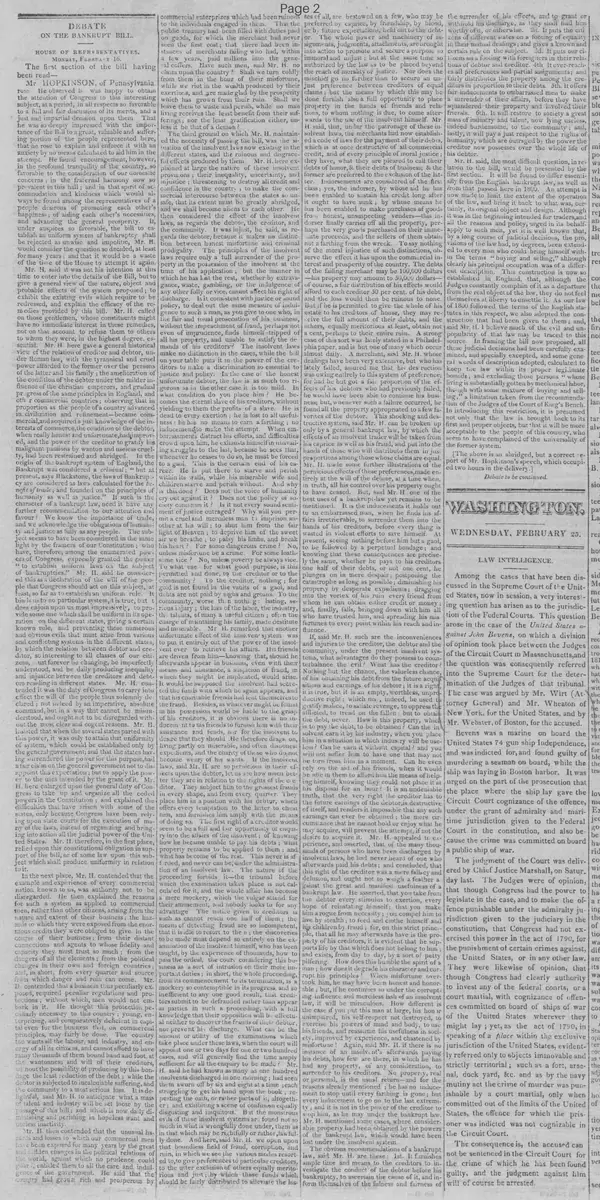
ON THE BANKRUPT BILL
HOUSE OF REPRESENTATIVES.
MONDAY, FEBRUARY 16.
The first section of the bill having been read—
Mr. HOPKINSON, of Pennsylvania, rose. He observed he was happy to obtain the attention of Congress to this interesting subject, at a period, in all respects so favorable to a full and fair discussion of its merits, and a just and impartial decision upon them. That he was so deeply impressed with the importance of the Bill to a great, valuable and suffering portion of the people represented here, that he rose to explain and enforce it with an anxiety by no means calculated to aid him in the attempt. He found encouragement, however, in the profound tranquility of the country, so favorable to the consideration of our domestic concerns; in the fraternal harmony now so prevalent in this hall; and in that spirit of accommodation and kindness which would always be found among the representatives of a people desirous of promoting each other's happiness; of aiding each other's necessities, and advancing the general prosperity. If, under auspices so favorable, the bill to establish an uniform system of bankruptcy shall be rejected as unwise and impolitic, Mr. H. would consider the question so decided, at least for many years; and that it would be a waste of the time of the House to attempt it again.
Mr. H. said it was not his intention at this time to enter into the details of the Bill, but to give a general view of the nature, object and probable effects of the system proposed; to exhibit the existing evils which require to be redressed, and explain the efficacy of the remedies provided by this bill. Mr. H. called on those gentlemen, whose constituents might have no immediate interest in these remedies, not on that account to refuse them to others to whom they were, in the highest degree, essential. Mr. H. here gave a general historical view of the relation of creditor and debtor, under Roman law, with the tyrannical and cruel power afforded to the former over the persons of the latter and his family: the amelioration of the condition of the debtor under the milder influence of the christian emperors, and gradual progress of the same principles in England, and other commercial countries; observing that in proportion as the people of a country advanced in civilization and refinement—became commercial, and acquired a just knowledge of the interests of commerce, the condition of the debtor, when really honest and unfortunate, had improved, and the power of the creditor to gratify his malignant passions by wanton and useless cruelty, had been restrained and abridged. In the origin of the bankrupt system of England, the Bankrupt was considered a criminal; "but at present, says Blackstone, the laws of Bankruptcy are considered as laws calculated for the benefit of trade; and founded on the principles of humanity as well as justice." If such is the character of a bankrupt law, need it have any further recommendation to our attention and favour? We know the importance of trade, and we acknowledge the obligations of humanity and justice as fully as any people. The subject seems to have been considered in the same light by the framers of our Constitution; who have, therefore, among the enumerated powers of Congress, expressly granted the power "to establish uniform laws on the subject of bankruptcies." Mr. H. said he considered this as a declaration of the will of the people that Congress should act on this subject, at least, so far as to establish an uniform rule. It binds us to no particular system, it is true, but it does enjoin upon us most impressively, to provide some one which shall be uniform in its operation on the different states, giving a certain known rule, and preventing those numerous and obvious evils that must arise from various and conflicting systems in the different states, by which the relation between debtor and creditor, so interesting to all classes of our citizens, must forever be changing, be imperfectly understood, and be daily producing inequality and injustice between the creditors and debtors residing in different states. Mr. H. contended it was the duty of Congress to carry into effect the will of the people thus solemnly declared; not indeed by an imperative, absolute command, but in a way that cannot be misunderstood, and ought not to be disregarded without the most clear and cogent reasons. Mr. H. insisted that when the several states parted with this power, it was only to attain that uniformity of system, which could be established only by the general government; and that the states having surrendered the power for this purpose, had a fair claim on the general government not to disappoint this expectation; but to apply the power to the uses intended by the grant of it. Mr. H. here enlarged upon the general duty of Congress to take up and organize all the ceded powers in the Constitution; and explained the difficulties that have arisen with some of the states, only because Congress have been relying upon state courts for the execution of many of the laws, instead of organizing and bringing into action all the judicial power of the United States. Mr. H. therefore, in the first place, relied upon this constitutional obligation in support of the bill, or of some law upon this subject which shall produce uniformity in relation to it.
In the next place, Mr. H. contended that the example and experience of every commercial nation known to us, was authority not to be disregarded. He then explained the reasons for such a system as applied to commercial men, rather than other citizens, arising from the nature and extent of their business; the hazards to which they were exposed from the enormous credits they were obliged to give in the course of their business; from their distant connections and agents to whose fidelity and capacity they must trust so much; from the dangers of all the elements; from the political changes in their own and foreign countries; and, in short, from every quarter and source from which danger and ruin can come. Mr. H. contended that a business thus peculiarly exposed, required peculiar regulations and protections; without which, men would not embark in it. He thought this protection peculiarly necessary to this country; young, enterprising, and comparatively deficient in capital even for the business that, on commercial principles, may fairly be done. The country too wants all the labour, and industry, and energy of all its citizens, and cannot afford to have many thousands of them bound hand and foot, at the wantonness and will of their creditors, without the possibility of producing by this bondage the least reduction of the debt; while the debtor is subjected to incalculable suffering, and the community to a most serious loss. It is delightful, said Mr. H. to anticipate what a mass of talent and industry will be set loose by the passage of this bill; and which is now daily diminishing and perishing in hopeless want and useless inactivity.
Mr. H. then contended that the unusual hazards and losses to which our commercial men have been exposed for many years by the great and sudden changes in the political relations of the world, against which no prudence could guard, entitled them to all the care and indulgence of the government. He said that the country had grown rich and prosperous by commercial enterprizes which had been ruinous to the individuals engaged in them. That the public treasury had been filled with duties paid on goods, for which the merchant had never seen the first cost; that there had been instances of merchants failing who had, within a few years, paid millions into the general coffers. Have such men, said Mr. H. no claim upon the country? Shall we turn coldly from them in the hour of their misfortune, while we riot in the wealth produced by their exertions, and are made glad by the prosperity which has grown from their ruin. Shall we leave them to waste and perish, while no man living receives the least benefit from their sufferings: nor the least gratification either, unless it be that of a demon?
The third ground on which Mr. H. maintained the necessity of passing the bill, was the situation of the insolvent laws now existing in the different states, and the ruinous and disgraceful effects produced by them. Mr. H. here explained at large the nature of these insolvent provisions; their inequality, uncertainty, and injustice; threatening to destroy all credit and confidence in the country; to make the commercial intercourse between the states so unsafe, that its extent must be greatly abridged, and we shall become aliens to each other. He then considered the effect of the insolvent laws, as regards the debtor, the creditor, and the community. It was unjust, he said, as regards the debtor, because it makes no distinction between honest misfortune and criminal prodigality. The principles of the insolvent laws require only a full surrender of the property in the possession of the insolvent at the time of his application; but the manner in which he has lost the rest, whether by extravagance, waste, gambling, or the indulgence of any other folly or vice, cannot affect his right of discharge. Is it consistent with justice or sound policy, to deal out the same measure of indulgence to such a man, as you give to one who, in the fair and usual prosecution of his business, without the impeachment of fraud, perhaps not even of imprudence, finds himself stripped of all his property, and unable to satisfy the demands of his creditors? The insolvent laws make no distinction in the cases, while the bill on your table puts it in the power of the creditors to make a discrimination so essential to justice and policy. In the case of the honest unfortunate debtor, the law is as much too rigorous as in the other case it is too mild. In what condition do you place him? He becomes the eternal slave of his creditors, without yielding to them the profits of a slave. He is dead to every exertion; he is lost to all usefulness: he has no means to earn a farthing; no inducement to make the attempt. When embarrassments distract his efforts, and difficulties crowd upon him, he exhausts himself in unavailing struggles to the last, because he sees that, whenever he ceases to do so, he must be forced to a gaol. This is the certain end of his career. He is put there to starve and perish within its walls, while his miserable wife and children starve and perish without. And why is this done? Does not the voice of humanity cry out against it? Does not the policy of society condemn it? Is it not every sound sentiment of justice outraged? Why will you permit a cruel and merciless man to imprison another at his will; to shut him from the fair light of Heaven; to deprive him of the sweet air we breathe; to palsy his limbs, and break his heart? For some dangerous crime? No, unless misfortune be a crime. For some loathsome vice? No, unless poverty be always vice. To what use for what good purpose, is this permitted and done, to the creditor or to the community? To the creditor, nothing: for gold is not found in the vaults of a gaol, and debts are not paid by sighs and groans. To the community, worse than nothing: lasting, serious injury; the loss of the labor, the industry, the talents, of many a useful citizen; often the charge of maintaining his family, made destitute and miserable. Mr. H. remarked that another unfortunate effect of the insolvent system was to put it entirely out of the power of the insolvent ever to retrieve his affairs. His friends are driven from him—knowing that, should he afterwards appear in business, even with their means and assistance, a suspicion of fraud, in which they might be implicated, would arise. It would be supposed the insolvent had secreted the funds with which he again appears, and that his charitable friends had lent themselves to the fraud. Besides, as whatever might be found in his possession would be liable to the grasp of his creditors, it is obvious there is no inducement to his friends to furnish him with their assistance and funds, nor for the insolvent to desire that they should. He therefore drags on, living partly on miserable, and often dishonest expedients, and the charity of those who do not become weary of his wants. If the insolvent laws, said Mr. H. are so pernicious in their effects upon the debtor, let us see how much better they are in relation to the rights of the creditor. They subject him to the grossest frauds in every shape, and from every quarter. They place him in a position with his debtor, which offers every temptation to the latter to cheat him, and furnishes him amply with the means of doing so. The first right of a creditor would seem to be a full and fair opportunity of enquiry into the affairs of the insolvent; of knowing how he became unable to pay his debts; what property remains to be applied to them; and what has become of the rest. This never is afforded, and never can be, under the administration of an insolvent law. The nature of the proceeding forbids it—the tribunal before which the examination takes place is not calculated for it, and the whole affair has become a mere mockery, which the vulgar attend for their amusement, and nobody looks to for any advantage. The notice given to creditors is such as cannot reach one half of them; the means of detecting fraud are so incompetent, that it is idle to resort to them; the discoveries to be made must depend so entirely on the examination of the insolvent himself, who has been taught, by the experience of thousands, how to pass the ordeal, the court considering this business as a sort of intrusion on their more important duties; in short, the whole proceeding, from its commencement to its termination, is a mockery so contemptible in its progress, and so inefficient to any one good result, that creditors submit to be defrauded rather than appear as parties in such a proceeding, with a full knowledge that their opposition will be effectual neither to discover the frauds of their debtor, nor prevent his discharge. What can be the amount or utility of the examinations which take place under these laws, when the court will appoint one or two days for one or two hundred cases, and will generally find the time amply sufficient for all the enquiry to be made? Mr. H. said he had known as many as one hundred insolvents discharged in one morning; had seen them sworn off by six and eight at a time; each struggling to get his hand upon the book; repeating the oath, or rather parts of it, altogether; and exhibiting a scene of confusion equally disgusting and iniquitous. But the monstrous evils of these insolvent systems are found not so much in what is wrongfully done under them as in that which may be rightfully or rather, lawfully done. And here, said Mr. H. we open upon that boundless field of fraud, corruption, and ruin, in which we see the various modes resorted to, to give preferences to particular creditors, to the utter exclusion of others equally meritorious and just; by which those funds which should be fairly distributed to alleviate the losses of all, are bestowed on a few, who may be preferred by caprice, by friendship, by blood or by future expectations, held out to the debtor. The whole power and machinery of assignments, judgments, attachments, are brought into action to promote and secure a purpose so immoral and unjust; but at the same time so authorized by the law as to be placed beyond the reach of morality or justice. Nor does the mischief go no further than to secure an unjust preference between creditors of equal claims; but the means by which this may be done furnish also a full opportunity to place property in the hands of friends and relations, to whom nothing is due, to come afterwards to the use of the insolvent himself. Mr. H. said, that, under the patronage of these insolvent laws, the merchants had now established a code of laws for the payment of their debts, which is at once destructive of all commercial credit, and of every principle of moral justice; they have, what they are pleased to call their debts of honor, & their debts of business; & the former are preferred to the exclusion of the latter. Indorsements are considered of the first class; yes, the indorser, by whose aid he has been enabled to sustain his credit long after it ought to have sunk; by whose means he has been enabled to make purchases of goods from honest, unsuspecting venders—this indorser finally carries off all the property, perhaps the very goods purchased on their immediate proceeds, and the sellers of them obtain not a farthing from the wreck. To say nothing of the moral injustice of such distinctions, observe the effect it has upon the commercial interest and prosperity of the country. The debts of the failing merchant may be 100,000 dollars—his property may amount to 50,000 dollars—of course, a fair distribution of his effects would afford to each creditor 50 per cent. of his debt, and the loss would then be ruinous to none. But if he is permitted to give the whole of his estate to his creditors of honor, they may receive the full amount of their debts, and the others, equally meritorious at least, obtain not a cent, perhaps to their entire ruin. A strong case of this sort was lately stated in a Philadelphia paper, and is but one of many which occur almost daily. A merchant, said Mr. H. whose dealings have been very extensive, but who has lately failed, assured me that his destruction was owing entirely to this system of preference for had he but got a fair proportion of the effects of his debtors who had previously failed, he would have been able to continue his business; but, whenever such a failure occurred, he found all the property appropriated to a few favorites of the debtor. This shocking and destructive system, said Mr. H. can be broken up only by a general bankrupt law, by which the effects of an insolvent trader will be taken from his caprice as well as his fraud, and put into the hands of those who will distribute them in just proportions among those whose claims are equal.
Mr. H. made some further illustrations of the pernicious effects of these preferences, made entirely at the will of the debtor, at a time when, in truth, all his control over his property ought to have ceased. But, said Mr. H. one of the best uses of a bankrupt-law yet remains to be mentioned. It is the inducements it holds out to an embarrassed man, when he finds his affairs irretrievable, to surrender them into the hands of his creditors, before every thing is wasted in violent efforts to save himself. At present, seeing nothing before him but a gaol, to be followed by a perpetual bondage; and knowing that these consequences are precisely the same, whether he pays to his creditors one half of their debts, or not one cent, he plunges on in mere despair; postponing the catastrophe as long as possible; diminishing his property by desperate expedients; dragging into the vortex of his ruin every friend from whom he can obtain either credit or money; and, finally, falls, bringing down with him all who have trusted him, and spreading his misfortunes to every point within his reach and influence.
If, said Mr. H. such are the inconveniences and injuries to the creditor, the debtor and the community, under the present insolvent systems, what advantages do they possess to counterbalance the evil? What has the creditor? Nothing but the chance, the valueless chance, of his obtaining his debt from the future acquisitions and earnings of his debtor; it is a right, it is true, but it is an empty, worthless, unproductive right; which may, indeed, be used to gratify malice, to satiate revenge, to oppress the afflicted, to tread on the fallen: but to obtain the debt, never. How is this property, which is to pay the debt, to be obtained? Can the insolvent earn it by his industry, when you place him in a situation in which industry will be useless? Can he earn it without capital? and you will not suffer him to have one that may not be torn from him in a moment. Can he even rely on the aid of his friends, when it would be idle in them to afford him the means of helping himself, knowing they could not place it at his disposal for an hour? It is an undeniable truth, that the very right the creditor has to the future earnings of the debtor, is destructive of itself, and renders it impossible that any such earnings can ever be obtained; the mere circumstance that he cannot hold or enjoy what he may acquire, will prevent the attempt, if not the desire to acquire it. Mr. H. appealed to experience, and asserted, that of the many thousands of persons who have been discharged by insolvent laws, he had never heard of one who afterwards paid his debts; and concluded, that this right of the creditor was a mere fallacy and delusion, and ought not to weigh a feather against the great and manifest usefulness of a bankrupt law. He asserted, that you take from the debtor every stimulus to exertion, every hope of reinstating himself; that you make him a rogue from necessity; you compel him to live by stealth; to feed and clothe himself and his children by fraud; for, on this strict principle, that all he may afterwards have is the property of his creditors, it is evident that he supports life by that which does not belong to him; and exists, from day to day, by a sort of petty pilfering. How does this humble the spirit of a man; how does it degrade his character and corrupt his principles! When misfortune overtook him, he may have been honest and honorable; but, if he continues so under the corrupting influence and merciless lash of an insolvent law, it will be miraculous. How different is the case if you put this man at large, his honor unimpaired, his self-respect not destroyed, to exercise his powers of mind and body, to use his friends, and reassume his usefulness in society, improved by experience, and chastened by misfortune! Again, said Mr. H. if there is no instance of an insolvent's afterwards paying his debts, how few are there, in which he has had any property, or any consideration, to surrender to his creditors. No property, real or personal, is the usual return—and for the reasons already mentioned; he has no inducement to stop until every farthing is gone; but every inducement to go on to the last extremity; and it is not in the power of the creditor to stop him, as he may under the bankrupt law.
Mr. H. mentioned some cases, where considerable property had been obtained by the powers of the bankrupt law, which would have been lost under the insolvent system.
The obvious recommendations of a bankrupt law, said Mr. H. are these: 1st. It furnishes ample time and means to the creditors to investigate the conduct of the debtor before his bankruptcy, to ascertain the cause of it, and inform themselves of the fulness and fairness of the surrender of his effects, and to grant or withhold his discharge, as they shall find him worthy of it, or otherwise. 2d. It puts the citizens of different states on a footing of equality in their mutual dealings; and gives a known and certain rule on the subject. 3d. It puts our citizens on a footing with foreigners in their relations of debtor and creditor. 4th. It over-reaches all preferences and partial assignments; and fairly distributes the property among the creditors in proportion to their debts. 5th. It offers fair inducements to embarrassed men to make a surrender of their affairs, before they have squandered their property and involved their friends. 6th. It will restore to society a great mass of industry and talent, now lying useless, indeed burdensome, to the community; and, lastly, it will pay a just respect to the rights of humanity, which are outraged by the power the creditor now possesses over the whole life of his debtor.
Mr. H. said, the most difficult question, in relation to the bill, would be presented by the first section. It will be found to differ essentially from the English bankrupt law, as well as from that passed here in 1800. An attempt is now made to limit the extent of the operation of the law, and bring it back to what was, certainly, its original object and design. Although it was in the beginning intended for traders, and all the reasons and policy, urged in its behalf, apply to such men, yet it is well known that, by a long course of judicial decisions, the provisions of the law had, by degrees, been extended to every man who could bring himself within the terms "buying and selling," although clearly his principal occupation was of a different description. This construction is now so established in England, that, although the Judges constantly complain of it as a departure from the real object of the law, they do not feel themselves at liberty to unsettle it. As our law of 1800 followed the terms of the English statutes in this respect, we also adopted the construction that had been given to them; and, said Mr. H. I believe much of the evil and unpopularity of that law may be traced to this source. In framing the bill now proposed, all these judicial decisions had been carefully examined, and specially excepted, and some general words of description adopted, calculated to keep the law within its proper legitimate bounds; and excluding those persons "whose living is substantially gotten by mechanical labor, though with some mixture of buying and selling," a limitation taken from the recommendation of the Judges of the Court of King's Bench. In introducing this restriction, it is presumed not only that the law is brought back to its first and proper objects, but that it will be more acceptable to the people of this country, who seem to have complained of the universality of the former system.
The above is an abridged, but a correct report of Mr. Hopkinson's speech, which occupied two hours in the delivery.
Debate to be continued.
What sub-type of article is it?
What themes does it cover?
What keywords are associated?
What entities or persons were involved?
Where did it happen?
Story Details
Key Persons
Location
House Of Representatives
Event Date
Monday, February 16
Story Details
Mr. Hopkinson delivers a speech advocating for a uniform federal bankruptcy law limited to traders, emphasizing constitutional duty, commercial necessity, and relief from unjust state insolvent laws that enable fraud, preferences, and perpetual debtor imprisonment without benefiting creditors.