Thank you for visiting SNEWPapers!
Sign up free
Letter to Editor
January 27, 1874
The Portland Daily Press
Portland, Cumberland County, Maine
What is this article about?
Letter to editor corrects correspondent 'Maine''s misstatement on 1872 Massachusetts railroad local freight rates (4.41 cents/ton/mile vs. 2.8) and denounces Boston & Maine's unfair billing refusals, higher tariffs, and legislative schemes against Maine Central and Eastern lines.
Clipping
OCR Quality
85%
Good
Full Text
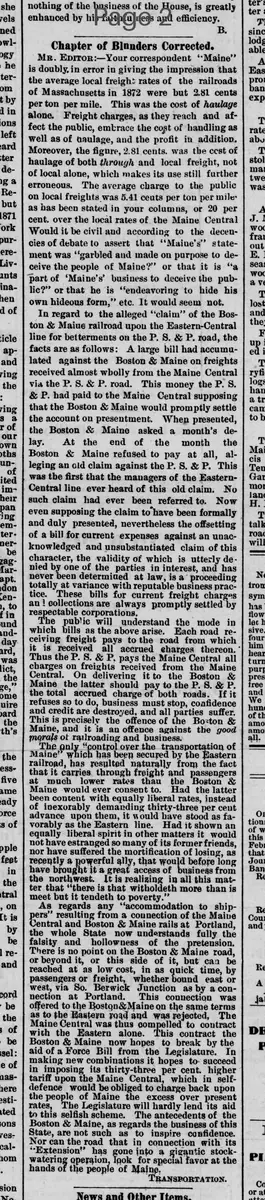
Chapter of Blunders Corrected.
Mr. Editor:—Your correspondent "Maine"
is doubly in error in giving the Impression that
the average local freight rates of the railroads
of Massachusetts in 1872 were but 2.8 cents
per ton per mile. This was the cost of haulage
alone. Freight charges, as they reach and af-
fect the public, embrace the cost of handling as
well as of haulage, and the profit in addition.
Moreover, the figure, 2.8 cents, was the cost of
haulage of both through and local freight, not
of local alone, which makes its use still further
inappropriate. The average charge to the public
on local freights was 4.41 cents per ton per mile
as has been stated in your columns, or 20 per
cent. over the local rates of the Maine
Central
Would it be civil and according to the decep-
theies of debate to assert that "Maine's" state-
ment was "garbled and made on purpose to de-
ceive the people of Maine?" or that it is
part of 'Maine's' business to deceive the pub-
lic?" or that he is "endeavoring to hide his
own hideous form," etc. It would seem not.
In regard to the alleged "claim" of the Bos-
the ton & Maine railroad upon the Eastern-Central
line for betterments on the P. S. & P. road, the
facts are as follows: A large bill had accumu-
lated against the Boston & Maine on freights
received almost wholly from the Maine Central
via the P. S. & P. road. This money the P. S.
& P. had paid to the Maine Central supposing
that the Boston & Maine would promptly settle
the account on presentment. When presented.
the Boston & Maine asked a month's de-
lay.
At the end of the month
the
Boston & Maine refused to pay at all, al-
leging an old claim against the P. S. & P. This
was the first that the managers of the Eastern-
Central line ever heard of this old claim. No
such claim had ever been referred to. Now
even supposing the claim to have been formally
and duly presented, nevertheless the offsetting
of a bill for current expenses against an unac-
knowledged and unsubstantiated claim of this
character, the validity of which is utterly de-
nied by one of the parties in interest. and has
never been determined at law, is a proceeding
totally at variance with reputable business prac-
tice. These bills for current freight charges
and collections are always promptly settled by
respectable corporations.
The public will understand the mode in
which bills as the above arise. Each road re-
ceiving freight pays to the road from which
it is received all accrued charges thereon.
Thus the P. S. & P. pays the Maine Central all
charges on freights received from the Maine
Central. On delivering it to the Boston &
Maine the latter should pay to the P. S. & P.
the total accrued charge of both roads. If it
refuses so to do, business must stop, confidence
and credit are destroyed, and all parties suffer.
This is precisely the offence of the Boston &
Maine, and it is an offence against the good
morals of railroading and business.
The only "control over the transportation of
Maine?" which has been secured by the Eastern
railroad, has resulted naturally from the fact
that it carries through freight and passengers
at much lower rates than the Boston &
Maine would ever consent to. Had the latter
been content with equally liberal rates, instead
of inexorably demanding thirty-three per cent
advance upon them, it would have stood as fa-
vorably as the Eastern line. Had it shown an
equally liberal spirit in other matters it would
not have estranged so many of its former friends,
nor have suffered the mortification of losing, as
recently a powerful ally, that would before long
have brought it a great access of business from
the northwest. It is realizing in all this mat-
ter that "there is that withholdeth more than is
meet but it tendeth to poverty."
As regards any "accommodation to ship-
pers" resulting from a connection of the Maine
Central and Boston & Maine rails at Portland,
the whole State now understands fully the
falsity and hollowness of the pretension.
There is no point on the Boston & Maine road.
or beyond it, or this side of it, but can be
reached at as low cost, in as quick time, by
passengers or freight, whether bound east or
west, via So. Berwick Junction as by a con-
nection at Portland. This connection was
offered to the Boston&Maine on the same terms
as to the Eastern road and was rejected. The
Maine Central was thus compelled to contract
with the Eastern alone. This contract the
Boston & Maine now hopes to break by the
aid of a Force Bill from the Legislature. In
making new combinations it hopes to succeed
in imposing its thirty-three per cent. higher
tariff upon the Maine Central. which in self-
defence would be obliged to charge back upon
the people of Maine the excess over present
rates. The Legislature will hardly lend its aid
to this selfish scheme. The antecedents of the
Boston & Maine. as regards the business of this
State, are not such as to inspire confidence.
Nor can the road that in connection with its
"Extension has gone into a gigantic stock-
watering operation, look for special favor at the
hands of the people of Maine.
Mr. Editor:—Your correspondent "Maine"
is doubly in error in giving the Impression that
the average local freight rates of the railroads
of Massachusetts in 1872 were but 2.8 cents
per ton per mile. This was the cost of haulage
alone. Freight charges, as they reach and af-
fect the public, embrace the cost of handling as
well as of haulage, and the profit in addition.
Moreover, the figure, 2.8 cents, was the cost of
haulage of both through and local freight, not
of local alone, which makes its use still further
inappropriate. The average charge to the public
on local freights was 4.41 cents per ton per mile
as has been stated in your columns, or 20 per
cent. over the local rates of the Maine
Central
Would it be civil and according to the decep-
theies of debate to assert that "Maine's" state-
ment was "garbled and made on purpose to de-
ceive the people of Maine?" or that it is
part of 'Maine's' business to deceive the pub-
lic?" or that he is "endeavoring to hide his
own hideous form," etc. It would seem not.
In regard to the alleged "claim" of the Bos-
the ton & Maine railroad upon the Eastern-Central
line for betterments on the P. S. & P. road, the
facts are as follows: A large bill had accumu-
lated against the Boston & Maine on freights
received almost wholly from the Maine Central
via the P. S. & P. road. This money the P. S.
& P. had paid to the Maine Central supposing
that the Boston & Maine would promptly settle
the account on presentment. When presented.
the Boston & Maine asked a month's de-
lay.
At the end of the month
the
Boston & Maine refused to pay at all, al-
leging an old claim against the P. S. & P. This
was the first that the managers of the Eastern-
Central line ever heard of this old claim. No
such claim had ever been referred to. Now
even supposing the claim to have been formally
and duly presented, nevertheless the offsetting
of a bill for current expenses against an unac-
knowledged and unsubstantiated claim of this
character, the validity of which is utterly de-
nied by one of the parties in interest. and has
never been determined at law, is a proceeding
totally at variance with reputable business prac-
tice. These bills for current freight charges
and collections are always promptly settled by
respectable corporations.
The public will understand the mode in
which bills as the above arise. Each road re-
ceiving freight pays to the road from which
it is received all accrued charges thereon.
Thus the P. S. & P. pays the Maine Central all
charges on freights received from the Maine
Central. On delivering it to the Boston &
Maine the latter should pay to the P. S. & P.
the total accrued charge of both roads. If it
refuses so to do, business must stop, confidence
and credit are destroyed, and all parties suffer.
This is precisely the offence of the Boston &
Maine, and it is an offence against the good
morals of railroading and business.
The only "control over the transportation of
Maine?" which has been secured by the Eastern
railroad, has resulted naturally from the fact
that it carries through freight and passengers
at much lower rates than the Boston &
Maine would ever consent to. Had the latter
been content with equally liberal rates, instead
of inexorably demanding thirty-three per cent
advance upon them, it would have stood as fa-
vorably as the Eastern line. Had it shown an
equally liberal spirit in other matters it would
not have estranged so many of its former friends,
nor have suffered the mortification of losing, as
recently a powerful ally, that would before long
have brought it a great access of business from
the northwest. It is realizing in all this mat-
ter that "there is that withholdeth more than is
meet but it tendeth to poverty."
As regards any "accommodation to ship-
pers" resulting from a connection of the Maine
Central and Boston & Maine rails at Portland,
the whole State now understands fully the
falsity and hollowness of the pretension.
There is no point on the Boston & Maine road.
or beyond it, or this side of it, but can be
reached at as low cost, in as quick time, by
passengers or freight, whether bound east or
west, via So. Berwick Junction as by a con-
nection at Portland. This connection was
offered to the Boston&Maine on the same terms
as to the Eastern road and was rejected. The
Maine Central was thus compelled to contract
with the Eastern alone. This contract the
Boston & Maine now hopes to break by the
aid of a Force Bill from the Legislature. In
making new combinations it hopes to succeed
in imposing its thirty-three per cent. higher
tariff upon the Maine Central. which in self-
defence would be obliged to charge back upon
the people of Maine the excess over present
rates. The Legislature will hardly lend its aid
to this selfish scheme. The antecedents of the
Boston & Maine. as regards the business of this
State, are not such as to inspire confidence.
Nor can the road that in connection with its
"Extension has gone into a gigantic stock-
watering operation, look for special favor at the
hands of the people of Maine.
What sub-type of article is it?
Informative
Persuasive
Investigative
What themes does it cover?
Commerce Trade
Economic Policy
Politics
What keywords are associated?
Railroad Freight Rates
Boston & Maine
Maine Central
Eastern Railroad
Freight Charges
Business Practices
Legislative Intervention
What entities or persons were involved?
Mr. Editor
Letter to Editor Details
Recipient
Mr. Editor
Main Argument
corrects 'maine''s error in stating massachusetts railroad local freight rates at 2.8 cents per ton per mile in 1872, clarifying it was 4.41 cents including handling and profit; criticizes boston & maine's refusal to pay freight bills and higher rates, defending eastern-central line's practices.
Notable Details
Average Charge To Public On Local Freights: 4.41 Cents Per Ton Per Mile
Boston & Maine Refused Payment Citing Old Unsubstantiated Claim
Eastern Railroad Offers Lower Rates Than Boston & Maine's 33% Higher Tariff
Maine Central Contracted With Eastern After Boston & Maine Rejected Connection At Portland