Thank you for visiting SNEWPapers!
Sign up free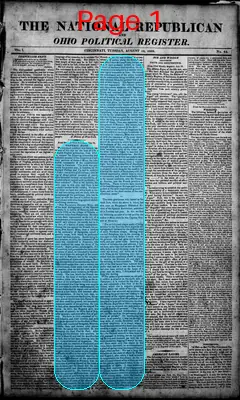
The National Republican And Ohio Political Register
Cincinnati, Hamilton County, Ohio
What is this article about?
Detailed biographical sketch of Spanish General Francisco Espoz y Mina, born 1782 in Navarre, highlighting his guerrilla exploits against French forces, promotions, post-war disillusionment with Ferdinand VII, exile, and command against Catalan insurgents, cementing his status as a key constitutionalist figure. Includes a visitor's account of his simple lifestyle in Pamplona.
Clipping
OCR Quality
Full Text
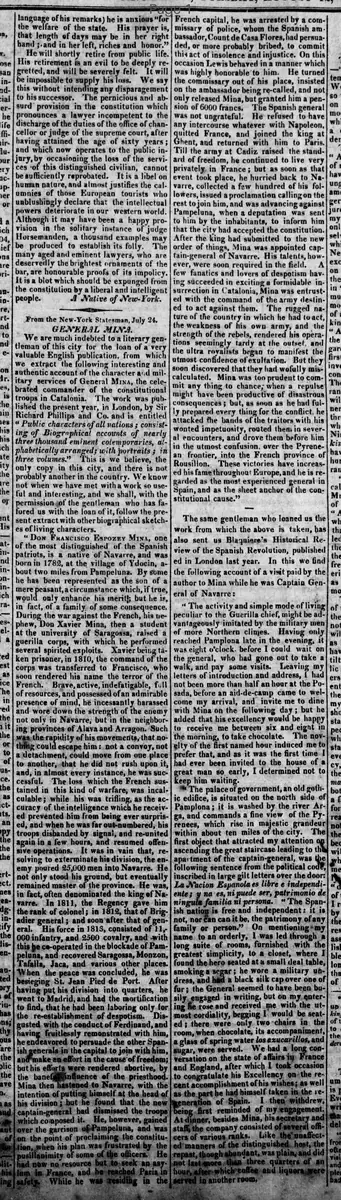
GENERAL MINA.
We are much indebted to a literary gentleman of this city for the loan of a very valuable English publication, from which we extract the following interesting and authentic account of the character and military services of General Mina, the celebrated commander of the constitutional troops in Catalonia. The work was published the present year, in London, by Sir Richard Phillips and Co. and is entitled "Public characters of all nations; consisting of Biographical accounts of nearly three thousand eminent cotemporaries, alphabetically arranged; with portraits; in three volumes." This is we believe, the only copy in this city, and there is not probably another in the country. We know not when we have met with a work so useful and interesting, and we shall, with the permission of the gentleman who has favored us with the loan of it, follow the present extract with other biographical sketches of living characters.
"Don Francisco Espoz y Mina, one of the most distinguished of the Spanish patriots, is a native of Navarre, and was born in 1782, at the village of Idocin, about two miles from Pampeluna. By some he has been represented as the son of a mere peasant, a circumstance which, if true, would only enhance his merit; but he is, in fact, of a family of some consequence. During the war against the French, his nephew, Don Xavier Mina, then a student at the university of Saragossa, raised a guerilla corps, with which he performed several spirited exploits. Xavier being taken prisoner, in 1810, the command of the corps was transferred to Francisco, who soon rendered his name the terror of the French. Brave, active, indefatigable, full of resources, and possessed of an admirable presence of mind, he incessantly harassed and wore down the strength of the enemy not only in Navarre, but in the neighboring provinces of Alava and Arragon. Such was the rapidity of his movements, that nothing could escape him: not a convoy, not a detachment, could move from one place to another, that he did not rush upon it, and, in almost every instance, he was successful. The loss which the French sustained in this kind of warfare, was incalculable; while his was trifling, as the accuracy of the intelligence which he received prevented him from being ever surprised, and when he was far out-numbered, his troops disbanded by signal, and re-united again in a few hours, and resumed offensive operations. It was in vain that, resolving to exterminate his division, the enemy poured 25,000 men into Navarre. He not only stood his ground, but eventually remained master of the province. He was, in fact, often denominated the king of Navarre. In 1811, the Regency gave him the rank of colonel; in 1812, that of Brigadier general; and soon after that of general. His force in 1813, consisted of 11,000 infantry, and 2500 cavalry, and with this he co-operated in the blockade of Pampeluna, and recovered Saragossa, Monzon, Tafalla, Jaca, and various other places. When the peace was concluded, he was besieging St. Jean Pied de Port. After having put his division into quarters, he went to Madrid, and had the mortification to find, that he had been laboring only for the re-establishment of despotism. Disgusted with the conduct of Ferdinand, and having fruitlessly remonstrated with him, he endeavored to persuade the other Spanish generals in the capital to join with him, and make an effort in the cause of freedom; but his efforts were rendered abortive, by the baneful influence of the priesthood. Mina then hastened to Navarre, with the intention of putting himself at the head of his division; but he found that the new captain-general had dismissed the troops which composed it. He, however, gained over the garrison of Pampeluna, and was on the point of proclaiming the constitution, when his plan was frustrated by the pusillanimity of some of the officers. He had now no resource but to seek an asylum in France, and he reached Paris in safety. While he was residing in the French capital, he was arrested by a commissary of police, whom the Spanish ambassador, Count de Casa Flores, had persuaded, or more probably bribed, to commit this act of insolence and injustice. On this occasion Louis behaved in a manner which was highly honorable to him. He turned the commissary out of his place, insisted on the ambassador being re-called, and not only released Mina, but granted him a pension of 6000 francs. The Spanish general was not ungrateful. He refused to have any intercourse whatever with Napoleon, quitted France, and joined the king at Ghent, and returned with him to Paris. Till the army at Cadiz raised the standard of freedom, he continued to live very privately in France: but as soon as that event took place, he hurried back to Navarre, collected a few hundred of his followers, issued a proclamation calling on the rest to join him, and was advancing against Pampeluna, when a deputation was sent to him by the inhabitants, to inform him that the city had accepted the constitution. After the king had submitted to the new order of things, Mina was appointed captain-general of Navarre. His talents, however, were soon required in the field. A few fanatics and lovers of despotism having succeeded in exciting a formidable insurrection in Catalonia, Mina was entrusted with the command of the army destined to act against them. The rugged nature of the country in which he had to act, the weakness of his own army, and the strength of the rebels, rendered his operations seemingly tardy at the outset, and the ultra royalists began to manifest the utmost confidence of exultation. But they soon discovered that they had wofully miscalculated. Mina was too prudent to commit any thing to chance; when a repulse might have been productive of disastrous consequences; but, as soon as he had fully prepared every thing for the conflict, he attacked the bands of the traitors with his wonted impetuosity, routed them in several encounters, and drove them before him in the utmost confusion, over the Pyrenean frontier, into the French province of Rousillon. These victories have increased his fame throughout Europe, and he is regarded as the most experienced general in Spain, and as the sheet anchor of the constitutional cause."
The same gentleman who loaned us the work from which the above is taken, has also sent us Blaguiere's Historical Review of the Spanish Revolution, published in London last year. In this we find the following account of a visit paid by the author to Mina while he was Captain General of Navarre:
"The activity and simple mode of living peculiar to the Guerilla chief, might be advantageously imitated by the military men of more Northern climes. Having only reached Pamplona late in the evening, it was eight o'clock before I could wait on the general, who had gone out to take a walk, and pay some visits. Leaving my letters of introduction and address, I had not been more than half an hour at the Posada, before an aid-de-camp came to welcome my arrival, and invite me to dine with Mina on the following day; but he added that his excellency would be happy to receive me between six and eight in the morning, to take chocolate. The novelty of the first named hour induced me to prefer that, and as it was the first time I had ever been invited to the house of a great man so early, I determined not to keep him waiting.
"The palace of government, an old gothic edifice, is situated on the north side of Pamplona; it is washed by the river Arga, and commands a fine view of the Pyrenees, which rise in majestic grandeur within about ten miles of the city. The first object that attracted my attention on ascending the great staircase leading to the apartment of the captain-general, was the following sentence from the political code, inscribed in large gilt letters over the door: La Nacion Espanola es libre e independiente; y no es, ni puede ser, patrimonio de ninguna familia ni persona. "The Spanish nation is free and independent: it is not, nor can it be, the patrimony of any family or person." On mentioning my name to an orderly, I was led through long suite of rooms, furnished with the greatest simplicity, to a closet, where I found the hero seated at a small deal table smoking a segar; he wore a military undress, and had a black silk cap over one of fur; the General seemed to have been busily engaged in writing, but on my entering he rose and received me with the utmost cordiality, begging I would be seated; there were only two chairs in the room, when chocolate, its accompaniment a glass of spring water los azucarillos, and sugar, were served. We had a long conversation on the state of affairs in France and England, after which I took occasion to congratulate his Excellency on the recent accomplishment of his wishes; as well as the part he had himself taken in the regeneration of Spain. I then withdrew being first reminded of my engagement. At dinner, besides Mina, his secretary and staff the company consisted of several officers of various ranks. Like the unaffected manners of the distinguished host, the repast, though abundant, was plain and did not last more than three quarters of an hour, after which coffee and liquors were served in another room."
What sub-type of article is it?
What keywords are associated?
What entities or persons were involved?
Where did it happen?
Foreign News Details
Primary Location
Navarre, Spain
Event Date
1782 1823
Key Persons
Outcome
routed catalan insurgents, drove them into france; recovered saragossa, monzon, tafalla, jaca; master of navarre against french; appointed captain-general of navarre.
Event Details
Biographical account of General Mina's origins, guerrilla warfare against French in Navarre and neighboring provinces from 1810, promotions to general, post-war opposition to Ferdinand VII, exile in France, return to support constitution, command against Catalan insurrection, and a visitor's description of his simple lifestyle in Pamplona.