Thank you for visiting SNEWPapers!
Sign up free
Editorial
June 30, 1826
Edwardsville Spectator
Edwardsville, Madison County, Illinois
What is this article about?
Editorial defends Mr. Cook against election rumors claiming opposition to reducing public land prices, republishing his 1820 congressional amendment proposing $1.50 per acre with credit for private sales to aid poor western settlers, aligning with Senators and Mr. Clay.
Merged-components note: Continuation of the editorial refuting rumors about Mr. Cook's stance on public land prices, spanning across pages 2 and 3 with sequential reading order.
Clippings
1 of 2
OCR Quality
95%
Excellent
Full Text
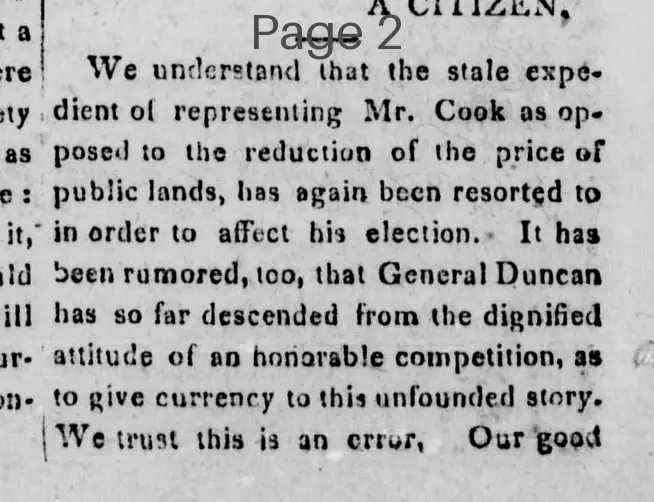
We understand that the stale expedient of representing Mr. Cook as opposed to the reduction of the price of public lands, has again been resorted to in order to affect his election.- It has been rumored, too, that General Duncan has so far descended from the dignified attitude of an honorable competition, as to give currency to this unfounded story. We trust this is an error. Our good opinion of General Duncan forbids the belief, without full proof, of a charge so much to his discredit. But let the tale be circulated by whom it may, we have the means of refuting it by documentary evidence; and although it has heretofore been successfully done, and although such of our citizens as resided here in 1820 will, many of them, remember that the following article and extract from the Congressional Journal was then published, to the dismay and discomfiture of the retailers of falsehood, we deem it due to those who have since come among us, to republish them, and thereby show that Mr. Cook not only made the motion to reduce the price, but also endeavored to procure a credit on such lands as should be purchased at private sale. Whether the latter measure would have been wise or not, in a national point of view, it gives convincing evidence of Mr. Cook's attention to the interests of his constituents.
From the Illinois Intelligencer.
Without any wish to take part in the approaching election for a Representative to Congress, we deem it due to Mr. Cook, whose exertions for the public interest all can attest, to place the nature of his vote on the subject of the public lands, which we understand has been variously represented, fairly before the public.
When that subject was before Congress, Mr. Cook offered the following amendment to the bill:
"Mr. Cook then moved to amend the said bill by striking out the second section of the bill; and inserting in lieu thereof the following:
Sec. 2. And be it further enacted, That from and after the first day of July next, credit shall not be allowed for the purchase money on the sale of any of the Public Lands, sold at public sale, but every purchaser of land which may be sold thereafter at public sale, shall on the day of purchase, make complete payment thereof, and if any person, being the highest bidder at public sale, for a tract of land, shall fail to make payment therefor on the day on which the same was purchased, the tract shall be again offered at public sale on the next day of sale, and such person shall not be capable of becoming the purchaser of that or any other tract of land at such public sale. And from and after the period aforesaid, whenever the purchaser, of any of the public lands at private sale shall, at the time of making such purchase, make complete payment therefor, the price shall be One Dollar and Fifty Cents per Acre. Provided however, That this provision shall not be construed as to prevent the purchase upon credit as heretofore, at Private Sale."
The insertion of this amendment will at once show, that he was in favor of fixing the price at $1.25 an acre; and also of dividing all the lands into half quarter sections. But as money was so universally scarce, he believed that unless there were some credit allowed for a part of the purchase money, that many poor men would be unable to obtain any of the public land, and therefore, wished to secure to them the right of entering in half-quarters, and also upon the usual credit, if they could not raise money to pay down. He knew that many men possessed industry, but little or no money, and therefore could not enjoy the bounty of the western lands without credit. By the plan he proposed, the poor man might enter a half-quarter section for $40, and have five years to pay the remainder in, while under the plan as it is now adopted, to get possession of a half-quarter, the purchaser must pay down $100, making a difference of $60; a sum that is no easy matter for a poor man to raise. In this vote, Mr. Cook agreed with both of our senators, and in accordance with the sentiments of Mr. Clay.
To destroy the credit system entirely, Mr. Cook thought calculated to injure the west, by checking the current of emigration. He saw that Ohio and Indiana, as well as this state, had gained a great population in consequence of the facility with which they could obtain a settlement.
Instead, therefore, of condemning his vote, we think the motives which produced it, are such as ought to be approved.
From the Illinois Intelligencer.
Without any wish to take part in the approaching election for a Representative to Congress, we deem it due to Mr. Cook, whose exertions for the public interest all can attest, to place the nature of his vote on the subject of the public lands, which we understand has been variously represented, fairly before the public.
When that subject was before Congress, Mr. Cook offered the following amendment to the bill:
"Mr. Cook then moved to amend the said bill by striking out the second section of the bill; and inserting in lieu thereof the following:
Sec. 2. And be it further enacted, That from and after the first day of July next, credit shall not be allowed for the purchase money on the sale of any of the Public Lands, sold at public sale, but every purchaser of land which may be sold thereafter at public sale, shall on the day of purchase, make complete payment thereof, and if any person, being the highest bidder at public sale, for a tract of land, shall fail to make payment therefor on the day on which the same was purchased, the tract shall be again offered at public sale on the next day of sale, and such person shall not be capable of becoming the purchaser of that or any other tract of land at such public sale. And from and after the period aforesaid, whenever the purchaser, of any of the public lands at private sale shall, at the time of making such purchase, make complete payment therefor, the price shall be One Dollar and Fifty Cents per Acre. Provided however, That this provision shall not be construed as to prevent the purchase upon credit as heretofore, at Private Sale."
The insertion of this amendment will at once show, that he was in favor of fixing the price at $1.25 an acre; and also of dividing all the lands into half quarter sections. But as money was so universally scarce, he believed that unless there were some credit allowed for a part of the purchase money, that many poor men would be unable to obtain any of the public land, and therefore, wished to secure to them the right of entering in half-quarters, and also upon the usual credit, if they could not raise money to pay down. He knew that many men possessed industry, but little or no money, and therefore could not enjoy the bounty of the western lands without credit. By the plan he proposed, the poor man might enter a half-quarter section for $40, and have five years to pay the remainder in, while under the plan as it is now adopted, to get possession of a half-quarter, the purchaser must pay down $100, making a difference of $60; a sum that is no easy matter for a poor man to raise. In this vote, Mr. Cook agreed with both of our senators, and in accordance with the sentiments of Mr. Clay.
To destroy the credit system entirely, Mr. Cook thought calculated to injure the west, by checking the current of emigration. He saw that Ohio and Indiana, as well as this state, had gained a great population in consequence of the facility with which they could obtain a settlement.
Instead, therefore, of condemning his vote, we think the motives which produced it, are such as ought to be approved.
What sub-type of article is it?
Partisan Politics
Economic Policy
What keywords are associated?
Public Lands
Price Reduction
Credit System
Election Rumors
Western Settlers
Congressional Amendment
What entities or persons were involved?
Mr. Cook
General Duncan
Mr. Clay
Editorial Details
Primary Topic
Defense Of Mr. Cook's Public Land Policy In Election
Stance / Tone
Supportive Of Mr. Cook, Refuting Election Smears
Key Figures
Mr. Cook
General Duncan
Mr. Clay
Key Arguments
Mr. Cook Moved To Reduce Public Land Price To $1.50 Per Acre With Credit For Private Sales
Amendment Aimed To Aid Poor Settlers Unable To Pay Cash
Cook's Vote Aligned With Senators And Mr. Clay
Credit System Essential For Western Emigration And Population Growth
Rumors Of Opposition Are Unfounded Falsehoods