Thank you for visiting SNEWPapers!
Sign up free
Story
January 15, 1876
Arizona Citizen
Tucson, Florence, Pima County, Pinal County, Arizona
What is this article about?
In 1857, Dr. B. J. D. Irwin discovered a large meteoric stone in Tucson, Arizona, and arranged its free transportation to the Smithsonian Institution despite challenges, arriving in November 1863. It became a major attraction and was relabeled the Tucson Meteorite.
Clipping
OCR Quality
98%
Excellent
Full Text
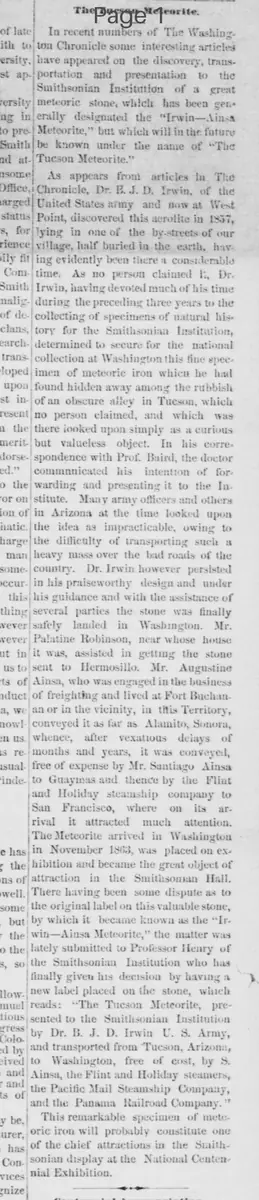
In recent numbers of The Washington Chronicle some interesting articles have appeared on the discovery, transportation and presentation to the Smithsonian Institution of a great meteoric stone, which has been generally designated the "Irwin-Linsa Meteorite," but which will in the future be known under the name of "The Tucson Meteorite."
As appears from articles in The Chronicle, Dr. B. J. D. Irwin, of the United States Army and now at West Point, discovered this aerolite in 1857, lying in one of the by-streets of our village, half buried in the earth, having evidently been there a considerable time. As no person claimed it Dr. Irwin, having devoted much of his time during the preceding three years to the collecting of specimens of natural history for the Smithsonian Institution, determined to secure for the national collection at Washington this fine specimen of meteoric iron which he had found hidden away among the rubbish of an obscure alley in Tucson, which no person claimed, and which was there looked upon simply as a curious but valueless object. In his correspondence with Prof. Baird, the doctor communicated his intention of forwarding and presenting it to the Institute. Many army officers and others in Arizona at the time looked upon the idea as impracticable, owing to the difficulty of transporting such a heavy mass over the bad roads of the country. Dr. Irwin however persisted in his praiseworthy design and under his guidance and with the assistance of several parties the stone was finally safely landed in Washington. Mr. Palatine Robinson, near whose house it was, assisted in getting the stone sent to Hermosillo. Mr. Augustine Ainsa, who was engaged in the business of freighting and lived at Fort Buchanan or in the vicinity, in this Territory, conveyed it as far as Alamito, Sonora, whence, after vexatious delays of months and years, it was conveyed, free of expense by Mr. Santiago Ainsa to Guaymas and thence by the Flint and Folly steamship company to San Francisco, where on its arrival it attracted much attention.
The Meteorite arrived in Washington in November 1863, was placed on exhibition and became the great object of attraction in the Smithsonian Hall.
There having been some dispute as to the original label on this valuable stone, by which it became known as the "Irwin-Ainsa Meteorite," the matter was lately submitted to Professor Henry of the Smithsonian Institution who has finally given his decision by having a new label placed on the stone, which reads: "The Tucson Meteorite, presented to the Smithsonian Institution by Dr. B. J. D. Irwin U. S. Army, and transported from Tucson, Arizona, to Washington, free of cost, by S. Ainsa, the Flint and Folly steamers, the Pacific Mail Steamship Company, and the Panama Railroad Company."
This remarkable specimen of meteoric iron will probably constitute one of the chief attractions in the Smithsonian display at the National Centennial Exhibition.
As appears from articles in The Chronicle, Dr. B. J. D. Irwin, of the United States Army and now at West Point, discovered this aerolite in 1857, lying in one of the by-streets of our village, half buried in the earth, having evidently been there a considerable time. As no person claimed it Dr. Irwin, having devoted much of his time during the preceding three years to the collecting of specimens of natural history for the Smithsonian Institution, determined to secure for the national collection at Washington this fine specimen of meteoric iron which he had found hidden away among the rubbish of an obscure alley in Tucson, which no person claimed, and which was there looked upon simply as a curious but valueless object. In his correspondence with Prof. Baird, the doctor communicated his intention of forwarding and presenting it to the Institute. Many army officers and others in Arizona at the time looked upon the idea as impracticable, owing to the difficulty of transporting such a heavy mass over the bad roads of the country. Dr. Irwin however persisted in his praiseworthy design and under his guidance and with the assistance of several parties the stone was finally safely landed in Washington. Mr. Palatine Robinson, near whose house it was, assisted in getting the stone sent to Hermosillo. Mr. Augustine Ainsa, who was engaged in the business of freighting and lived at Fort Buchanan or in the vicinity, in this Territory, conveyed it as far as Alamito, Sonora, whence, after vexatious delays of months and years, it was conveyed, free of expense by Mr. Santiago Ainsa to Guaymas and thence by the Flint and Folly steamship company to San Francisco, where on its arrival it attracted much attention.
The Meteorite arrived in Washington in November 1863, was placed on exhibition and became the great object of attraction in the Smithsonian Hall.
There having been some dispute as to the original label on this valuable stone, by which it became known as the "Irwin-Ainsa Meteorite," the matter was lately submitted to Professor Henry of the Smithsonian Institution who has finally given his decision by having a new label placed on the stone, which reads: "The Tucson Meteorite, presented to the Smithsonian Institution by Dr. B. J. D. Irwin U. S. Army, and transported from Tucson, Arizona, to Washington, free of cost, by S. Ainsa, the Flint and Folly steamers, the Pacific Mail Steamship Company, and the Panama Railroad Company."
This remarkable specimen of meteoric iron will probably constitute one of the chief attractions in the Smithsonian display at the National Centennial Exhibition.
What sub-type of article is it?
Curiosity
Extraordinary Event
Historical Event
What themes does it cover?
Triumph
Exploration
What keywords are associated?
Meteorite
Discovery
Transportation
Smithsonian
Tucson
Irwin
Ainsa
What entities or persons were involved?
Dr. B. J. D. Irwin
Prof. Baird
Mr. Palatine Robinson
Mr. Augustine Ainsa
Mr. Santiago Ainsa
Professor Henry
Where did it happen?
Tucson, Arizona
Story Details
Key Persons
Dr. B. J. D. Irwin
Prof. Baird
Mr. Palatine Robinson
Mr. Augustine Ainsa
Mr. Santiago Ainsa
Professor Henry
Location
Tucson, Arizona
Event Date
1857 To November 1863
Story Details
Dr. Irwin discovered a large meteorite in a Tucson alley in 1857 and, despite transport challenges, coordinated its free delivery to the Smithsonian Institution, arriving in 1863 after assistance from various parties; it was relabeled the Tucson Meteorite.